








Amid multiple ongoing conflicts, the United States’ strategic bandwidth is increasingly overstretched. Few would have anticipated Washington’s main role in the Middle Eastern war, alongside a markedly transactional and unpredictable posture. This reorientation has strained US resources and attention, diverting focus from the Indo-Pacific. It marks a departure from the regionally-oriented policy trajectory that has defined American policy over the past decade.
In China, a prevailing view holds that US commitments in the Indo-Pacific are gradually losing effectiveness. Chinese discourse, however, frames this more as part of a longer-term pattern dating back to the end of the Cold War. More fundamentally, it underscores a belief that the US has been struggling to maintain its primacy and to counter China effectively.
Structural sources of US overstretch
Zhang Yao, associate researcher at the School of Public Administration, Nanjing Normal University, argues that the US global strategy, highlighted by its involvement in the US-Israel-Iran conflict, reveals deeper, long-term structural flaws. As the sole superpower after the Cold War, the US became overly focused on maintaining dominance, resulting in strategic overextension, short-termism, and declining global credibility.
Focusing on Asia, Zhang contends that although US strategic investment has increased since Barack Obama’s pivot to Asia, and has continued under Donald Trump and Joe Biden through the Indo-Pacific strategy, its influence has paradoxically weakened. The core problem, in his assessment, is that greater effort has produced diminishing returns.
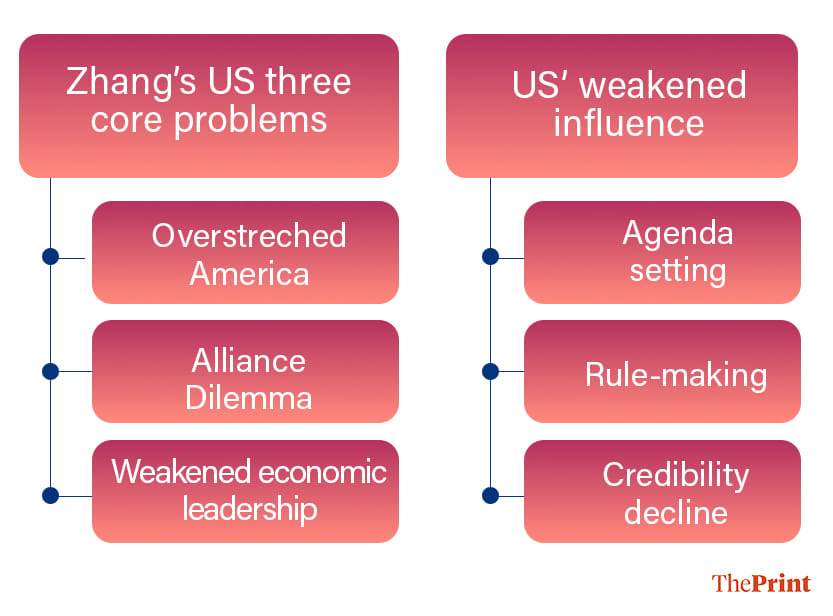
Zhang identifies three core challenges confronting the United States. First, geostrategic overstretch: the US is unable to focus fully on Asia while simultaneously managing crises in Europe and the Middle East. Second, the alliance dilemma—greater reliance on partners helps distribute burdens but diminishes US control, as allies gain autonomy and confidence in US commitments erodes, particularly under transactional ‘America First’ policies.
Third, weakened economic leadership. Although US economic tools did re-emerge, they are increasingly deployed in the service of strategic competition, especially vis-à-vis China, rather than fostering open growth, thereby reducing their appeal to regional states.
In addition, Zhang highlights three dimensions of declining US influence:
- Agenda-setting decline: US strategy prioritises security and competition, whereas many Asian countries prioritise economic growth and development.
- Rule-making decline: US-led frameworks are increasingly exclusive and small-group oriented rather than broad.
- Credibility decline: Allies are increasingly questioning US’ reliability due to policy shifts and burden-sharing demands.
Source: Author’s illustration
Echoes in Chinese discourse
Zhang’s assessment finds broad resonance within Chinese media and the strategic community. Writing in Shanghai-based news site Guancha, Ruan Jiaiqi contends that although successive US administrations have pledged to prioritise Asia and counter China, they have repeatedly been drawn into Middle Eastern conflicts, diverting military resources from Asia, eroding US credibility with regional allies, and diminishing its capacity to deter China. Consequently, the long-standing pivot to Asia is increasingly viewed as unrealistic and a failure. From this perspective, the US faces a structural constraint: despite its stated intention to focus on Asia, recurring crises elsewhere weaken its global strategy and indirectly create strategic advantages for China.
Similarly, Zhang Weiwei, Member of the Council of National High-end Think Tanks, Dean of the China Institute of Fudan University, argues that the US strategy appears increasingly incoherent. He suggests that Washington lacks a clear and consistent long-term strategy, as evidenced by contradictory policy signals. In his view, the US is becoming more isolated, with its alliance system under strain and its global leadership role diminishing, from that of a “world’s policeman” to a more constrained and contested actor.
Also read: Why Chinese media is amplifying Pakistan’s role in US-Iran ceasefire talks
Allies and partners stepping up
A significant strand of opinion within Chinese discourse suggests that an irreversible process of de-Americanisation may already be underway. Commentary also highlights shifting responses among US allies and partners. Japan’s evolving Indo-Pacific role is, in some analyses, interpreted as reflecting both greater regional agency and declining confidence in US leadership.
At the same time, discussions in Chinese digital spaces, including commentary by independent content creators, suggest that other members of the Quad may pressure the US to refocus its strategic attention on the Indo-Pacific. Meanwhile, Southeast Asian states are described as adopting increasingly cautious and hedging strategies. A commentator, Liu Bai, writing in Guancha, argues that Association of Southeast Asian Nations (ASEAN) countries in particular exhibit growing uncertainty toward US engagement, with some gradually deepening ties with China.
While instability in the Middle East poses challenges for all major powers, including China, Chinese discourse frames renewed US entanglement as strategically consequential for the Indo-Pacific. The diversion of attention and resources amplifies perceptions of American overstretch, undermines its capacity to maintain regional leadership, and simultaneously creates strategic opportunities for China, expanding its room for manoeuvre in the Indo-Pacific.
Sana Hashmi, PhD is a fellow at the Taiwan-Asia Exchange Foundation. She tweets @sanahashmi1. Views are personal.
(Edited by Ratan Priya)