






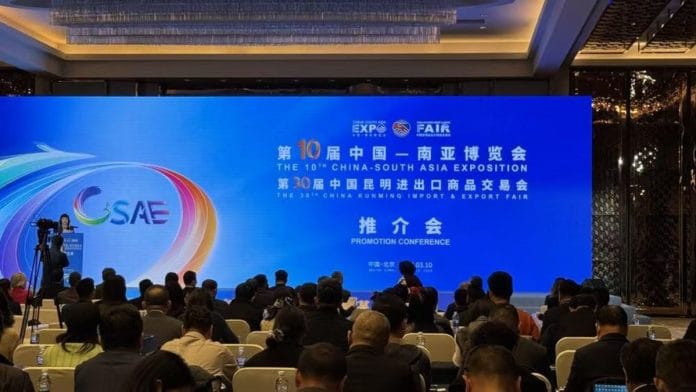



The Asian Department at China’s Ministry of Commerce announced on 10 March that trade between China and South Asian countries had surpassed $ 200 billion for the first time, marking a 10.7 per cent year-on-year increase.
The department’s director, Wang Liping, presented this milestone as evidence of the resilience and growing dynamism of regional economic cooperation. The announcement coincided with the 10th China–South Asia Expo and the 30th China Kunming Import and Export Fair, two flagship platforms advancing China’s economic outreach in the region.
It is noteworthy that India was conspicuously absent from the meetings and official references. Excluding a country that accounts for over 60 per cent of total China–South Asia trade can’t be incidental. Rather, it reflects a deeper and more consistent pattern in China’s regional framing, one that separates India’s economic and strategic weight from its narrative presence.
A South Asia without India?
Chinese academic discourse offers further insight into this positioning. Lin Minwang, vice dean at Fudan University’s Institute of International Studies, described India as a “complex and volatile” South Asian power. Even though the volatility is attributed to the region rather than India itself, such characterisations help justify China’s push for alternative regional frameworks that proceed without India.
This pattern is visible in China-led institutional platforms. Last year, the Shanghai Institute of International Studies convened a China-South Asia Development Cooperation High-level Dialogue. The forum brought together participants from China, Bangladesh, the Maldives, Nepal, Pakistan, and Sri Lanka, while excluding India. The dialogue’s policy recommendations centred on three priorities: deepening cooperation in trade, infrastructure, and security; promoting flexible, trilateralism and minilateralism, alongside enhanced connectivity and people-to-people exchanges; and strengthening strategic alignment through Belt and Road projects and tailored economic corridors.
These initiatives illustrate the gradual consolidation of China-centric frameworks that operate parallel to India. While presented as inclusive and development-oriented, they risk reshaping regional cooperation in ways that constrain India’s institutional role and strategic influence.
Seen in this light, the emerging narrative appears deliberate. One interpretation traces China’s framing of a South Asia without India to historical legacies. British colonial strategy cast Tibet as a buffer between India and China, embedding a top-down territorial logic that continues to influence regional geopolitics. Within sections of India’s strategic community, the commentator noted, South Asia is viewed as a natural sphere of influence, while Tibet and the broader Qinghai–Tibet Plateau are framed in terms of strategic depth.
This critique is amplified in popular Chinese discourse. A Baijiahao commentator, for instance, questioned why, among the seven countries surrounding India, five appear closer to China, leaving India relatively isolated in South Asia. The explanation offered points to structural factors: unresolved colonial-era borders, a rigid territorial outlook, pressures from smaller neighbours, and persistent security anxieties. These dynamics can position India as a dominant regional actor, at times underestimating the agency of its neighbours.
By contrast, the commentator argues, China is portrayed as a partner unburdened by colonial legacies, emphasising economic cooperation, infrastructure development, and non-interference. For resource-constrained states, such an approach can be particularly attractive, prompting some to align more closely with China on key issues.
In this framing, India’s perceived marginalisation is a structural outcome shaped by history and policy orientation. In regional diplomacy, influence tends to follow those who combine respect with the consistent delivery of tangible benefits.
At the same time, Chinese discourse increasingly casts India as a regional hegemon and, at times, a disruptive actor—narratives that help justify its exclusion from emerging regional initiatives. It also subtly reinforces anti-India sentiment among neighbouring states. Discussions on Chinese online platforms have even entertained the idea of South Asian cooperation frameworks functioning without India.
One commentator argued that South Asia’s future will depend on who can deliver tangible development outcomes, suggesting that China’s initiatives offer a more “open” alternative. They warn that India risks alienating its neighbours and pushing them further toward “looking east” if it clings to notions of regional primacy.
Also read: Strait of Hormuz crisis shows limits of US, say Chinese. ‘India most vulnerable’
Sidelined in discourse, central in reality
Chinese discourse portrays India’s influence in South Asia as under scrutiny and in decline. A Baijiahao commentator, for instance, points to perceived infrastructure constraints, industrial dependencies, and domestic pressures to argue that India’s regional ambitions are faltering. Such assessments, however, are overstated. India remains the pivotal power in South Asia, with enduring economic, strategic, and geopolitical weight that cannot be easily marginalised.
China’s regional engagement is presented as inclusive, yet its discourse selectively sidelines India to bolster Beijing’s strategic positioning. This framing appears less an objective reflection of regional realities than an attempt to shape them, projecting benevolence while reconfiguring regional alignments. In practice, India’s structural centrality ensures that it remains an indispensable power, complicating and ultimately challenging the reductive narrative of an “India in decline in South Asia” advanced in sections of Chinese media.
Sana Hashmi, PhD, is a fellow at the Taiwan-Asia Exchange Foundation. She tweets @sanahashmi1. Views are personal.
(Edited by Ratan Priya)