






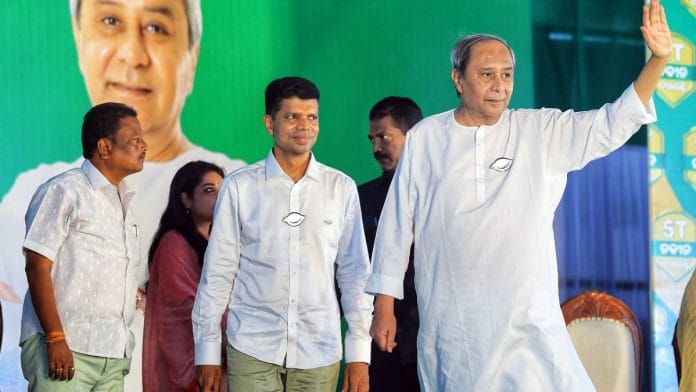



Former Odisha Chief Minister Naveen Patnaik may be thanking his lucky stars today. In 2018, his government secured a resolution in the state assembly to form a Legislative Council. In 2022, the then-Union Law Minister Kiren Rijiju told the Rajya Sabha that the Centre had not received the resolution. That’s the last time one heard of it. Anyway, the Bharatiya Janata Party and the Biju Janata Dal often played friendly ping-pong matches until they fell apart.
Patnaik must be relieved today that there is no Legislative Council in Odisha. Remember what happened in Maharashtra in June 2022? On 10 June, the BJP won three of the six Rajya Sabha seats, although the ruling Maha Vikas Aghadi (MVA) was expected to get four. Several MVA MLAs cross-voted for the BJP, obviously. Ten days later, on 20 June, the BJP won five of the 10 seats in the Legislative Council polls—one more than expected, thanks to the cross-voting.
A frustrated Prithviraj Chavan, former Maharashtra CM, said, “In the Rajya Sabha polls, the BJP (having 105 MLAs) got 123 and in this (Council polls), they got 133. This means 10 more people voted for the BJP in the past ten days.” The mystery was resolved within hours after the Council poll results, as Shiv Sena leader Eknath Shinde, along with 30 party MLAs, rebelled against CM Uddhav Thackeray and left Mumbai for a safe haven, Surat, that night. The rest is history, as they say.
In Odisha Rajya Sabha polls on 16 March, BJP-backed Independent candidate Dilip Ray won. Eight MLAs from the BJD and three from the Congress cross-voted in his favour. On Saturday, BJD president Patnaik suspended six of these MLAs for anti-party activities; two others were already suspended.
Out of 50 MLAs, the BJD’s effective strength in the Assembly is 42 now— a 16 per cent reduction. That’s why Patnaik may be thanking his stars. What if there were a Legislative Council in Odisha and there were elections to fill some vacancies—like in Maharashtra? Could Patnaik afford to face another test of his MLAs’ loyalty?
Since the setback in the 2024 Assembly and Lok Sabha elections, he has seen many of his loyalists rise in rebellion. Barely three months after the setback, Mamata Mohanta resigned from the Rajya Sabha and joined the BJP. Rajya Sabha member Sujeet Kumar followed suit. Another RS member, Debasish Samantray, resigned from the post of BJD vice-president last November, although he continues in the party.
As BJD leaders say, rats jumping out of a seemingly sinking ship or self-seeking individuals opting for greener pastures is a given in politics. The bigger blow to Patnaik was the evidence of the BJD’s declining mass base in the Nuapada assembly bypoll last November. The party came third in the bypoll that was necessitated by the death of BJD MLA Rajendra Dholakia. The BJP had fielded the late BJD leader’s son, Jay. The Congress coming second was like the proverbial salt on the BJD’s wound.
A Maharashtra re-do in Odisha for BJP?
The BJP seems to be on a mission to replicate in Odisha what it achieved in Maharashtra—splitting Thackeray’s Shiv Sena and Sharad Pawar’s Nationalist Congress Party (NCP). It’s so keen that Prime Minister Narendra Modi didn’t restrain his party from backing a coal scam convict, Dilip Ray, in the Rajya Sabha bypoll in Odisha.
The ruling party may have reasons to launch this mission. The BJP was instrumental in the creation of the BJD. When Biju Patnaik died in April 1997, the BJP had literally no presence in Odisha, where the Congress dominated politics for decades. Atal Bihari Vajpayee deployed Pramod Mahajan to put in place a party that would claim Patnaik’s legacy and also create space for the BJP.
Mahajan roped in senior BJD leaders and Biju confidantes like Dilip Ray and Bijoy Mohapatra to prop up the ex-CM’s son, Naveen Patnaik, who spoke no Oriya, ran a boutique in a five-star Delhi hotel, loved Dunhill cigarettes, and enjoyed Famous Grouse whiskey every evening, as my friend Ruben Banerjee writes in his brilliant, authoritative biography, Naveen Patnaik in 2018.
The BJP was behind the founding of the BJD in 1997 with Naveen Patnaik at the helm. In 2009, Patnaik dumped the BJP as an ally. The BJD’s ‘creator’ must have felt like a jilted lover— and used and thrown. Seventeen years later, the BJP would like to destroy what it created. If and when it does that, Odisha is likely to become a Gujarat-like fort for the BJP—almost Opposition-mukt. Because the Congress never showed the will to fight.
Also read: Amit Shah won’t lose sleep over Kerala, Tamil Nadu, Puducherry, Assam. Bengal is different
Last man standing
Naveen Patnaik could be the last man standing between the BJP and its dream of invincibility in Odisha. He will turn 80 in October. And he hasn’t bothered to groom a successor. As if he thought the BJD’s relevance was limited to his political life, co-terminus.
The BJP is counting on this, of course. It chose a CM, Mohan Charan Majhi, who wouldn’t quite measure up to his predecessor—and, probably, isn’t expected to. His government can be run from Delhi. Principal Secretary to PM Modi, PK Mishra, is from Odisha, and Ashwini Vaishnaw, the third most powerful minister in the Modi government after the PM and Home Minister Amit Shah, served as an IAS officer in the Odisha cadre.
Modi-Shah, therefore, don’t need an administrator to govern Odisha, certainly not someone with an independent mind and big political stature. That’s probably why they denied the job to Union Minister Dharmendra Pradhan.
Installing a tribal CM makes for good optics. It’s another matter that Majhi’s confidant, Prasanna Sarangi, a retired state administrative service officer now appointed OSD-cum-Special Secretary to the CM, is making waves in the power corridors as the go-to man for everything. Meanwhile, Odisha Governor Hari Babu Kambhampati is also super-active, reviewing the government’s welfare programmes and schemes. Last heard, he was advising public sector undertakings and companies to get listed on the stock market.
The BJP may not be much concerned about Majhi’s ability to deliver. He can get by without making big splashes. Odias are not known to be very exacting. They tend to exemplify what global investor Ruchir Sharma said about Indians—a spiritual acceptance of slow progress. A few welfare schemes here, some infrastructure projects there, and an unobtrusive, low-profile governance model—they work just fine.
That perhaps explains the uninterrupted 24-year reign of Naveen Patnaik. In the last election, the BJP made “the outsider”—then-IAS officer VK Pandian—a big issue, helped along by many BJD leaders who echoed the same line. It hasn’t deterred Patnaik. Pandian has since resigned from the IAS but remains a constant presence at Naveen Niwas. His close associate and former Additional Secretary to the CM, Aditya Mohapatra, is now Private Secretary to the Leader of Opposition Patnaik.
So, can Patnaik prevent the BJP from doing to the BJD what it did to the Shiv Sena and the NCP in Maharashtra? Veteran Odisha BJP leaders like Dharmendra Pradhan would know what the 79-year-old ex-CM is capable of. Even when he was seen as a political novice, he had outsmarted many party veterans and aspiring challengers.
Ruben Banerjee’s book is an eye-opener. When the party’s constitution was being drafted in 1997, Patnaik insisted on being made president for life. When told the Election Commission wouldn’t allow it, he proposed an alternative before the party’s registration. The BJD’S newly drafted constitution entrusted the political affairs committee (PAC) with the final power to choose candidates for elections. Patnaik forced the party to amend the rules and empower the party president to cancel the PAC’s nominations.
At the time, BJD leaders didn’t make much of it. Bijoy Mohapatra—No. 2 in the Biju Patnaik government and one of the party’s founders, certainly didn’t know what Naveen Patnaik was capable of. In 2000, while Mohapatra was presiding over the PAC meeting in Bhubaneswar, Patnaik used his authority to cancel Mohapatra’s nomination as the party candidate from Patkura and replaced him with a journalist. By the time Mohapatra learnt of it, he didn’t have time to file nomination papers.
Patnaik had used the veto over PAC nomination to deny a ticket to the PAC chairman himself. Mohapatra decided to back an independent candidate who won, only to later switch his loyalty to CM Patnaik. That was the end of the road for Mohapatra. The next 24 years at the helm witnessed many ambitious Mohapatras of the BJD licking their wounds.
In a nutshell, Naveen Patnaik knows his politics. With the back to the wall now, the reclusive politician is suddenly doing what he seldom did before—coming to the Assembly daily, making interventions, giving statements to TV channels, and hitting the streets. He recently met people injured in the deadly fire incident at the SCB medical college and hospital last week. Patnaik has been meeting party MLAs and office-bearers more frequently than ever. He is showing firmness in dealing with his party detractors, which was evident from the way he suspended two MLAs in January, weeks before the Rajya Sabha elections. He chose to even join hands with the Congress, a party that he fought against from the very first day as a politician.
But his chips are down. Dissident voices are emerging from some corner or the other every day—from party office-bearers to MLAs and MPs. Given the absence of a successor, the party looks doomed to disintegrate after Patnaik hangs up his boots. The BJP can’t take things for granted. Even in 2024, the BJD secured 37,627 votes more than the BJP. The BJD got 40.64 per cent of votes with 51 seats as against the BJP’s 40.49 per cent with 78 seats. The Congress got 13.4 per cent of the votes.
These figures tell us that if the BJD and the Congress decide to extend their Rajya Sabha poll partnership in the future, the BJP won’t have it easy. There is a big ‘if’ here, of course.
A Biju Patnaik associate of Janata Dal days told me on Sunday, “Naveen Patnaik remains the key here. He is looking fit and healthy today, but elections are three years away.” I agree, but have another ‘if’ to add. If the BJP were in the Congress’ place today in Odisha, the ruling party would be having jitters. Because the BJP is known to build on alliances to eat up both its allies and adversaries. However, the Congress has often proved to be an extra burden for bigger regional allies.
Naveen Patnaik can pull it up as long as he can, but that’s about it.
DK Singh is Political Editor at ThePrint. He tweets @dksingh73. Views are personal.
(Edited by Ratan Priya)