







Stop scrolling Instagram for the Cannes Red Carpet. Step out, and you’ll find several birds which will outdo both the Cannes and the Met Gala in their glory, beauty and sheer presence. India is home to several birds that effortlessly outdo every costume. It has been a struggle to pare it down to just three, so everyone can see something.
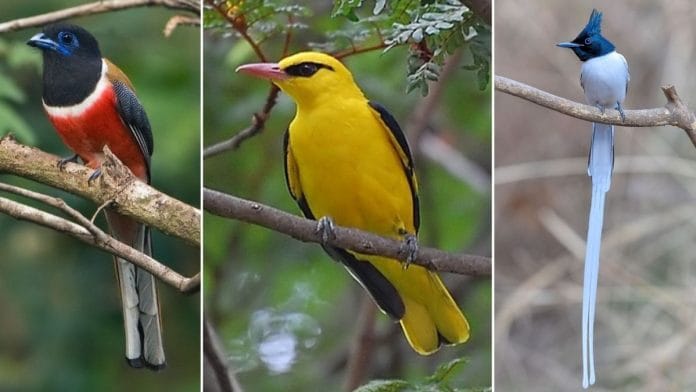
The most dramatic bird of all this season is the male Asian Paradise Flycatcher. It is one of my favourite sights, something I can see again and again without tiring. To start with, when it is young, the male is a striking rufous-cinnamon coloured bird, as if it were lavishly coated with a powdery henna. At this point, the rufous female isn’t that different to the untrained eye. As they get older, at about four years, several males embrace a dramatic new avatar.
They turn milky white, with a deep black head and spiky crest—the unforgettable white morph. Even more dramatic than the ball gown trains at the Met Gala are the bird’s long, milky white, streamer-like tail, which flutters as it flies. The while morph offers no advantage to the male bird-if anything, it makes it more visible and therefore, vulnerable. But being visible to a female is an advantage, and this is what it seeks.
You don’t even have to spend a fortune to catch a glimpse. You can see it in most of the peninsular and Western India, and even the Delhi region. The first time you see it, the aura stays with you for a long time. Perhaps longer than any individual costume.
Indian Golden Oriole
Global extravaganzas include gold-embroidered costumes, masks or jewellery. You’ve seen it a few times, but you can do better. Abandon that phone for a minute. Step out on a summer morning, or late afternoon, and you might see the Indian Golden Oriole or the Black Hooded Oriole—both birds with a brightness and history much richer than you’d imagine. Both males of the species are bright yellow birds, with largely black wings and, of course, a medieval-looking black hood for the latter. And both have cheerful red eyes.
Generally, orioles are songbirds, found in India, Southeast Asia, Central Asia, Europe and even North America. The Indian Golden and Hooded are slightly bigger than the Common Mynah. Several of the males are golden, with small variations that tell them apart. The females are a duller colour, and then, we have a Maroon Oriole in the Himalayas.
But let’s come back to these golden treasures. The Oriole got its name in the 13th century, derived from auriolus, the Latin for “golden” or “laced with gold”. Back in the day, the ancient Greeks believed that a patient dying of jaundice could survive if they stared at the Eurasian Oriole, because their ‘yellowness’ would be transferred to the bird. And did you know, jaundice itself has an etymological link to the French word Jaune, which means yellow?
Today, I say if you spend the next year actively looking for either of these orioles, you are likely to see at least one. And it might not make you cast off a disease, but it will make you happy.
Also read: The Asian Koel makes other birds raise its young—it lays eggs in their nests
The Malabar Trogon
It has been hard to list out just three sightings that outdo people on red carpets—we have so many. Still, with some struggle, I have a third bird on my list—the Malabar Trogon. As you can guess from its name, it is found in Kerala. But also, in patches upwards till Surat. On the East, reports have come in from Orissa, West Bengal and Telangana. You could find it in Sri Lanka. That’s it.
I’ve put this bird, or rather, the male species of this bird, on my list because of its sheer colour. A black head, and separated by a white ring, is a thick, bright red chest, leading to a light gulab-jamun post-belly region. At the back, a rich marmalade-like colour, with contrasting black wings. The first time I saw it was in the damp, luscious green forests of Kerala’s Thattekad. It was a slow, low-flying individual who didn’t mind being seen. I thought it was a fiery arrowhead.
Here is what this list means—the birds not too far from you have a lot of drama, colour and costume to offer, if only you can peel yourself away from faraway extravaganzas on social media. So step out and take in the pageant in your neighbourhood.
Bharati Chaturvedi is an avid birder. She is the founder of the environmental non-profit organisation, Chintan India. She tweets at @Bharati09. Views are personal.
(Edited by Saptak Datta)