






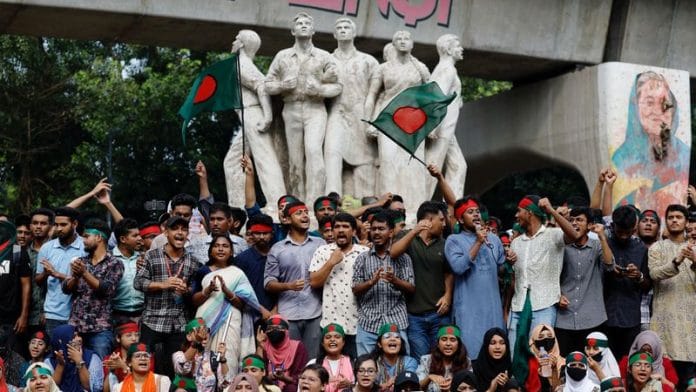



India’s immediate neighbourhood is in a politically charged phase, with elections in countries such as Bangladesh and Myanmar having just concluded and upcoming polls in Nepal shaping the regional mood. But all these countries, while being very different to each other in character and polity have one binding common thread. All these elections are not just simple democratic transitions, they have emerged from prolonged periods of political turbulence, much of it catalysed by student mobilisation.
In Bangladesh, there were youth-led protests by Islamic Chattra Shibir, Jatiobadi Chattra Dal and counter mobilisation by Bangladesh Chattra League. Youth leaders like Naheed Islam and Sarjis Alam rose to prominence becoming key coordinators and organisers of the coalition protests against the now banned Awami League, led by Sheikh Hasina.
In neighbouring Myanmar, university students were at the forefront of the post-coup resistance through the Civil Disobedience Movement. They aligned themselves with pro-democracy forces associated with the National League for Democracy and later elements within the National Unity Government framework to counter the military junta post the 2021 coup.
In Nepal, the recent Gen Z protests were a backlash against corruption and what the youth in Nepal saw as a recycled elite class dominating post-2008 republican politics. Unlike Nepal’s historic movements (1990 Jana Andolan, 2006 People’s Movement), the Gen Z youth mobilisation was largely non-partisan, digitally coordinated and did not have a central figurehead or leadership.
Though in the upcoming elections, some of the youth energy has indirectly strengthened anti-establishment currents, including public support for figures like Balen Shah, whose independent mayoral victory in 2022 signalled appetite for non-traditional leadership. The protests however did not consolidate into a nationwide youth party or parliamentary bloc.
Across all these countries, elections have followed youth-driven agitation, underscoring how student movements often lay the groundwork for political transitions. Yet, what is more significant is that these movements have frequently struggled to shape, let alone control the political structures that have followed in the aftermath. While they succeed in catalysing change by bringing government to their knees, delegitimising incumbents by filling the streets with moral urgency and forcing electoral recalibration, the post-election architecture of power is finally absorbed by established parties, entrenched elites or security establishments.
Also read: Toppling govts is easier than winning polls for protesters. Bangladesh is the latest proof
When protests give way elections
In Bangladesh, the newly formed National Citizen’s Party (NCP), born out of the student-led agitation, is a recent example of the gap between protest energy and political consolidation. The party’s convenor Nahid Islam secured a narrow victory in Dhaka-11 in the 13th National Parliamentary Elections, winning 93,872 votes against the Bangladesh Nationalist Party (BNP) candidate MA Qayyum’s 91,833.
On paper, it was a symbolic breakthrough, a protest leader crossing over into Parliament. Yet, beyond that constituency level success, the larger picture told a different story. The NCP struggled to translate street legitimacy into nationwide traction, securing only five seats out of 299.
What looked like the beginning of a generational shift remained, in electoral terms, a marginal foothold. The movement may have shaken the political establishment, but it did not displace it. The erstwhile elite force, the Bangladesh Nationalist Party led by Tarique Rahman, has returned to power in Dhaka, the centre of gravity has shifted back to one of the traditional poles of Bangladeshi politics. Today, NCP is alleging widespread result tampering.
In Myanmar too the elections have a familiar rhythm. The military-backed Union Solidarity and Development Party (USDP) won a decisive victory in the recently concluded elections. But unlike purely reformist movements elsewhere, Myanmar’s student activism after 2021 rapidly fused into the broader Civil Disobedience Movement and, in many areas, into armed resistance networks aligned with the National Unity Government (NUG) blurring the pathway from street mobilisation to parliamentary contest.
Historically, Myanmar’s strongest civilian political force was the National League for Democracy (NLD). The post-coup environment dismantled that channel, but conversely NLD also failed to groom a second rung of leadership who could take over from Aung San Suu Kyi the face of the famous 8888 Uprising. Though she herself did not emerge from the ranks of the student protestors in the 1988 civilian protests, once in power it is alleged that she did not absorb and promote the prominent student leaders of the revolution.
A recurring pattern
Recent elections in India’s neighbourhood have made it clear that student movements generate momentum because moral legitimacy converges with demographic energy. Campuses are dense ecosystems of ideas, networks and rapid communication especially in the age of social media. Students can mobilise quickly and take risks that older constituencies often cannot. They are capable of scaling protests at remarkable speed and capturing the national conversation.
The upcoming elections in Nepal are likely to draw significant international attention. Recent Gen Z protests were largely leader-light and decentralised.
Though some young contenders have prior administrative exposure at the municipal level, scaling the momentum nationally, as seen with NCP in Bangladesh, without structural penetration and long term commitment is an uphill task.
Because temporality is a constraint. Youth political movements or protests are inherently transient. Unlike entrenched parties, labour unions or religious networks, student platforms lack mechanisms for long term focus. Let alone the leadership, local supporters too move on from grievances. Many, to begin with, don’t have in-depth knowledge of the grievance or commitment to the cause.
The result is a recurring pattern: Movements surge, reshape public discourse and unsettle incumbents but struggle to embed themselves within the machinery of the state.
The core dilemma lies in the gap between mobilisation and institutional control. Winning the streets is fundamentally different from winning elections and the outcome of recent elections in India’s neighbourhood is a prime example that momentum cannot be confused with power.
Rami Niranjan Desai is a scholar of Northeast region of India and the neighbourhood. She is a columnist and author and presently Distinguished Fellow at India Foundation, New Delhi. Views are personal.
(Edited by Theres Sudeep)
Please draft a rebuttal as proposed. Thanks!
Myanmar’s struggle is not a story of “winning the streets but losing elections.” It is a story of a military overthrowing an elected government, waging war on its own people, and preventing any genuine election from taking place. The article’s core frame simply does not fit the post‑coup reality.
1. No “recently concluded elections” in Myanmar
The article claims that Myanmar has recently held elections in which the military‑backed USDP has “won a decisive victory.” That is factually wrong. Since the 1 February 2021 coup, the junta has not conducted any nationwide, credible general election. It has instead repeatedly postponed the sham polls it promised, as it loses territory and legitimacy in the face of armed and civil resistance. The last real general election was in November 2020, when the National League for Democracy (NLD) won a landslide victory that the military then nullified at gunpoint.
In other words, there is no electoral outcome in post‑coup Myanmar that can be used to prove that “street” movements failed to convert mobilization into votes. There is only the brute fact that the generals refused to respect the votes that were actually cast.
2. A coup against a landslide, not a protest that “couldn’t win”
The article’s regional thesis suggests a common pattern: youth‑led movements can draw crowds and topple governments but somehow fail where it really matters—at the ballot box. That logic is inverted in Myanmar. Before the coup, decades of civic mobilization, party organizing, and underground activism culminated in repeated NLD victories in 2015 and 2020, despite a military‑written constitution and reserved seats for officers. Far from failing to “translate the streets into seats,” Myanmar’s democratic forces did exactly that under extraordinarily restrictive rules.
The problem was not that movements could not win elections. It was that the military refused to accept their repeated electoral victories. Treating Myanmar as one more case of protesters “losing” at the ballot box erases that central reality and implicitly blames citizens for an outcome created by tanks, not voters.
3. No normal “street vs ballot” dynamic under total war
The article’s framework assumes that there is a functioning electoral arena in which protest movements either succeed or fail. That is not the case in Myanmar. After the coup, the struggle shifted from electoral competition to nationwide resistance against an entrenched military regime.
Students, workers, civil servants and professionals launched the Civil Disobedience Movement, paralyzing state functions and refusing to work under junta control.
A broad constellation of local defence forces and ethnic resistance organisations has opened a multi‑front war, with the National Unity Government attempting to coordinate political and military efforts.
The junta has responded with scorched‑earth tactics, massacres, airstrikes and mass displacement on a scale that makes anything resembling normal political competition impossible.
In this environment, asking why student movements have “not won elections” is like asking why fire‑fighters have not yet rebuilt the house they are still inside trying to stop from burning down. Elections are not the arena of contest right now; physical survival and liberation from military rule are.
4. Mischaracterizing youth movements and generational politics
The article also suggests that youth movements are inherently transient and that leaders like Aung San Suu Kyi “did not absorb and promote” student leaders, implying a neat causal chain from generational mis‑management to electoral “failure.” This is at best an oversimplification. For decades, Myanmar’s student and youth activists—especially the 1988 generation—have sustained long, often underground, forms of resistance: organizing unions, coordinating protests, building community structures and, more recently, bridging the gap between older NLD‑aligned networks and new post‑coup formations.
There is legitimate debate about centralization and generational dynamics in the NLD. But those internal political questions cannot explain why youth‑led movements supposedly “lost” an election that was never held, or a result that was never honored. To suggest otherwise reduces a brutal coup and a complex, evolving resistance to a cautionary tale about fickle Gen‑Z activists.
5. Collapsing very different regimes into one story
Finally, by lumping Bangladesh, Myanmar and Nepal into a single narrative about “winning the streets” but “losing elections,” the article collapses crucial differences:
Nepal, despite instability and elite capture, has held broadly competitive multiparty elections in which newcomers such as Balen Shah could emerge through the ballot box.
Bangladesh has held polls whose fairness and competitiveness are heavily disputed, amid boycotts, repression, and a ruling party that dominates the state.
Myanmar is in the grip of a military junta that overthrew an elected government, annulled results, and is fighting a nationwide war against its own population.
These are not variations on a single theme. In Myanmar, there is no meaningful electoral marketplace where movements could simply “organise better” and succeed next time. There is a junta that refuses to allow “next time” unless it can predetermine the outcome.
6. A more accurate lesson
If there is a lesson from Myanmar, it is not that youth movements must learn to “convert the streets into votes.” They already did, repeatedly. The lesson is that:
Elections without civilian control of the military are fragile and reversible.
Constitutional and institutional design—who controls force, courts, and electoral bodies—matters as much as turnout and campaign tactics.
When authoritarian actors can arbitrarily nullify results, movements need strategies that go beyond elections: building alternative institutions, forging broad social coalitions, and securing international leverage that constrains coup‑makers.
Any serious comparative analysis must start from these structural facts. Recasting Myanmar’s tragedy as another example of “protesters who can’t win elections” misdiagnoses the problem and risks normalizing, rather than challenging, authoritarian rule.