



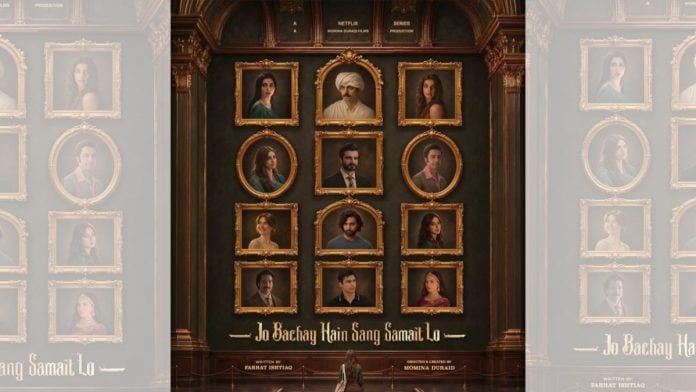
The All India Cine Workers Association has asked Prime Minister Narendra Modi to prevent the release of Netflix’s first Pakistani original series, Jo Bachay Hain Sang Samait Lo, in India. The demand may be politically understandable, but it raises a larger question: in an era when YouTube, social media, piracy and global streaming platforms can carry stories across the world within hours, can borders cage culture? And can a ban keep a show out?
A long history of cultural border walls
India and Pakistan have repeatedly treated cinema as an extension of diplomacy, war and national security. Pakistan was the more consistent and restrictive party: it restricted Indian films from 1952 and imposed a near-total ban on their screening in cinemas after the 1965 war. The restrictions remained in place until Indian films began returning to Pakistani screens in 2006–08.
India did not maintain an equivalent long-term official ban on Pakistani films. However, cross-border political tensions and distribution barriers meant Pakistani cinema had little presence in Indian theatres. Khuda Kay Liye (2008) became one of the first Pakistani films to receive a general theatrical release in India after 1965.
The Pakistani ban, however, was never a stable settlement. It was revived or tightened during periods of tension, including after the 2016 Uri attack and India’s surgical strikes, when Pakistani exhibitors stopped screening Bollywood films. It was lifted again in early 2017, only to remain vulnerable to the next diplomatic rupture.
Following India’s Balakot airstrike in February 2019, Pakistan’s Cinema Exhibitors Association announced a boycott of Indian content, and the government said no Indian film would be released in Pakistan.
Information Minister Fawad Chaudhry also said the Pakistan Electronic Media Regulatory Authority (PEMRA) had been instructed to act against “Made in India” advertisements.
Pakistan’s most sweeping restrictions came in 2019, months after the Pulwama attack. Its Ministry of Information and Broadcasting announced a ban on cultural exchanges with India, including joint ventures in entertainment. It also said no Indian films would be screened in Pakistani cinemas and that Indian dramas, films and similar content would be barred.
India, too, has restricted Pakistani cultural presence at various points. After the Pulwama attack in 2019, Indian industry bodies and political groups pressured producers to remove Pakistani artistes from Indian projects.
More recently, following the Pahalgam attack, the Ministry of Information and Broadcasting issued an advisory on 8 May 2025, asking OTT platforms and intermediaries in India to stop streaming Pakistan-origin content, including films, web series, songs and podcasts.
AICWA’s demand is therefore not new. It is the latest episode in a decades-old pattern: whenever relations deteriorate, cultural exchange becomes one of the first casualties.
Why the demand resonates
The call for a ban does not arise in a vacuum. For many Indians—especially families who have lost relatives to terrorism, soldiers killed in cross-border conflict, and communities affected by attacks attributed to Pakistan-based groups—the presence of Pakistani entertainment can feel like normalisation of a relationship marked by violence.
That sentiment deserves to be respected. A demand for a ban is not necessarily about insecurity, competition or even one Netflix show. It can also be an expression of grief, anger and a desire for national solidarity. When families have suffered irreparable losses, asking them to separate “art” from the political reality of terrorism can sound dismissive.
Yet sympathy for that sentiment does not automatically settle the policy question. The state must decide whether a blanket cultural prohibition serves security, justice and public order—or whether it mainly offers symbolic reassurance while leaving the underlying conflict untouched.
What AICWA seeks
AICWA wants an immediate block on the 4 December 2026 release of Jo Bachay Hain Sang Samait Lo in India, along with a permanent legal prohibition on Pakistani films, web series, songs, podcasts and artistes across Indian platforms, backed by severe penalties.
It argues that Pakistani content has no place on Indian screens and wants all OTT platforms to comply with the government’s advisory.
There is another detail worth noting: Netflix has classified this particular web series under MENA, or the Middle East and North Africa region, meaning it was commissioned by the platform’s MENA team. That classification does not, by itself, establish whether the series will be available in India.
However, AICWA’s demand goes beyond one programme. It seeks to convert an administrative advisory into a blanket statutory prohibition on Pakistani content and artistes across Indian platforms.
There is, however, an important distinction between a targeted, legally grounded restriction and a blanket cultural embargo. The first may address a specific security concern; the second risks punishing artists, technicians, audiences and ordinary cultural exchange for the actions of states and armed groups.
Also read: Netflix’s first Pakistani series faces India hurdle. AICWA writes to Modi for permanent ban
The VCR era proved bans leak
The history of India-Pakistan cultural exchange is also a history of censorship and bans struggling to keep pace with technology.
During the years when Indian films were formally barred from Pakistani cinemas, the VCR created a parallel market. Pirated videotapes of Bollywood films circulated widely in Pakistan, often reaching viewers around the same time as—or sometimes before—their Indian theatrical release.
That did not make the official ban meaningless, but it exposed its limits. A government could stop a film from playing in a licensed cinema; it could not stop a cassette from being copied, rented, traded or watched in a living room.
The same was true in reverse. In the 1980s and 1990s, Indian audiences discovered Pakistani television classics such as Dhoop Kinare and Tanhaiyaan through videotapes, cable networks, family connections and, later, early internet sharing.
These dramas built devoted Indian followings without needing an official Indian release, a cinema hall or a streaming licence.
The Dar-e-Nijaat-Alfaaz paradox
The demand also comes at a time when another ongoing Pakistani drama, Dar-e-Nijaat, has demonstrated how difficult it is to keep audiences apart.
The show has attracted a visible Indian following, with viewers praising its story and characters—especially Abu Bakr, whose gentleness has become a talking point across the border. Some Indian fans have reportedly organised screenings and watch parties, while social media commentary has celebrated the show’s emotional appeal.
This is precisely what makes a ban such a blunt instrument. Dar-e-Nijaat did not become popular because Indian audiences were instructed to like it. It spread because people found its storytelling compelling, shared clips and reactions online, and built a community around it.
The same is true of Hamza Malik and Zain Zohaib’s song Alfaaz. It gained popularity because listeners connected with its music and lyrics, even though Indian platforms were not streaming it. It is proof that audiences can respond to a song’s emotional appeal without waiting for a government-approved playlist.
A ban may remove a title from an official catalogue, but it cannot erase audience curiosity or the social media ecosystem that feeds it. If a drama or song can build a cross-border fan base through social platforms, a formal ban on one streaming service may matter far less than its supporters fear—or its critics hope.
Does a ban still work?
In the pre-digital era of cinema halls and physical distribution, a ban could have real force. A film needed prints, distributors, exhibitors, censorship clearance, and physical access to audiences. If Indian films could not reach Pakistani theatres, or Pakistani films could not reach Indian ones, the barrier was tangible.
Streaming changes that logic. Netflix may control what appears in its Indian catalogue, but it cannot fully control what Indians encounter online. A trailer, interview, review, clip, reaction video, or even a full episode can travel through YouTube, Instagram, Telegram, X, Facebook, and piracy sites within hours.
In this age, calling for a ban may make political sense, but it rarely makes practical sense. A ban may produce three outcomes at once:
(a) It may remove the show from Netflix India’s official catalogue.
(b) It may generate free publicity and make the series more sought-after.
(c) It may push viewers towards unofficial sources, where there is no age verification, no revenue flow to rights holders, and little content moderation.
The very controversy over Jo Bachay Hain Sang Samait Lo has already made the title more visible in India. This is the central irony of cultural censorship: the act of banning something can become its most effective advertisement.
What is being banned, exactly?
“Pakistani content” is an unusually broad category. Does it include a Pakistani actor in an international production? A song composed by a Pakistani musician but released by an Indian label? A documentary co-produced across borders? A Pakistani creator’s YouTube channel? A Netflix series funded by a global platform?
A blanket rule would be easy to announce and difficult to administer. It would also affect Indian workers. Dubbing artistes, subtitle translators, marketers, localisation firms, post-production studios, musicians and digital distributors often work together on international content alongside Pakistani creators.
Would they also be required to stop collaborating? And if a Pakistani director, writer or composer is involved, would the final product be barred from India simply because of that person’s nationality?
These are difficult questions, and it would be equally difficult to frame objective guidelines to address them. A blanket ban does not merely keep a Pakistani actor off an Indian screen; it can also take away livelihoods in India’s creative economy.
Also read: Why Indians are flocking to hold watch parties of a Pakistani TV show in Delhi and Bengaluru
The better test for both India and Pakistan: Content, not passport
The reasonable principle is not that every Indian or Pakistani artist must be welcomed, nor that every Indian or Pakistani production must be banned. The test should be the content and conduct, not the passport.
A series should face scrutiny if it incites violence, spreads state propaganda designed to inflame hatred, glorifies terrorism, or violates domestic laws. These are objective concerns that can be examined under existing legal standards, without inviting discretionary, arbitrary or knee-jerk decisions.
India’s IT framework already provides for action against content that threatens national security, public order or other legally recognised interests. By contrast, a romantic drama, family story or literary adaptation should not be treated as a security threat simply because its creators hold Pakistani citizenship.
Jo Bachay Hain Sang Samait Lo is described as an adaptation of Farhat Ishtiaq’s bestselling Urdu novel and was commissioned by Netflix as its first Pakistani original. That does not settle whether it is good, acceptable or politically innocuous. But it does suggest that the debate should begin with the programme itself, not merely the country of its origin.
The cost of permanent hostility
Cultural boycotts are tempting because they offer a visible act of resistance. They allow institutions to say: we will not do business as usual. Yet they also harden the idea that entire populations are indistinguishable from their government policies.
Pakistan’s long ban on Indian cinema did not end conflict; it mainly deprived Pakistani audiences of Indian films and weakened opportunities for ordinary cultural contact. India’s restrictions on Pakistani artistes have similarly affected individual performers and collaborative projects more than they have altered strategic realities.
The question, then, is not whether India or Pakistan can ban each other’s content. They can certainly restrict access through policy and pressure on platforms. The real question is whether they should—and whether such a ban protects citizens, upholds the law and strengthens either country’s cultural confidence, or simply displays anger to appease a domestic constituency while the content continues to circulate.
A more credible response
Both India and Pakistan need to choose between selective regulation and blanket prohibition. A more coherent approach would be:
(a) Apply clear, content-based standards to foreign programming.
(b) Require platforms to comply with lawful takedown or blocking directions tied to specific legal criteria.
(c) Avoid blanket nationality-based bans that punish artists and Indian creative workers indiscriminately.
(d) Distinguish official propaganda from independent drama, music or literature.
(e) Recognise that enforcement in the streaming era is imperfect and that bans can amplify demand.
Neither side should assume that its people are so fragile that a film or drama will suddenly overwrite their loyalties or brainwash them. Indians have long watched anti-Pakistan films and political commentary without ceasing to be Indian; Pakistanis have similarly consumed Indian cinema and television without ceasing to be Pakistani.
Audiences can enjoy a story, admire its craft and still reject its politics.
If a country believes its identity is strong, it should be confident enough to let its people watch, argue, criticise and decide for themselves. For both countries, the stronger response is not to pretend that a border can stop a stream.
It is to decide, clearly and publicly, what their cultural policy is meant to protect—and whether a work of fiction truly endangers it.
In the digital era, the state can decide what appears on licensed platforms, but it cannot seal culture behind a border. It cannot entirely stop curiosity, sharing, piracy, or global distribution either.
Amit Krishankant Paul is a lawyer, independent researcher, and author. Views are personal.
(Edited by Maryam Hassan)