






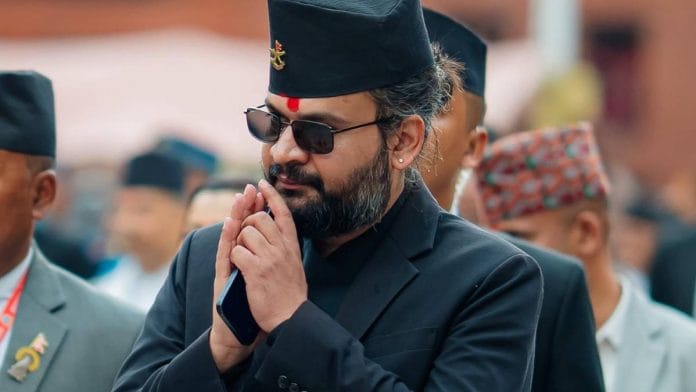



In a historic move and moving away from the established Nepalese foreign policy norm, the newly elected Prime Minister of Nepal, Balendra Shah, aka Balen, met with the 17 ambassadors and heads of diplomatic missions in Kathmandu on 8 April at his office. This included ambassadors of India, China, the United States, Japan, Pakistan, Bangladesh, Qatar, and the United Nations Resident Coordinator, among others. While past leaders have met foreign envoys in more informal settings, meeting in a group indicates a well-calibrated start to foreign policy.
Since Balen Shah took the oath as Nepal’s youngest Prime Minister on 27 March, Nepal watchers have been speculating about the direction of his foreign policy. For a first-time member of parliament, a first-time prime minister, and the leader of a party founded four years ago, every administrative move has been the first. Also, unlike the grand old parties of Nepal, Shah’s Rashtriya Swatantra Party (RSP) lacks an objectively defined ideological base, which makes it more difficult to speculate about its foreign policy.
Going by the traditional line, India and China have been the two top priorities. Liberal democratic parties like the Nepali Congress were considered close to India, the Communists and the Maoists were often seen using the China card, and the cycle repeated with each new leader and administration.
Balen Shah wants to move away from the norm and present a more neutral, objective outlook as he approaches the redefinition of an aspirational Nepal’s foreign policy. The question remains: does he have a strategy?
Key partnerships
Balen Shah’s decision to meet the envoys in a joint call avoids positioning Nepal as pro-India or pro-China and presents all diplomatic ties as equally important. Interestingly, the first group he met included countries that reflected not only Nepal’s geographical proximity but also the growing importance of its newer strategic and economic relationships. For instance, Nepalese are among the largest immigrant communities in the Gulf, and remittances from the region contribute substantially to Nepal’s Gross Domestic Product.
Amid growing concerns in West Asia, safeguarding Nepal’s interests is a key foreign policy priority for the new government. Therefore, inviting envoys from the Gulf countries was a well-thought-out decision that reflected intent and symbolism.
Envoys from India, China, the United Kingdom, and the United States were naturally expected, with invitations extended to Japan and Switzerland as well, reflecting Nepal’s attachment to long-term partners and contributors to Nepal’s development. Therefore, the selection for the first round of meetings with foreign envoys was a mix of traditional parentships, development partnerships and new partnerships. Since Balen has promised to bring more investments to Nepal, a message conveyed to key partners in this regard may have far-reaching implications.
Neutrality proposed differently
The centrality or the over-projection of two neighbours has long been viewed as problematic to Nepal’s interests, but Kathmandu has found it difficult to do away with. This posture has often been criticised, but rarely has the leadership offered an alternative. Or to say, leaders did not try much experimenting with foreign policy, as established norms kept the status quo intact, and much could always be credited to Nepal’s geography.
For a landlocked country like Nepal, bordered by India on three sides and China to the north, prioritising the two neighbours has not been merely a question of diplomatic courtesy, but a matter of survival. However, as the two giant Asian economies have raced for greater influence, with India having the edge due to people-to-people ties, economic ties, security, cooperation, an open border, and a no-visa/passport travel regime. Whereas China has been keen on seeking security guarantees from Nepal on the Tibet front, including keeping a close watch on thousands of Tibetan exiles in Nepal.
A new government’s first move has always been closely watched in Nepal. When the country transitioned to democracy in 2008, and voters brought the Maoists to power, Pushpa Kamal Dahal alias Prachanda became the Prime Minister and accepted China’s invitation to attend the closing ceremony of the Beijing Olympics that year. The commentaries and media bites in India almost declared Nepal has moved away from its ‘special relationship’ with New Delhi and made Beijing its new favourite. But Prachanda’s days in office were short-lived, so was the China tilt.
However, much could be blamed on Nepal’s political instability and short-term leadership. Foreign policies were often tied to political gains rather than defined objectively.
Because Balen Shah has the strongest-ever numbers in the house, risking political gains may not be his worry. His seemingly neutral foreign policy is similar to what King Birendra Shah had proposed to the world community to acknowledge Nepal as a ‘Zone of Peace’ (ZoP) in the 1970s and 80s.
In a historic letter to former US President Jimmy Carter, Birdenra sought endorsement of his proposal for ZoP: “I wish to take this opportunity to write to you frankly some of my country’s problems and share with you my thoughts on how best we feel the United States can extend cooperation.”
He added how Nepal, as a small country, is situated between two of the world’s most populated countries and that it maintains relations of peace, friendship and cooperation with both. “Our geographical location is in an area which has been the scene of armed conflict on several occasions in the last thirty years. Nepal has not been involved in any of these hostilities, and we would like this state of affairs to be perpetuated. It is in this context that I have proposed that Nepal be declared a Zone of Peace.”
While countries like the US and China, among others, endorsed the proposal, India didn’t because it viewed it as an attempt by Kathmandu to move away from mutual security arrangements. The proposal was soon lost in interpretations, but nationalists in Nepal have tried experimenting with neutrality.
While the quest for neutrality makes a comeback after five decades, Balen Shah has come up with a fresh approach for pursuing such proposals. He’s not asking for support from country heads, but those representing those countries in Kathmandu.
Also read: What can be expected from the ongoing talks in Islamabad? Odds of resolution remain slim
What’s next?
With a new start, there will still be some media buzz once Balen Shah goes on State visits. New Delhi would still be keen to host him first, while Beijing would also make similar efforts.
His first State visit will mark another shift from the established norm of traditional rituals and stopovers. He might instead prefer countries like Japan or the Gulf—Saudi Arabia, Qatar, Kuwait, Oman, and Bahrain. During his political campaign and outreach to the Nepalese diaspora, Balen Shah has promised to safeguard their interests, and by visiting a country that hosts them, he will certainly deepen that connection. But it will have to wait as the Prime Minister has domestic priorities.
Rishi Gupta is a commentator on Global Strategic Affairs. Views Personal.
(Edited by Ratan Priya)