






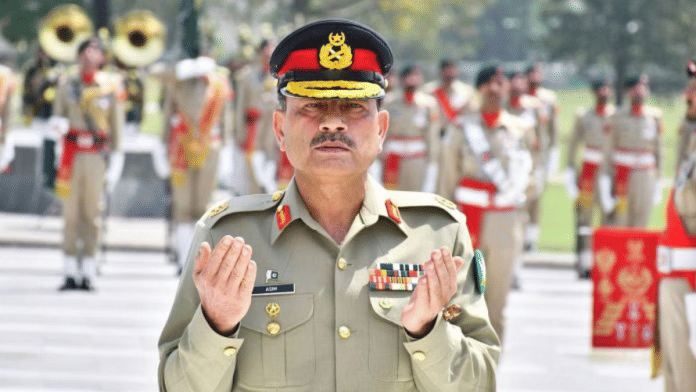



It was interesting to receive calls from both India and Pakistan about the continued delay in notifying Army Chief Field Marshal Asim Munir’s two-year extension and his concurrent appointment as the Chief of Defense Forces.
Of course, the lack of an official document, compounded with social media speculation, has raised weird expectations of pushback from the Army’s GHQ or within the existing political management.
The stories floating around social media are nothing but gossip. The delay in issuing the notification is due to Prime Minister Shahbaz Sharif’s absence, who was in the United Kingdom on a personal trip. Sharif does not want to extract more concessions from the Army Chief, as some YouTubers or commentators would like to believe, but prefers to be in the country when he makes the notification public with great fanfare. Probably, Sharif doesn’t think it is becoming for the honour of the Field Marshal to just announce the latter’s maximisation of power. Maybe he wants to announce it in a manner that would yet again underscore the commitment of the prime minister to the current power arrangement.
Some sources, however, suggest that the delay is due to confusion left in the 27th amendment regarding tenure of the CDF, which is to be determined by the prime minister. This leaves room for some negotiations. Additional gossip from the Islamabad grapevine is that there are some talks going on with politicians insisting on the appointment of a vice chief of army staff.
I could only laugh at the suggestion that the government might extract some additional benefits from Munir. Pakistan’s political system is now too dead for a prime minister or any political party to pose a threat to Munir. While Sharif is extremely meek to say no to issuing a notification, no other political party has the strength to stop Munir. In any case, no party blocked the controversial 27th Amendment to the Constitution, which effectively grants him lifetime immunity. His concurrent appointment as the Chief of Defence Forces is comparatively a minor issue. Thus, hearing speculations from India made me realise how little many understand Pakistan’s political system.
Also read: How IMF’s routine data critique was spun to discredit India’s growth story
Imran Khan, PTI & power struggle
A keen Pakistan observer called me from India, wondering if the delay in notification was because former Pakistan PM Nawaz Sharif opposed the move or was plotting something. I reminded him that the older Sharif had other concerns, like securing his daughter’s political future or perhaps seeing her become the prime minister one day. There is too much at stake for Nawaz Sharif or even Pakistan President Asif Ali Zardari—both have invested too much in introducing their next generation in the country’s power politics to pose any threat to Munir. As for the younger generation, it would probably take them at least another decade or two to build the mood for any pushback against Munir or future generals.
The current Army Chief has all political parties where he can hurt them the most—they fear that the threat of ever-popular Imran Khan could only be fought if they sided with the general. Not that Khan’s Pakistan Tehreek-e-Insaaf (PTI) is posing much of a challenge. The party is too weak now. Frankly, the only thing left of the PTI is Imran Khan, who is in jail and being constantly pressured to change his attitude and, perhaps, turn around and accept Munir’s leadership. Just like he once did with former Army Chief Qamar Javed Bajwa and Lt Gen (retd) Faiz Hameed.
The day Khan concedes would probably be the last day for the Sharifs in power. Hence, it is a mistake to assume that Khan has been killed. His sons and close family members are concerned because he has disappeared from public view.
The leader of the PTI has not been allowed to meet his sisters or lawyers for over a fortnight, which naturally raises suspicions, especially given the propensity of Pakistan’s Army to physically remove political leaders who pose a personal and institutional threat. One may disagree with Khan’s politics or style of political engagement, but denying basic rights to a political prisoner cannot be condoned.
However, he is too vital to eliminate. His greater worth lies in keeping the existing government in line and signaling, and home and abroad, that Munir is turning Pakistan into a hard State willing to deal with internal enemies with a heavy hand. Even as Khan’s family and PTI supporters raise alarms about his safety in international media, Munir’s attitude toward the PTI leader is unlikely to change.
But then what about rumours of pressure within his own institution? The story regarding an internal pushback is also the imagination of those who would want this to happen. These are similar to stories that were spread when Munir was made the Army Chief. The grapevine in Islamabad used to be abuzz with rumours of the now-retired Chairman Joint Chiefs of Staffs Committee (JCSC), General (retd) Sahir Shamsahad Mirza, planning an internal coup. It wasn’t true. Mirza proved to be the wall that stood between Munir and those who disagreed with his ascendency to power.
For the Chairman JCSC, the office of the Army Chief was a reality and important to be respected and defended to uphold the Army as an institution. In the last three years in power, Munir has effectively disciplined both the serving and retired officers into compliance and subservience. The changes brought in the Army Act that allow Munir to now court-martial even retired officers if suspected of leaking information or planning against him have done miracles. Too fearful of losing their pension, medical care, or other perks and privileges, the officer cadre – both serving and retired – dare not stand against the Army Chief.
This is not to say that all will remain quiet on the institutional front forever. There could be serious challenges in the future. But for the moment, Munir has things under control. He has also demonstrated his capability to learn from history. He’s not too eager to appoint a four-star Vice Chief of Army Staff, knowing that the VCOAS helped unseat both Zia-ul-Haq and Pervez Musharraf before taking power themselves.
Munir has managed the unease around promotions by making himself the authority. He alone will advise the prime minister on elevating another general to four-star rank and then be made commander of nuclear forces. This means that another general will get promoted but will not have control over the Army, which a VCOAS would have. The other two service chiefs offer little resistance to Munir as they have far smaller forces and feel they don’t have the capacity to challenge him. In any case, they are too interested in securing their own extension and perks and privileges to even bother about murmurs from their own services.
Surely, Asim Munir’s endless greed for an extended tenure could meet an ending, especially if Pakistan’s economic situation does not improve. His promises of turning the country into a trillion-dollar economy and setting politics right will backfire if he is unable to deliver on both fronts. What he does not realise is that the longer he stays in power and manipulates the system, the greater the instability—which is not good news for the economy. The next five years are not likely to be smooth or peaceful.
Ayesha Siddiqa is a senior fellow at the Department of War Studies at King’s College, London. She tweets @iamthedrifter. Views are personal.
(Edited by Ratan Priya)