



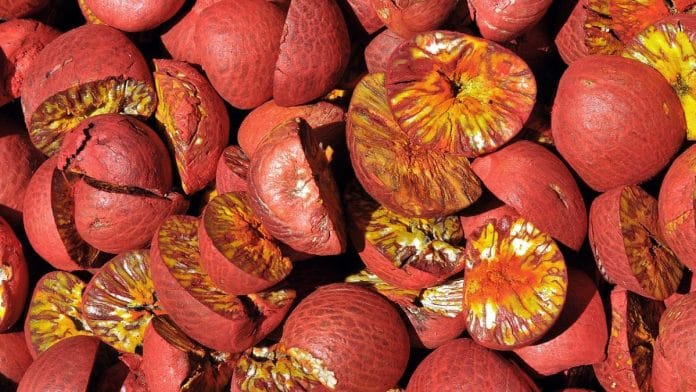
In Assam, tamul paan is customary when welcoming a guest. The areca nut and betel leaf are offered as a gesture of respect. In the Khasi hills, kwai is shared to open a conversation or seal a friendship. In Manipur, the Kwa has ceremonial importance at birth. On the other hand, in Mumbai, it can mean something entirely different. The supari can mean a contract to kill. That a single nut can stand for both hospitality and a criminal deal captures what is now happening along India’s eastern frontier. The areca nut is legal to grow, sell and chew and yet it has become the currency of one of the Northeast’s most lucrative smuggling economies.
Unlike narcotics, areca nuts are not contraband; instead, what makes them a smuggling commodity is how they enter India. How they bypass customs duties, import restrictions and phytosanitary checks. The trade matters because it shows how illegal networks are exploiting India’s eastern borders to move goods. But the paradox is striking, as India produces approximately 14 lakh tonnes of areca nut in 2023-2024, accounting for nearly 63 per cent of global production, with Karnataka, Kerala, Assam and Meghalaya being principal producing states. But the demand seems insatiable because areca nut is not only used in customary, traditional practices but also in pan masala and gutkha manufacturing.
The scale of the pan masala industry is staggering. According to market research firm IMARC Group, India’s pan masala market was valued at approximately Rs 48,456 crore in 2025 and is projected to reach Rs 67,035 crore by 2034, reflecting an annual growth rate of approximately 3.5 per cent. The areca nut is the primary raw material in pan masala, creating a huge market for its procurement. The industry is enormous, and at the very least there is a possibility that smuggled areca nut could find its way into legitimate supply chains. Combating smuggling cannot simply end on India’s borders; it must also extend throughout the supply chain.
Smuggling the areca nut
Smuggling of the areca nut is not driven by shortages. On the contrary, it is driven by profitability. India’s 100 per cent import duty and minimum import price on areca nuts of Rs 351 per kilogram, subject to applicable conditions, make cheaper foreign-origin nuts attractive to illicit traders. India is one of the world’s largest producers and consumers of areca nuts, and to protect these farmers, the government levies a Basic Customs Duty of 100 per cent on imports.
Since October 2025, a Directorate General of Foreign Trade notification has barred imports priced below Rs 351 per kilogram, with exemptions for special economic zones or SEZ. Nevertheless, the wider the gap between the cost of a nut in Myanmar or Indonesia and its price in India, the larger the margin for anyone who can bring it in without paying or avoiding these restrictions creating considerable profit margins.
Both Myanmar and Bangladesh have emerged as important routes of illegal sourcing of the areca nut. From Myanmar, the route runs overland across the 1643 kms of porous and densely forested India-Myanmar border. It is also carried across the Tiau River near Zokhawthar and Champhai in Mizoram without customs clearance, using fraudulent documentation at times to disguise its foreign origin, with local facilitators warehousing it.
The smuggling on the Bangladesh border, however, recently added another dimension to the areca nut smuggling problem. In August 2026, the Directorate of Revenue Intelligence (DRI) discovered a labyrinth of routes. Networks were importing areca nuts from Indonesia, Thailand, Malaysia and other Southeast Asian countries, declaring them Bangladeshi produce in order to benefit from the customs duty exemptions under the South Asian Free Trade Area (SAFTA). Investigators estimated the resulting revenue loss at over Rs 2500 crore.
In both Myanmar and Bangladesh, not just overland routes were exploited, but also riverine routes disguising the origin of goods and demonstrating that areca nut smuggling is not just a local border issue but a component of wider trade extending all the way from Southeast Asia to India’s domestic markets.
Also Read: China’s Medog dam is a threat India cannot afford to ignore. Siang project is a necessity
The ramifications
For Northeast India, the consequences extend beyond customs violations. Smuggling of the areca nut brings another illicit trade into the wider criminal networks that operate in the border states. While undermining legitimate farmers, the illicit economy associated with the areca nut remains the least explored or discussed in the public domain. Even though the numbers are as staggering as those of the narcotics trade. For instance, in May this year, the DRI seized about 60,000 kg of Myanmar-origin nuts in Mizoram and Assam and arrested five people. On 5 August, officers recovered 10 tonnes from a train’s parcel van at Rangia in Assam. In September, the DRI, supported by Customs, Assam Rifles and Champhai Police, found warehouses near Ruantlang village near the Myanmar border with over 125680 kgs of areca nuts along with 25440 kgs of poppy seeds.
It is apparent that to even move this cargo, the transportation coordination would be complex, with some sort of internal support. For instance, in Mizoram, it became a political issue where the Mizo National Front accused the ruling Zoram People’s Movement government of party favouritism over the areca nut smuggling crisis. Previously, before the 2023 elections, areca nut smuggling via Myanmar was a major political issue directed against the then ruling Mizo National Front.
It is this very overlapping logistics that makes it a security risk for India. The revenues of insurgent groups benefit from the illegal taxes that they collect in the name of protection payments and transit taxes. A study published by the Land Ports Authority of India drawing on a 2018 ICRIER survey found that informal payments to so-called social groups accounted for approximately 33 per cent of the transaction costs of transporting a truckload of areca nuts through the Moreh–Imphal corridor. For militant groups, illegal taxes have been an age-old tradition in the northeast. Another study undertaken by UNU-WIDER in August 2026 found that the conflict in Myanmar and Manipur had an impact on the areca nut trade, increasing transport costs sevenfold as the various insurgent groups competed for control of routes to impose higher taxes on commercial movements.
The implications of this illegal revenue are considerable in transforming an ordinary commodity into one that now contributes substantially to the financial sustainability of militant groups.
For India, areca nut smuggling must, therefore, be understood not simply as an agricultural or customs violation, but as an economic and security challenge with implications for insurgent financing, border governance and the stability of the Northeast.
The areca nut is offered across India as a sign of welcome and trust. On India’s eastern frontier, that same nut has exposed how easily trust in the country’s borders, documents and supply chains can be bought. The task now is to ensure that the northeast becomes a gateway for legitimate trade, not an open door for organised crime.
Rami Niranjan Desai is a Distinguished Fellow at the India Foundation, New Delhi. She tweets @ramindesai. Views are personal.
(Edited by Insha Jalil Waziri)