





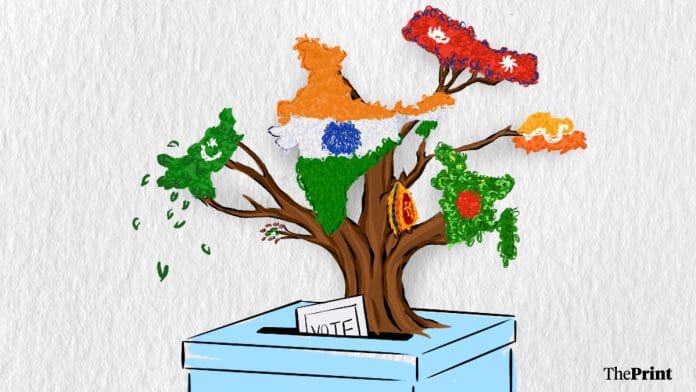



Try as we might, we’ll not find another contiguous region in the world where about two billion people vote and value democracy. Not in the Americas, not Africa. Europe doesn’t have the numbers, and most of Eastern Asia has the 1.4-billion Chinese overhang.
Something makes the Indian Subcontinent different. All of its nations, from the Maldives through Sri Lanka, India, Nepal, Bangladesh and Bhutan have regular elections. Of course the quality of democracy varies, let’s say from Pakistan at the lowest rung to India. It isn’t my case that Indian democracy is perfect.
Rating democracies is a tricky business. I’m only using the simple metric of who’s had the most peaceful, stable, normal political transitions and continuity. India has had the most of it, barring the 19-month aberration of the Emergency that delayed an election by a year.
Pakistan we rate as the lowest on this scale as it discovered elections more than 25 years after its creation, and even then has never had an elected Prime Minister complete a full term. It has always ceded much ground to the Army and invented its own hybrid arrangement. It has also had many full military interregnums for long periods, such as General Musharraf, from 1999 to 2008. Yet, people continue voting.
Look elsewhere now. In a tiny, ultra-stable Himalayan monarchy like Bhutan the King has been farsighted enough to hold regular elections and pass much power on to the Prime Minister and the Cabinet so installed. Bangladesh, Nepal, Sri Lanka and the Maldives (listed in order of their population size) have all been having elections and stable, peaceful transitions. Nowhere has that dreaded ‘A’ word, for the Army, cropped up. Not even in Bangladesh for three decades despite its history of two military dictatorships.
Commitment to elected democracy therefore is well-established among one-fourth of humankind, living in one geographically cohesive Subcontinent. If anything, in all countries except Pakistan the Army has proved to be a force for good, backstopping stability for fresh elections and transition—even when an established government was swept away dramatically by a furious street protest.
In the past four years we’ve seen this play out among three of these neighbours. Sri Lanka’s Mahinda Rajapaksa fell first, then Sheikh Hasina Wazed in Bangladesh, and then Khadga Prasad Sharma Oli in Nepal. All three, after what looked like a disruption to rival the Arab Spring, didn’t collapse into anarchy. They sprang back on their feet, held clean, peaceful elections and elected popular leaders with wide majority.
Two of those, Sri Lanka and Nepal, in the process also discovered new political parties. There was anger with the ‘system’. It’s just that it became a fury against the established political party instead: ‘they’re all the same, equally bad, complicit’. The answer wasn’t a new non-constitutional force or a new Constitution, but a new political party.
Also Read: Pakistan is fighting a two-front war. I saw it coming 15 yrs ago
Nepal is the latest. Over two dramatic days between 8 and 9 September in 2025, the Oli government fell, and amid speculation on ‘what the Army would do’, it did nothing. It just maintained order so a transitional government under a respected Chief Justice (Nepal’s first woman chief justice) Sushila Karki was set up with the solitary agenda of holding a peaceful and fair election soon.
She delivered it within six months and allowed all parties to contest freely. The results were a spectacular rejection of all those between whom 14 prime ministerships had changed hands since the end of monarchy and establishment of democracy and a Republican Constitution in 2008.
This marked the end of the Maoist power. Now, with a shade less than 10 percent in the 165-directly elected House they’ve been swept away to the garbage heap of democratic history.
The new leader? Balendra Shah, just 35, and not in the job because he’s the offspring of a famous parent. A structural engineering M.Tech from Belagavi’s Visvesvaraya Technological University (VTU), he was merely a rapper who became a humongous cult figure with his lyrics reflecting popular frustrations against corruption, lousy governance, desperate outward migration and quality of life. The party he joined, Rastriya Swatantra Party, was launched by journalist Rabi Lamichhane in 2022 and has now won one short of a two-thirds majority. At this moment it even looks ideology-free although it calls itself centrist. The nutgraf of the story is, a complete trust in the Constitution, democratic process and the fact that all key institutions, from the Supreme Court, Presidency, the Election Commission and the Army stayed intact and retained their stature and respect.
Bangladesh played out just a little bit earlier, and had its variations. The supposed caretaker government under Mohammad Yunus didn’t quite act like one and pretended as if it was fully mandated to make policy shifts, including reversals. It was the Army chief who nudged Yunus back into reality.
The election was far from ideal as one major party, the Awami League was banned. However, the election finally was peaceful—way more peaceful than any we remember in our West Bengal—and Tarique Rahman, 60, won a two-thirds majority. Almost immediately we’ve seen some return to sanity. The anti-India rhetoric and activity is down, conversations re-established and the new government is looking at Bangladesh’s future rather than grievances, national or personal, of the past. Bangladesh’s democracy has emerged stronger even if the Awami League ban remains a blot.
Also Read: Dear Narendrabhai, Bangladesh polls give India space to hit reset button
Sri Lanka before that, went through a longer, but remarkably calm process. Initially while the rest of the Rajapaksa family left, Gotabaya, as President, appointed the old UNP (United National Party) stalwart Ranil Wickremesinghe as Prime Minister.
Two months later the popular protest, called Aragalaya (the struggle) also threw Gotabaya out and Wickremesinghe was made President. This, when his party had only one MP. The secret ballot in the national Parliament chose to continue with him. Why? Because they had faith in their Constitution, democracy and a shared commitment to stability in the national interest. The election was held entirely peacefully in November 2024 where Anura Kumara Dissanayake (57), a committed communist and formerly from the Janatha Vimukthi Peramuna (JVP), which was once considered a terrorist organisation and violently suppressed, swept all of the established parties aside to win a two-thirds majority. To this extent this was a pattern of rejecting all legacy parties that Nepal followed. The only difference being that one gave a landslide to the hard Left (Sri Lanka) and the other (Nepal) rejected it sweepingly.
The Maldives has also had peaceful, electoral transitions since 2008 although the odd incoming leader may have jailed his predecessor. We told you there is no such thing as a perfect democracy.
Early on we also listed Pakistan among these democracies and that’s only because the country is now going through its longest continuous phases of elected governments, such as they might be. Within its hybrid history the current arrangement has produced the weakest government and it has conspired with the Army to mutilate the Constitution.
So here’s the question. How come while all the others in the Subcontinent have seen their democracy mature and strengthen, Pakistan has slipped?
The answer, may I say, is in the way each has imagined its nationalism. Pakistan is exceptional in that it’s still fighting to justify the two-nation theory. It is this fixation that never allowed any institution except the Army to build moral stature. Happens when you define yourselves ideologically as a national security state. The Pakistan predicament is existential. Existential not in the sense that it’s commonly used these days, but in the sense closer to the original Jean-Paul Sartre: why do I exist? And how do I exist? Therein lies the difference between the quality of its democracy and the rest of the Subcontinent’s two billion.
Also Read: Gen Zs have taken down the Nepal regime. Here’s why this will never happen in India
China shares a long border with India, Bhutan and Nepal — it’s unambiguously part of the neighbourhood. 1.4 billion people with zero electoral democracy, and Gupta simply sidesteps it entirely by framing his thesis around the “Indian Subcontinent” rather than “Asia.” That’s a convenient geographic box that excludes an inconvenient data point. If your argument is that this region uniquely values democracy, you can’t just draw the map to exclude the largest counter-example next door.
Once you factor in both of these — the China omission and the source’s credibility questions — this piece starts looking less like rigorous analysis and more like a feel-good narrative with a selectively drawn map. Calling two elections “a sign of mature democracies” across the whole subcontinent, while ignoring 1.4 billion people next door living under one-party rule, is analytically quite weak.
The grass does always look greener on the other side. Despite what he might say, Bangladesh is an Islamist nation and so is Pakistan. China is Indian neighborhood too. That os 1.3 billion people not participating in democratic process. Why does Mr.Shekar Gupta not gaze ok that nation?
Mr.ashok should also ponder about it
Educative column, except for the concluding paragraph. Where as a dove have the only serious difference with the Editor. Two billion people. Working hard for a better future for their children. That becomes easier to achieve if South Asia, like almost the rest of the world, places its faith in regional cooperation. 2. Two decisions of the past decade I particularly regret. Mothballing of SAARC. Not joining RCEP. As some of the assumptions of recent foreign policy falter, it would be great for India to rediscover the virtues of its neighbourhood. Respect for democracy one of them.