





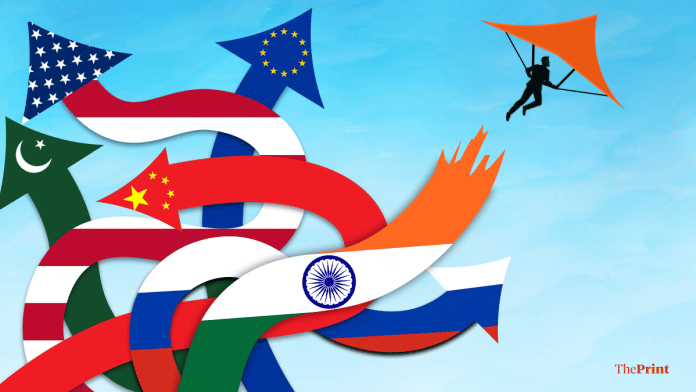



That the world is so distracted with multiple wars, shifting and fraying alliances and the return of hard power is only a greater reason for India to refocus within. It’s another crisis not to be wasted.
Because these big power and hostile neighbour preoccupations bring the gift India would’ve prayed for. A gift of time to address some critical vulnerabilities, build deterrence and prepare ourselves for the inevitable next crisis.
Of course this also means India remains disciplined enough not to be knee-jerked into reacting to what Pakistan sees as its moment in the sun. Let them soak it in, while we put our heads down to what’s more urgent. Remember what we said in this 17 January 2026 National Interest: Pakistan se azaadi (liberate yourselves from Pakistan). So move beyond them. A West Asian peace is good for us any which way.
Let’s first understand what we mean by the world being distracted. Pakistan is enjoying being the peace-broker. No guarantees but it’s most unlikely to start any adventure with us anytime soon.
Going by its record, it will try to consummate this new opportunity and then take the fullest advantage of it, in economic and military aid.
It won’t have the money to buy very much by itself, and will probably look to Saudi Arabia, even Qatar for funds while the Americans resume selling. In any case, these things take time.
Donald Trump has to find a way to end his Iran adventure with peace and some plausible claim of victory. Israel is re-assessing its post-war strategic moves. The Arabian Gulf is redefining friend and foe. Our new friend Europe and oldest partner Russia are taking a fresh look at their immediate neighbourhood. This takes care of India’s friends’ distractions.
The other hostile power, China, has been watching quietly as the bigger power entangles itself and needs a Beijing protectorate for “facilitation”. Following the Napoleonesque dictum, not only will China not interrupt an enemy (Washington) while it’s making a mistake, it will also prepare itself to benefit from the war-wrecked West Asia, especially Iran. There will be hundreds of billions of dollars in rebuilding if peace comes. Armies of contractors will descend on the region, leading to a global shortage of construction cranes. The Chinese want most, if not all of these to be theirs. They’re licking their chopsticks in anticipation. New troubles with India won’t be their priority now. This should account for our adversaries.
With the friends, near-allies and adversaries all preoccupied India is entering another of those interregnums when it can build its strength in peace. I would risk erring on the side of optimism.
Also Read: China insulated itself against energy shocks. India is ‘all talk, no walk’
Since Independence, we have faced a major security threat or warlike situation every five years on average. We began with a two-season war over Jammu & Kashmir (J&K), had the Goa project hanging with the Portuguese hiding under the NATO Article 5 protection, its liberation in 1961, wars with China and Pakistan in 1962, 1965 and 1971, as also a sizeable skirmish in Nathula in 1967. Five in 24 years makes it a military challenge every five years.
The defeat and division of Pakistan brought a respite, but from 1986-onwards, the strategic threats became more frequent. Wangdung/Sumdorong Chu standoff with the Chinese and Operation Brasstacks (ok, we provoked that one) in 1986-87, the 1990 Pakistani threat of war over Kashmir and the first nuclear warning.
And then we can keep counting. Kargil (1999), Parliament attack and Op Parakram (2001), 26/11 attacks (2008) and then Uri (2016), Pulwama (2019), Pahalgam (2025). In the middle of this the Chinese also ratcheted up tensions at least thrice, twice under the UPA: over the Dalai Lama’s Arunachal visit in 2009, and in Depsang and Chumar in 2013-14. This culminated in the eastern Ladakh standoff which has now been quieted, but not resolved. You don’t need the calculator. Simple mental math would tell you it’s a crisis every five years.
The distractions listed earlier may have opened up another of those five-year peace epochs for us.
One reason I’m still keeping it tightly to five years is that in 2030 Asim Munir’s multiple extended terms will come to an end. He will be only 62 then, the age at which an Indian armed forces chief routinely retires after his regular term. He would have seen through the tenures of four Indian Army chiefs by then, if not five.
One thing we know about military dictators, in Pakistan or elsewhere, is that they have no retirement plan. In any case, for a Pakistani Field-Marshal-for-life, is 62 (in 2030) any age to retire?
Given the state and direction of his country’s economy and history we can imagine him becoming deeply unpopular by then. If a Pakistani dictator knows one method of fighting popular disaffection other than creating a warlike situation with India, we haven’t seen it as yet. That’s why we limit our optimism to five years on the outside. We could get lucky, but hope, as is said, is no plan.
This is also the period the Chinese will now need as they see Trump enfeebling America, burning its alliances, and the successor finding his way around in a still-divided America. China will also need about five years until it feels strong enough to move on to its old irredentist dreams. Taiwan, South China Sea islands and, who knows, the Himalayas.
Also Read: Gulf war exposed India’s fragilities. It’s time for navel-gazing, in the national interest
If this optimistic reading turns out right, and India gets these five years, what does it do with them? What did we mean when we said refocus within?
Trump’s bullying on trade, defence modernisation gaps in Op Sindoor, and the war in the Gulf have underscored five critical vulnerabilities for India. These are, in no particular order, military modernisation, energy dependency, space intelligence gaps (last two PSLVs with important satellites having failed and the NavIC project mostly over), fertilisers, and critical minerals. It isn’t possible to address all of these in five years, but you can do much to bridge the gaps to be in a much better position when the next crisis arrives.
On the military side some change has come, but one year after Op Sindoor it is still more talk than action. The pace of transformation must pick up. Energy is a more complex challenge. New explorations will take time yielding results. New hydroelectric projects will take even longer.
India has to move much faster with renewables, electrification for its public and personal transport, increase ethanol blending (with maize rather than sugarcane or paddy), coal gasification, and mining in general. The first output of synthetic gas from coal should be allocated to fertilisers. And then, the issue we talk so little about: mining, our chronic laggard.
There’s a new law, much effort to reform, but the shadow and the heavy hand of the government and the PSUs do not free up this vital area. The latest example is a district mining officer serving a Rs 1,755 crore notice on the Tatas for ‘overmining’ of coal. And when are they supposed to have committed that ‘crime’ of mining more than the licences allowed? From 2001 to 2006. We know this was drawn from a flawed Supreme Court order. But the legislature must fix it.
This is not how you address the strategic dependencies that left you so exposed and helpless over the past many months. New possibilities have opened up here with the end of armed Maoism freeing the mineral-rich east-central India.
Finally, there’s an important lesson from our own learnings. Why did India manage the Western challenge over human rights in Kashmir (1994), Pokharan-2 sanctions (1998) and Kargil so much better than in the past? It was because we reformed our economy in 1991 and were seen as a rising power. A growing economy is our best strategic deterrent.
Also Read: The Vishwaguru delusion, mine vs yours, is ruining our view of the world