



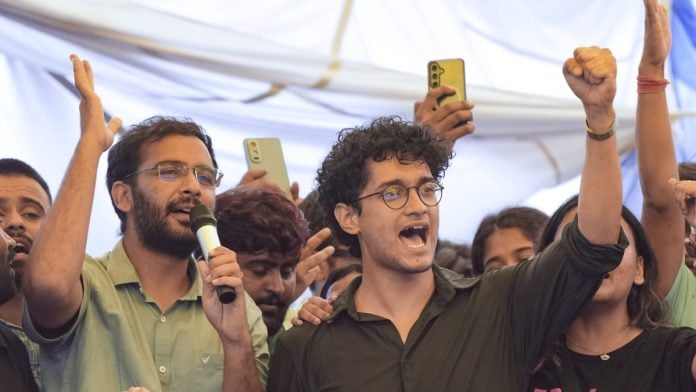
New Delhi: After a hearing which went on for more than an hour, Cockroach Janta Party co-conveners Saurav Das and Ashutosh Ranka Wednesday decided to withdraw their petition in Delhi High Court, challenging the Special Executive Magistrate (SEM) court order to extend their judicial custody till 21 October.
During the hearing, Delhi High Court Justice Subramonium Prasad made extensive oral observations, eventually suggesting them to withdraw the plea, with the SEM set to reconsider the sureties furnished by Das and Ranka at 4 pm.
Referring to procedural technicalities, Justice Prasad also asked their lawyer Abhik Chimni to move the revisional court before coming to the high court.
Das and Ranka were detained on 13 October for allegedly breaching police barricades and entering Jantar Mantar to protest against Chief Election Commissioner Gyanesh Kumar, a day after it was denotified as a designated protest site.
This, Delhi Police alleged, was a violation of the maintenance of peace bonds signed by both of them, when they were being released from detention on 11 October—the day they were taken into custody from inside the airplane they had flown to Delhi in. CJP had called for a protest against Chief Election Commissioner Gyanesh Kumar at Jantar Mantar that day.
The petition was filed Tuesday with an urgent hearing plea. The court, however, took up the matter only Wednesday.
As the hearing began, Justice Prasad remarked, “When you go and break a barricade, the chances of 10 or 20 more people in violation of Section 163 (BNSS) is very high. There may be persons who might not be in your and who may do things. We are seeing what is happening outside our country. Arson etc. You may have started with something you say is peaceful. For that purpose, you take police permission which is to prevent unwanted persons who join your group and spoil your name”.
While their lawyer was reading out the prayers made in the petition, the judge asked, “…By the way, what are your ages?”
Advocate Chimni replied, saying that Das is 27 and Ranka is 32. To this, the judge said, “Then you are not Gen Z. What is Gen Z?”
Notably, Das and Ranka’s petition had made no reference to Gen Z, or the anti-CEC protests being GenZ protests.
After the court was informed that Gen Z refers to the generation of people born after 1997, Justice Prasad noted that Das and Ranka were not Gen Z, and that the July agitation was a student protest.
The judge was referring to the CJP-led Jantar Mantar protests in July this year to seek Dharmendra Pradhan’s resignation as education minister over the NEET-UG paper leak and other exam-related issues. Das and Ranka had actively led the demonstration, which had drawn several Gen Z protesters.
“People remain the same, cause changes, correct? The next question will be who are you. What are you? What is your association, and what is the purpose of your association? Please understand when there is apprehension of peace and tranquility, all these questions will assume importance… You are drawing the court into a debate, which might ultimately not go in your favour,” Justice Prasad told Chimni, suggesting to withdraw the case.
“You are a person who has actually broken a bond…Your remedy actually lies in revision”, he added, asking the duo to go before a revisional court instead of filing a petition under Article 226 of the Indian Constitution. Article 226 empowers High Courts to issue orders, directions, or writs to enforce fundamental rights or any other legal remedy.
During the course of the hearing, the judge also suggested to the lawyer to wait for the SEM hearing later in the day, and said that if the duo still do not get their desired relief, they can come back before the high court the next day for an urgent hearing.
What the plea said
Before the high court, the CJP spokespersons had challenged the SEM’s order passed on 19 October, extending the duo’s judicial custody by two days till 21 October. The petition noted that the order was “illegal, in breach of guaranteed constitutional rights, a colourable exercise of power, as well as arbitrary are liable to be set aside”.
They relied on the 2018 Delhi High Court ruling—Aldanish Rein vs State of NCT of Delhi & Anr.—where the court had held that once an individual has submitted their surety bonds, the person arrested should be released on personal bond till verification is pending. The petition stated that the petitioners had been in custody for six days, as of 20 October, despite submitting required sureties multiple times.
They also said that a restraint on the liberty of the petitioners founded on “an apprehension of breach of tranquillity or public order and attributed to them, must satisfy the test of Article 19(3) of the Constitution”.
It added, “If liberty is curtailed on a purported apprehension, then the apprehension ought to be substantiated, and cannot rest on feeble and ambiguous facts, they argued, noting that a restriction in the interest of public order requires a proximate and real nexus with disturbance of public order, a spark in a powder keg and not a remote possibility—as established by the Supreme Court in S. Rangarajan v. P. Jagjivan Ram, 1989.”
(Edited by Mannat Chugh)