





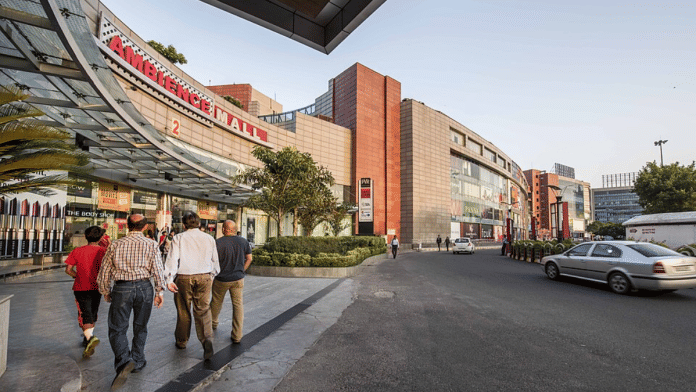



New Delhi: The Supreme Court has set aside a 2020 Punjab and Haryana High Court judgement ordering a Central Bureau of Investigation (CBI) probe into the de-licensing of land used for the Ambience Lagoon Island residential complex and Ambience Mall in Gurugram.
The ruling ends years of uncertainty surrounding the Ambience Island project and also has wider ramifications for Haryana’s real estate sector, as it not only frees developers from criminal liability arising out of the high court’s order but also comes as a major relief to 58 real estate projects across the state developed through similar de-licensing.
On Tuesday, a bench comprising Justices J.B. Pardiwala and Sandeep Mehta allowed the appeal filed by Ambience Developers and Infrastructure Pvt Ltd, overturning the high court’s directions quashing de-licensing orders and calling for a CBI investigation.
Ambience Island, a premium luxury residential complex in Gurugram (NCR), houses hundreds of residents and tenants who had faced prolonged legal uncertainty.
The controversy traces its origins to a licence granted to HLF Enterprises (now Ambience Developers) in 1993 for developing a residential colony over 18.98 acres in Nathupur in Gurugram.
Over time, the developer sought to bifurcate the licensed land, retaining 10.98 acres for the Ambience Lagoon Island residential project and seeking de-licensing of the remaining eight acres, later expanded to include 3.9 acres, for commercial development.
The Haryana Department of Town and Country Planning (DTCP) issued de-licensing orders on 18 October 2001 and 1 September 2010, permitting the construction of a commercial complex on the de-licensed land. This commercial development eventually became the Ambience Mall.
De-licensing, in effect, meant that a portion of land originally covered under a residential licence was taken out of its purview and permitted to be used for commercial purposes.
HC’s 2020 judgment
On 10 July 2020, the Punjab and Haryana High Court quashed the DTCP’s de-licensing orders, holding that the exercise was illegal and amounted to a “fraudulent” and “colourable exercise of power”.
The HC also cancelled approvals for Ambience Commercial Tower II and directed the CBI to investigate what it described as an “unholy nexus” between the developer and state officials, sending shockwaves through Haryana’s real estate sector, as similar de-licensing practices had been followed in several other projects.
Haryana’s 2020 validation law
Even before the government challenged the high court’s order in the Supreme Court, the Haryana legislature enacted a validation law to legitimise past actions of the town planning department.
In August 2020, the Assembly passed the Haryana Development and Regulation of Urban Areas (Second Amendment and Validation) Bill, granting retrospective validation to actions taken by the DTCP, including de-licensing of land.
The law said that any such action taken before the HDRUA (Amendment and Validation) Act, 2020 would be deemed valid “notwithstanding any judgment, decree or order of any court or tribunal or any authority”.
The amendment also empowered authorities to amend, suspend or rescind a licence or an order to de-license land.
Also Read: Days after Turkman Gate, Delhi HC orders MCD to verify claims of encroachment around Jama Masjid
Relief beyond Ambience project
Appearing for the Haryana government, Solicitor General Tushar Mehta told the Supreme Court that 58 projects had been developed similarly. “If the impugned judgment is allowed to stand, all such projects, which were brought up long back, would be exposed to serious jeopardy,” Mehta said.
The Supreme Court took note of this broader impact while assessing the legality of the high court’s directions. It recorded that following the high court’s directions, the CBI registered an FIR and filed a report under Section 173(2) of the erstwhile Code of Criminal Procedure.
“In the said report, the act of de-licencing of 8 acres of land has been found to be in accordance with law. However, the only illegality attributed to the appellants-developers pertains to the alleged misrepresentation in the Apartment Buyers’ Agreement,” the bench noted.
The court made it clear that while allegations of misrepresentation under Sections 420 and 120B of the erstwhile Indian Penal Code (IPC) may proceed independently before the appropriate forum, they could not justify quashing administrative approvals or ordering a CBI probe into the licensing process itself.
‘Dotted Line’ theory, ‘forum shopping’
The apex court rejected the high court’s suggestion that buyers were compelled to “sign on the dotted line” without full knowledge of the project’s scope, saying the finding was “conjectural and unsupported by any pleadings or credible material.”
It said the Apartment Buyers’ Agreement executed in 2001, “unequivocally conveyed” that the Ambience Lagoon Housing Project would come up on 10.98 acres of the total licensed land of 18.98 acres.
The bench emphasised that buyers had not pleaded fraud or coercion either in their 2015 writ petition or in the 2010 civil suit.
The SC was also critical of the timing of the legal challenge. Construction of the Ambience Mall and the Leela Ambience Hotel began in 2002 and was completed by 2007, yet the writ petition was filed only in 2015.
“The rank silence and utter indifference shown by the flat owners in taking any action for a period of almost a decade for the alleged violation of their rights creates a serious doubt on the bonafides of the actions of the writ petitioners,” the court observed.
It also noted that similar issues were raised earlier in civil and writ proceedings, pointing towards possible “forum shopping”.
The same set of flat owners, it said, chose different forums, which “clearly demonstrates an intentional attempt at covering up for the delayed action and indulging in forum shopping” to reopen settled issues and pressure the builders.
The top court further noted that the 2020 amendment retrospectively validating the disputed action was not under challenge. “The said issue can be independently agitated by the parties before the appropriate forum, if they so desire,” the bench said, declining to examine the validity of the amendment in the present proceedings.
NGT proceedings kept in abeyance
In a related development, the Supreme Court ordered that proceedings pending before the National Green Tribunal (NGT)—which had recommended environmental compensation of Rs 138.83 crore and suggested possible demolition—shall remain in abeyance.
These proceedings will stay on hold until the HC decides another writ petition challenging the DTCP’s 2021 order.
The SC expressed “serious doubt” about the NGT’s jurisdiction, noting that the dispute primarily involved land utilisation rather than a substantial environmental question.
The top court clarified that its decision will not affect other connected cases pending before the high court on separate issues and directed that those matters be decided independently.
Ultimately, it held that the high court’s 2020 judgment was “ex facie, unsustainable in facts and in law”, allowing the developers’ appeal while leaving limited criminal allegations to be tested independently in trial.
(Edited by Sugita Katyal)