





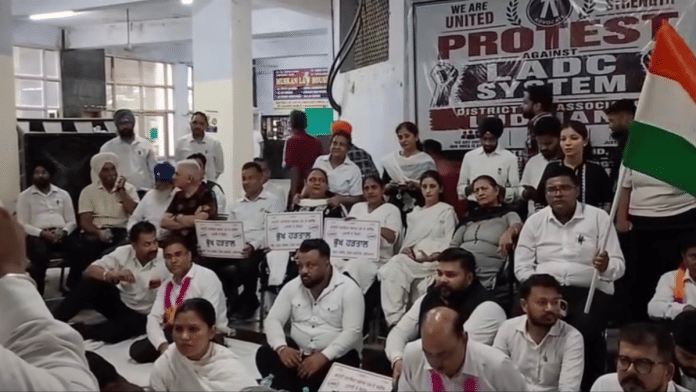


Chandigarh: Advocates across all district courts in Punjab have been on a “no work” strike for the past month, demanding the rollback of the Legal Aid Defence Counsel (LADC) system, which provides free legal aid to criminal defendants who can’t afford private legal representation.
On Monday, several lawyers in district courts in Haryana and Chandigarh also joined the strike that had been limited to Punjab so far. A day later, the Punjab and Haryana High Court Bar Association also resolved to suspend work in the high court until 30 July in support of the striking district bar associations. On Thursday, the bar association further extended the strike until Monday, 3 August.
Striking advocates, spearheaded by the Joint Action Committee of Bar Associations of Punjab, Haryana and Chandigarh, are demanding the rollback of the LADC system and the restoration of the earlier panel-based legal aid system.
In a representation to the Union Law Minister Arjun Ram Meghwal, advocate S.S. Sidhu, president of the joint action committee, listed 16 objections to the LADC system created by the National Legal Services Authority (NALSA).
The representation says that the LADC system policy is contrary to established law and will lead to erosion of the independence of the legal profession. Besides, it is contrary to the professional ethics prescribed by the Bar Council of India and creates a parallel criminal bar.
The representation adds that it will hurt the livelihood of practising advocates while restricting the litigant’s right to choose a counsel from the open bar or a large panel.
The protesting advocates added that the system will also lead to administrative control over independent advocates and LADCs.
“The system will destroy the existing legal aid panel system apart from being misused by extending legal aid to ineligible persons,” added the representation.
Protesting advocates further alleged that this system could lead to illegal collection of professional fees apart from solicitation and inducement of litigants. The system would also place pressure on litigants and lead to referral malpractice, apart from the possibility that salaried LADCs may fail to provide independent service to litigants.
Also Read: In SC judge Ujjal Bhuyan’s candour beyond the courtroom, some questions for the judiciary
Recommendations for improving LADC system
Acting on a similar representation by advocates from Punjab, NALSA constituted a committee of Punjab and Haryana High Court judges in March to revisit the LADC scheme.
Committee members met the protesting advocates Wednesday to allay their doubts.
Sources said the committee told bar members that all possible actions at the high court level were being taken, considering the objections by the advocates. They, however, added that solutions not possible at the high court level cannot be offered.
The committee members said a strike was not a solution and it was harming both the advocates and the litigants. They added that communication between the bar and the committee should continue and further suggestions can be considered.
After considering the representation by the protesting lawyers, the high court circulated a series of recommendations by the committee for better implementation of the LADC system.
The circular laid down the procedure to be followed for the appointment of an LADC.
It recommended that in case a defence counsel decides not to appear in a matter, the presiding officer will not directly appoint an LADC to defend the accused.
Instead, the presiding officer will first pass an order noting their absence and communicate this to the accused or the advocate of the accused.
If, despite this communication, the accused or his advocate fails to appear on the next date of hearing, the presiding officer will move a case for the appointment of an LADC.
The registrar general of the high court circulated the recommendations within the high court as well as among all district and sessions judges in Punjab, Haryana and Chandigarh, requesting them to further circulate these among all Judicial Officers and Secretaries and District Legal Services Authorities.
PIL to end strike
The matter is also under consideration of the Punjab and Haryana High Court after a public interest litigation (PIL) was filed last week seeking directions to end the statewide strike because of the inconvenience it was causing to litigants.
The PIL filed by advocate Arvind Seth on 20 July sought directions from the court to restore the normal functioning of the courts and to take action against those who were “obstructing the day to day functioning of the court”.
Taking up the petition, a bench of Chief Justice Ashwani Kumar Mishra and Justice Rohit Kapoor said it hoped that “wiser heads will prevail” in the matter and the court will not be called upon to deal with the issue.
The bench noted that the bar association of the Punjab and Haryana High Court and some members of the bar council who appeared in the court were of the view that such issues should be resolved at the level of the bar itself.
The matter was again taken up on 23 July when the bench noted that discussions were still ongoing and deferred the hearing to 27 July. When the matter came up for hearing Monday, the bench expressed its displeasure over the continuing strike.
The matter escalated after advocates in the high court gathered outside the chief justice’s courtroom and chanted slogans demanding the rollback of the LADC system. Some bar members also claimed that the chief justice had made an oral observation against the protesting advocates.
An emergent meeting of the bar association executive committee was held, where it was decided that a general house body meeting of the bar be called Tuesday to deliberate on the next course of action.
During the general house meeting Tuesday, three resolutions were passed. It was resolved that a show cause notice be issued to advocate Arvind Seth for filing a PIL opposing the legal fraternity.
The general house further resolved that the bar council be asked to suspend the license of the LADC counsels throughout Punjab, Haryana and Chandigarh and suspension orders be placed before the general house, which would again meet on 30 July till which time work in the High Court would remain suspended.
However, the bar association decided on Thursday to extend the strike till Monday and hold a general house meeting on Monday morning.
When the PIL came up for resumed hearing on Tuesday, the division bench of Chief Justice Ashwani Kumar Mishra and Justice Rohit Kapoor pressed for the discontinuation of the strike because the common man was being denied access to justice.
Referring to the recommendations circulated by the high court for the better implementation of the LADC system, the bench pointed out that during the 27 July hearing, members of the bar association and the bar council had agreed that practically all concerns regarding the alleged misuse of the LADC System have been taken care of.
The bench said that it had also expressed its “pain and anguish” over the prolonged blocking of access to justice to the common litigant across Punjab for the last 27 days, which it said, “would be shameful, for the justice delivery system”.
The bench added that during the hearing on 27 July, an assurance was given that there likelihood of amicable resolution, the matter was deferred to July 28.
However, the bench added that when the case was taken up on 28 July, it was informed that the oral observations made by the court regarding the continued blocking of access to justice to the common man had been misquoted.
“We note with regret that despite the fact that detailed directions have been issued, in order to assuage the apprehension of the Members of the Bar, regarding implementation of LADC Scheme, yet, such a concocted projection is sought to be made,” says the bench’s July 28 order.
“We have reiterated our sentiments to the learned Members of the Bar, that denial of access to justice, to the common litigant, would be a failure on the part of the entire justice delivery system, which cannot be permitted,” concludes the order.
(Edited by Sugita Katyal)