





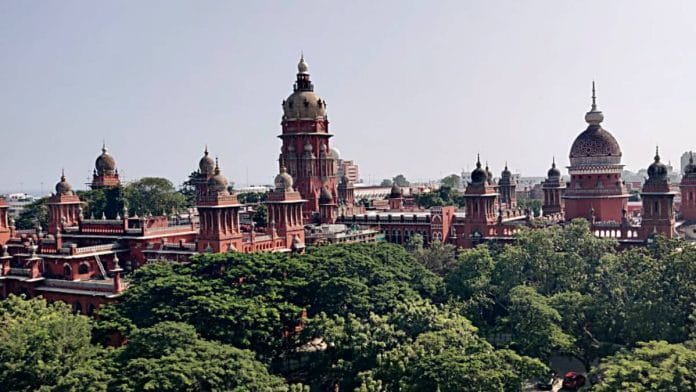


New Delhi: The Madras High Court directed a principal district judge last week to grant full maternity leave to a judicial employee for her third pregnancy, saying a “welfare state” cannot discriminate in approving maternity benefits.
The court criticised a March 2026 Tamil Nadu government order limiting maternity leave for a third child to 12 weeks, observing that the physical impact of pregnancy is the same for all pregnancies.
“If it is a pregnancy, maybe the first pregnancy or the second or the third, suffering would be the same and the pre-delivery as well as the post-delivery care must be taken by the mothers and this equal to all such pregnancies, whether it is the first or second or third,” the court said while directing the sanction of maternity leave to the petitioner.
The high court order adds to a series judgements and judicial interventions questioning limits on maternity leave for third pregnancies. At the centre of all these decisions is a woman’s reproductive freedom and health as a fundamental right.
The Maternity Benefit Act 1961 – now incorporated within the Code on Social Security 2020 – provides for 26 weeks of paid maternity leave to all women employees of establishments employing more than 10 people. But it includes a 12-week leave limit for third pregnancies.
State and Central government employees are governed by service rules, which use the act as a benchmark.
However, the Central Civil Services (CCS) Rules are often seen to be at odds with both the statute and evolving jurisprudence. Contrary to the act and Supreme Court precedent, the CCS Rules allow a woman to take maternity leave for two pregnancies. The rules are silent on third or further pregnancies.
Court intervention
Recent judicial interpretations of maternity benefits have questioned the statutory leave restrictions on third pregnancies. While courts have not granted relief beyond the 12-week limitation in all cases, they have questioned the discriminatory nature of that limitation.
In the landmark 2025 K. Umadevi v. State of Tamil Nadu case, the Supreme Court held that maternity benefits cannot be denied for a third pregnancy.
Emphasising maternity benefits as a fundamental right under reproductive health, the court highlighted Article 21, which guarantees the right to life and liberty, and Article 42, which mandates just and humane conditions of work.
A bench of Justices A.S. Oka and Ujjal Bhuyan held that beneficial legislation should be interpreted with a “purpose-oriented” approach and must receive a “liberal construction” to promote its objectives.
Accordingly, granting maternity leave to the petitioner on par with that for a first or second pregnancy, the bench said: “Concept of maternity leave is a matter of not just fair play and social justice but is also a constitutional guarantee to the women employees of this country towards fulfilment whereof the State is bound to act.”
The judgement also referred to India’s commitment to international law on maternity benefits under ratified treaties such as the Universal Declaration of Human Rights (UDHR) and the Convention on the Elimination of All Forms of Discrimination Against Women (CEDAW). The UDHR recognises that motherhood and childhood are entitled to special care and assistance.
In an earlier ruling in 2009, the Supreme Court held that reproductive rights include a woman’s entitlement to carry a pregnancy to term and to give birth. And in 2016, the Court stressed the need to protect reproductive health and rights.
While holding population control to be a laudable public policy goal, the court has said it cannot be achieved by violating fundamental reproductive rights. It stressed the need for constitutional harmonisation and purposive interpretation of maternity benefit rules.
The Supreme Court has also recognised maternity benefits for non-traditional family structures. In 2023, it held that a woman cannot be denied maternity leave because she has surviving children from a previous marriage. Also, in 2026, the maternity benefit rights of adoptive mothers were significantly expanded.
With maternity benefits recognised as a fundamental right irrespective of the number of pregnancies, aggrieved women now approach high courts directly under Article 226, which empowers high courts to issue directions, orders, and writs for enforcing Fundamental Rights or for “any other purpose”.
Courts across the country have been applying Supreme Court precedents in maternity benefit disputes.
In 2024, the Delhi High Court upheld maternity leave for a woman police constable, saying that while the state can disincentivise large families, it cannot trample upon a third child’s right to maternal care.
A year later, the Himachal Pradesh High Court emphasised that technical service regulations cannot override the special attention required in both motherhood and childhood.
The petitioner in this case was denied maternity leave for her third pregnancy under the CCS rules that do not provide for maternity leave beyond the second pregnancy. Yet, the court granted maternity leave of 12 weeks for her third pregnancy in line with the benchmark set by the Maternity Benefit Act.
In early 2026, the Madras High Court rebuked its own registry for denying leave for a third pregnancy, emphasising that judicial precedents apply to all and not just specific individuals who file a case. The case arose despite the high court granting similar relief in previous cases involving judicial officers.
Importantly, the 2025 Supreme Court decision has not set aside the maternity benefits limit on a third pregnancy. Rather, it has clarified the social justice objective of the Maternity Benefit Act, allowing courts to interpret individual cases in this light.
The Madras High Court’s latest order criticising the 12-week limitation is based on precedent. The court called the statutory restrictions “otiose in view of the law having been settled by the Hon’ble Supreme Court”.
(Edited by Sugita Katyal)
Also read: Supreme Court’s maternity leave verdict corrects a flawed idea of motherhood in law