





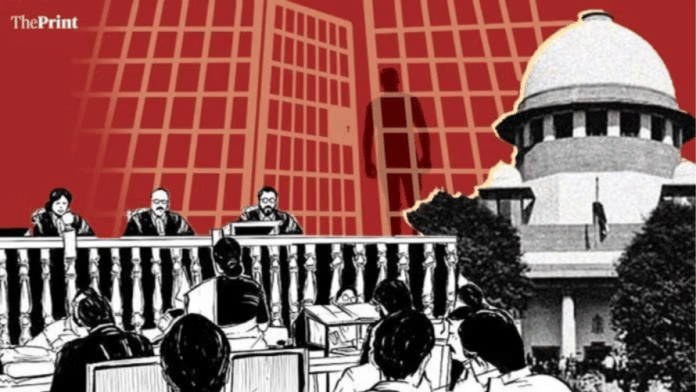


New Delhi: Questions of consistency in India’s remission and premature release framework have resurfaced after the Delhi High Court pulled up the Sentence Review Board (SRB) for its decision rejecting life convict Santosh Kumar Singh’s plea, calling its decision “publicly perceived”.
Justice Anup Jairam Bhambani’s assurance of last week to Singh, convicted of raping and murdering Priyadarshini Mattoo, of “objective treatment” raises the inevitable question: what exactly is objective in such cases?
Singh has challenged the SRB’s October 2025 decision rejecting his representation for premature release. The Board had ruled that Singh committed the crime “with premeditation and in such a way that makes the offence not only a heinous offence but horrible too” and that his premature release “will set a wrong example for the society at large”.
The Board’s order relied upon a police report raising concerns over Singh’s release. The report said Singh’s crime was heinous and that his presence in the area, if released, “will affect public peace and tranquility”.
Singh’s petition in Justice Bhambani’s court is part of a batch containing over 22 petitions by various life convicts challenging SRB decisions rejecting premature release. In most of these cases, the Board rejected applications for reasons of “perversity” or “heinousness” of the crime.
Sarthak Maggon, counsel for many of the 22 petitioners before Justice Bhambani, noted that the issue of premature release is not merely legal, it is “deeply shaped by political will, administrative convenience, and public perception”.
In the Bilkis Bano case, the Gujarat government in August 2022 released 11 men convicted of raping the five-month pregnant Muslim woman and murdering her family members. Based on a 1992 state remission policy, the government freed them based on a jail advisory committee’s report citing their “good conduct” after serving over 14 years in prison.
In 2024, the Supreme Court, however, reversed the decision, ruling the lack of Gujarat government’s jurisdiction as the trial was held in Maharashtra. Justices B.V. Nagarathana and Ujjal Bhuyan criticised the Gujarat government, stating it acted “in tandem with the convicts” and misused its power to grant premature release.’
The infamous Manu Sharma, son of then Haryana Congress heavyweight Venod Sharma, was sentenced for life in the Jessica Lal murder case, but was released in 2020, with authorities citing good conduct and completion of the minimum incarceration period under remission policies. Sharma was granted premature release after over two decades in prison and the SRB recommended release based on good conduct in jail which was approved by the Governor. His brother, Kartikeya Sharma, is the founder of the ITV Network and currently a Rajya Sabha Member of Parliament.
Also Read: Trial courts handed 128 death sentences in 2025, highest female convictions since 2016, says report
Remission framework & role of SRBs
Article 72 of the Constitution empowers the President to grant pardon, remission, or commutation, and Article 161 gives similar powers to the Governor.
Under the Bharatiya Nagarik Suraksha Sanhita (BNSS), Sections 473 & 474 enable state governments to grant remission and Section 475 mandates minimum 14 years of actual imprisonment, especially in cases where death penalty was an option.
Although the Supreme Court in several cases such as Laxman Naskar v. Union of India and State of Haryana v. Jagdish has held that remission cannot be denied solely on the ground of the heinous nature of the offence, advocate Shannu Baghel explained that the absence of a uniform national standard or structured criteria further exacerbates inconsistency, leading to divergent outcomes across similarly placed convicts, both inter-state and intra-state. This in turn results in a system where “executive discretion operates with limited transparency and insufficiently reasoned decisions”, raising concerns under Articles 14 and 21 of the Constitution.
Advocate Maggon shared a pertinent concern over SRB clubbing multiple premature release applications filed by convicts of a case and giving a common order regarding them. Such a practice overlooks individual assessment of each convict due to which there is also lack of a reasoned judgement by the SRB. He said each convict should be dealt individually, even if they are part of the same First Information Report.
The law requires the SRB to evaluate factors such as reformation, conduct, likelihood of reintegration, and family circumstances, yet in many cases these are either cursorily noted or entirely disregarded, Maggon said, adding this process creates an impression that the outcome is often pre-determined, instead of being an objective evaluation.
“Although SRBs may formally record additional factors, a closer reading shows that these are often peripheral or perfunctory, with the gravity of the offence effectively driving the decision – which runs contrary to the Supreme Court’s jurisprudence (which emphasizes that remission is forward-looking, focusing on reformation and present circumstances, not merely the past act),” Maggon added.
SRBs typically comprise a state’s Home Minister, Director-General of Prisons, Home Secretary, a District Judge, a Commissioner of Police and a member of the Social Justice Department. The purpose of varied members in the Board is their contribution towards bringing in the overall perspective for the “purpose of evaluation”.
There is no single, binding national standard, however, to determine how these factors must be weighed, leaving significant discretion to individual boards. While state-wise remission policies outline eligibility thresholds such as minimum years served, ambiguity remains on the definition of criteria like “heinousness,” “public sentiment,” and “reformation”.
The timelines themselves are inconsistent. Some cases are deferred repeatedly without substantive consideration, Maggon told ThePrint, while others are decided more promptly. “This undermines the principle of legitimate expectation and raises concerns under Article 14 (equality before law)”.
The Supreme Court and various High Courts have in past rulings emphasised the need for reasoned decisions by SRBs and adherence to applicable policies. In UoI v. Sriharan, the Supreme Court in 2015 while dealing with the landmark case of the Rajiv Gandhi’s assassination case held that remission must be guided by factors such as the convict’s conduct, age, psychological profile and prospects of rehabilitation.
The Supreme Court has repeatedly held, including in the Sriharan decision, that a life sentence does not automatically mean imprisonment until the last breath and that remission cannot be denied solely on the ground of the heinousness of the crime as doing so would violate the reformative principles of the penal system.
Also Read: Why Supreme Court hasn’t confirmed a single death sentence in the last two years
Cases before Justice Bhambani
Santosh Kumar Singh, who has been in open prison since 2019 and is convicted for the 1996 rape and murder of Priyadarshini Mattoo, a law student junior to him in Delhi University, petitioned the High Court seeking the quashing of the order.
Singh has now spent approximately 30 years in jail; a trial court acquitted in 1999, the High Court handed him a death sentence in 2006 and the Supreme Court turned that to life imprisonment in 2010. Several people, including Mattoo’s brother, President of the All India Kashmiri Samaj and a BJP spokesperson, also a former Delhi MLA, had opposed Singh’s remission plea, a fact that the Board noted in its rejection order.
The Delhi High Court in July 2025 set aside an earlier SRB rejection, noting “elements of reformation” in Singh’s conduct and sending the matter back for reconsideration. In the second round as well, the Board in November 2025 rejected Singh’s plea for premature release noting the crime’s “heinous nature”. Filed by advocate Amod Kumar Singh, the plea argues that Singh’s case has not been considered by the SRB in a fair, unbiased and lawful manner.
Another case before Justice Bhambani is that of life convict Ashish Kumar Kapri, in jail since 2004 for rape, robbery and murder of an Australian woman. He has also challenged the August 2024 SRB order which rejected his plea for premature release stating that “considering the gravity, perversity and heinousness of the crime and circumstances under which the offence was committed”. It notes a strong objection by the police, that recommending release of Singh “who had committed heinous crime with a foreign national” may not be “in the interest of the society as it also affects the international relations of our nation with other countries”.
Another case is that of life convict Ram Dass who has challenged the February 2024 SRB order. Dass has been in jail for the murder of two persons by causing firearm injuries. The Board in its order rejecting Dass’s application for premature release notes that the “crime committed by the convict was brutal and the release could adversely affect the society at large”.
Challenging the order, Dass—via his advocate Sarthak Maggon—has argued that the “reliance on the gravity or brutality of the offence, committed over 16 years ago, disregards the well-settled principle that the nature of the offence cannot by itself override the subsequent conduct and reformation of the convict” and that the Board’s conclusion is “speculative” and unsupported by any empirical or individualized assessment.
In the case of life convict and former soldier Anil Kumar, the SRB in its 2023 order rejected his plea for premature release on account all the facts and circumstances of the case: “… murder of a person by firearm injury daring robbery, the gravity of the offence, re-arrested in other criminal case during parole in 2018, shown non-reformative attitude, possibility of committing crime again, etc”.
Kumar is charged for the murder of a person by firearm and robbery and has been in jail for more than 16 years. His case, via advocate Baghel, before the High Court is that he was an ex-army man and during his time on parole in the Covid epidemic, he showed good behaviour and morals in society.
Separately, in jail for over 23 years, life convict Rajnath is charged with raping a 4-year-old girl. He, via advocate Baghel, has also challenged a 2021 SRB order rejecting his plea for premature release on the ground of the “heinousness/gravity and perversity of the crime, possibility of committing crime again”. The Delhi Police and the Social Secretary Department’s Secretary had opposed his premature release.
“The constitutional framework treats remission not as an act of charity, but as a recognition of reformation and a step towards reintegration,” said Maggon, emphasising the need for SRB decisions to evolve towards structured, reasoned, and uniform standards, without which “the process risks being seen as discretionary rather than principled”.
(Edited By Nardeep Singh Dahiya)