


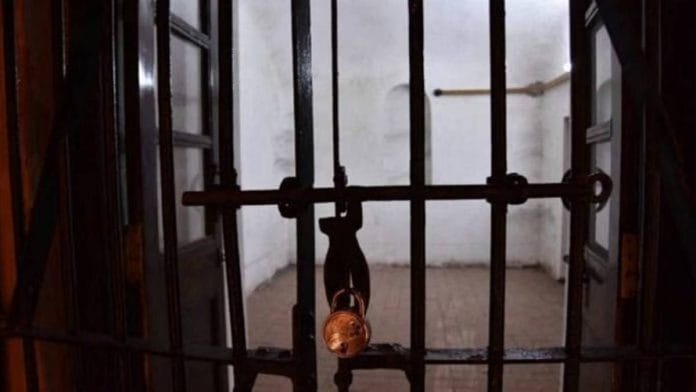
New Delhi: Dilip Debbarma, a convict serving a 12-year sentence at Tripura’s Kendriya Sansodhanagar prison, was assigned the daily task of cleaning the waste of a German Shepherd dog kept on the prison premises. No other convict was made to do this job. After he hanged himself in a prison toilet in October 2024, the Tripura Human Rights Commission found that the discriminatory assignment had subjected him to severe mental distress and humiliation.
Last week, the Tripura High Court rejected the state’s challenge to the state human rights commission’s recommendations in the custodial death case of Dilip Debbarma, ruling that such orders are legally binding on the government. In orders passed in 2025 and this year, the Tripura Human Rights Commission recommended a compensation of Rs 4 lakh to the convict’s family as the death happened when he was in custody. It also recommended a departmental inquiry against the staff responsible for it.
Although the commission concluded that the death was a suicide by hanging, it held the prison administration directly responsible for fostering the discriminatory conditions that precipitated the incident. The commission revealed that the prison maintained a German Shepherd dog under an official order, and jail authorities exclusively assigned the now deceased convict to clean the dog’s waste every single day. No other rigorous imprisonment convict was ever deployed for this task.
The commission observed that being forced into this daily routine caused the prisoner severe mental distress, disappointment, and humiliation, ultimately driving him to take his life. In its order, the THRC declared that the convict was subjected to “overtly oppressive acts, which amounted to discrimination and his right to lead a dignified life and to get fair and non-discriminatory treatment under Articles 14 and 21 of the Constitution of India was violated”.
The material considered by the commission indicated that no other convict was assigned the work of cleaning up the dog’s waste. The commission also noted that when the jail authority officially ordered that a dog be kept in the jail premises, it was also their duty to arrange for proper cleaning of the room by deployment of rigorous imprisonment convicts on payment of wages, but ordering only the deceased to do it indicates discrimination.
The commission also cited prima facie negligence against warder Raju Debbarma, who remained in the control room while the area where the convict worked was outside camera coverage.
The man was convicted under IPC sections pertaining to kidnapping, abducting or inducing woman to compel marriage, and aggravated rape by person in trust or authority.
Also Read: HC reduces acid attack convict’s term, says frustration with wife ‘mitigating circumstance’
Grounds of challenge
The Inspector General of Prisons, Home (Jail) Department, Government of Tripura, challenged the commission’s recommendations in the high court via a writ petition. Their primary ground of opposition relied on a separate Magisterial Inquiry Report conducted under Section 196(1A) of the Bharatiya Nagarik Suraksha Sanhita (BNSS) 2023.
In that report, the Judicial Magistrate First Class, Agartala, noted that while the cause of death was suicide, “there can be no culpability attributed to the jail authorities, staff or inmates”. Citing this finding, the State petitioned the THRC for a review of its decision, contending that prison authorities had been exonerated of negligence or foul play.
Additionally, the State argued that the commission’s recommendations could not be treated as final or legally enforceable prior to the completion of formal departmental proceedings against the staff. The State also contended that the THRC lacked the jurisdiction to issue binding directions for compensation and recovery from public officials.
HC’s verdict on scope of inquiry and binding orders
Rejecting the State’s contentions, the Tripura High Court bench of Chief Justice M.S. Ramachandra Rao and Justice Biswajit Palit held that recommendations made by Human Rights Commissions under Section 18 of the Protection of Human Rights Act 1993, constitute legally binding adjudicatory orders that the State is obligated to enforce.
In a 16-page ruling delivered last week, the high court found no merit in the challenge, directing the Inspector General of Prisons to implement all directions of the Commission, including the payment of compensation, within one month.
Addressing the magisterial report, the high court clarified that inquiries under Section 196 of the BNSS have a “very limited scope i.e., to identify what is the apparent cause of the death” . Quoting the Supreme Court’s 2003 ruling in Amar Singh v. Balwinder Singh, the bench highlighted that details regarding how or under what circumstances an individual died fall outside a magistrate’s statutory scope. The high court ruled: “So to the extent the magistrate in his report… went into the aspect about negligence of jail authorities, he had no jurisdiction. So any finding recorded by him in this regard has no validity and would not bind the commission”.
On the question of enforceability, the high court cited the full bench decision of the Madras High Court in Abdul Sathar v. State, affirming that “the recommendation of the H.R. commission under Section 18 is an adjudicatory order which is legally and immediately enforceable”. The bench firmly dismissed the State’s defence regarding internal inquiries, stating that “the state cannot contend that unless departmental inquiry is held against the officers, the commission is precluded from passing a final order”.
(Edited by Nardeep Singh Dahiya)
Also Read: After SC, how Tripura High Court added muscle to freedom of speech & expression