


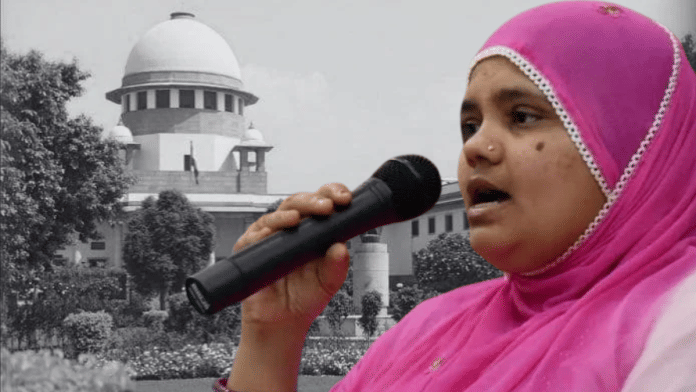
New Delhi: Twenty-four years after she was left for dead by the men who gang-raped her, Bilkis Bano is once again being forced to relive her brutal ordeal, after the Supreme Court granted bail to two of the convicts. Now 45, Bano says “familiar fears are resurfacing” and that she will “fight the order”.
“I must. I do this for my children, who do not deserve to live haunted by these fears and scars for the rest of their lives. I do this for my 3 year old Saleha who deserved to live, and whose memory demands justice. I do this for women everywhere,” Bano said in a statement issued through her lawyer, senior advocate Shobha Gupta.
Those familiar fears have also prompted Bano and her family to flee Gujarat earlier this month, according to her uncle. According to a PTI report, he said Bano was “terrified” because the convicts “frequently return to the village while out on parole—sometimes for 15 days, sometimes for up to a month”. He added that the family feared that if the convicts could secure bail, they were capable of doing anything.
Displacement has been a recurring feature of Bano’s life. A 2024 Supreme Court judgment took note of her frequent relocations over the past two decades, during which she lived in more than 20 locations and safe houses across Gujarat, Maharashtra and Delhi because of death threats. The threats had also prompted her to seek a transfer of her trial from Gujarat to another location.
In her statement, Bano recalled the ordeal of the past two decades and said, “For 24 years I have searched for and found reservoirs of courage I did not know I had, only because a million voices of support and solidarity came my way. I have walked to courtroom after courtroom, and been grateful each time I was vindicated; each time my faith in the idea of justice was restored.”
“Yet today I find myself losing the very justice I had fought so hard to win,” she wrote, saying the Supreme Court’s order suspending the sentences of Bipinchand Joshi and Pradip Modhiya was passed without hearing her.
A Supreme Court bench of Justices M.M. Sundresh and Prasanna B. Varale suspended the sentence of the two convicts and granted them bail, noting that they had spent more than 17 years in prison. The order does not overturn their convictions, which remain under challenge.
Bano’s legal battle has spanned 24 years, multiple courts and a series of landmark judgments. As she prepares to approach the Supreme Court once again, ThePrint looks back at the years she has spent fighting for justice, compensation and, above all, the right to live without fear.
Also Read: Bilkis Bano case convicts controversy: Why the 11 were released under ‘old’ 1992 policy
Long road from FIR to conviction
Bano was 21 and five months pregnant when she fled her home in Randhikpur village with 16 relatives after communal riots broke out in Gujarat in February 2002, following the Godhra train burning.
After moving between villages for several days, the family was attacked on 3 March 2002 near Chhaparvad village by a mob of 20–30 men. Bano was gang-raped and left for dead after losing consciousness. Her mother and a cousin who had recently delivered a baby were also gang-raped and murdered. Eight minors, including the cousin’s two-day-old infant, were killed. Bano’s three-year-old daughter was murdered with her head smashed against a rock. Of the 17 family members, 14 were killed, according to the Supreme Court’s 2024 judgment.
An FIR was registered at Limkheda police station on 4 March 2002. Although Bano knew her attackers, many of whom were her neighbours in Randhikpur, and named them to Head Constable Somabhai Gori, the police omitted their names and did not mention the rape in the FIR. The following day, an Executive Magistrate recorded Bano’s statement at the Godhra Relief Camp on the instructions of the then Panchmahal District Collector, Jayanti Ravi.
In November 2002, the Limkheda police filed an ‘A’ Summary Report, stating that an offence had taken place but the culprits could not be traced. A judicial magistrate rejected it. However, after the police submitted a second such report in February 2003, the magistrate accepted it in May, effectively closing the case.
Bano approached the Supreme Court against the closure. In December 2003, the court ordered the case to be reopened and transferred the investigation to the Central Bureau of Investigation (CBI).
The CBI began its investigation in January 2004 and filed a chargesheet against 20 accused in April that year. Twelve were charged with offences including gang rape, murder and rioting. Six police personnel were accused of dereliction of duty, falsifying the FIR, suppressing evidence and shielding the accused, while two doctors were charged with conducting false post-mortems and destroying forensic evidence.
In 2004, Bano also approached the Supreme Court seeking a transfer of the trial from Gujarat to a neutral location, citing threats to her and her family. In August, the court allowed her plea and directed that the trial be held in Mumbai.
One accused died while the trial was pending. In January 2005, charges were framed against the remaining 11 accused under various provisions of the Indian Penal Code, including those relating to rioting, murder, rape of a pregnant woman and gang rape.
On 21 January 2008, nearly six years after the attack, a Mumbai trial court convicted all 11 and sentenced them to life imprisonment for the gang rape of Bano, the gang rape and murder of her mother and cousin, and the murder of her daughter and 12 other family members, besides rioting and other offences.
The court also convicted one police personnel for deliberately recording the FIR incorrectly. However, it acquitted the remaining five police personnel and the two doctors.
Bano had welcomed the verdict, saying it had “finally brought some closure to a long and very painful journey”. But she expressed disappointment over the acquittals, saying those whose “jobs was to protect me” had “emboldened, encouraged, and protected the criminals who destroyed life”.
Even then, she knew the fight was far from over. The conviction of the 11, she said, would give her “strength for the much larger and perhaps longer struggle which lies ahead”.
Trial reaches HC, then SC
As Bano had anticipated, the 11 convicts challenged their convictions before the Bombay High Court in 2008. The CBI simultaneously appealed against the acquittal of the five police personnel and two doctors.
After the appeals remained pending for nearly a decade, a division bench of Justices V.K. Tahilramani and Mridula Bhatkar began their final, day-to-day hearing on 15 July 2016. The hearing concluded in December that year, when the court reserved its verdict.
In May 2017, the Bombay High Court upheld the convictions and life sentences of all 11 men. It also set aside the acquittals of the five police personnel and two doctors, sentencing them to the period of imprisonment already undergone.
Bano said the verdict had “vindicated me and upheld my faith in the judiciary” and hoped that she and her family could finally begin living their lives “free of fear”.
The convicts subsequently approached the Supreme Court, which dismissed their challenge in November 2017, upholding the Bombay High Court’s findings and sentences.
In January 2018, Bano moved the Supreme Court seeking exemplary compensation, a government job and accommodation. In April 2019, the court directed the Gujarat government to pay her Rs 50 lakh in compensation within two weeks and provide her with a government job and housing of her choice.
The court observed that Bano had been “coerced to live life of a nomad and as an orphan”, surviving on the charity of NGOs after losing her family members. The violence, it said, had left an “indelible imprint on her mind” that would continue to torment her and that the loss and suffering she faced “surpass normal cases”.
The compensation order brought some stability to Bano’s life. In April 2019, she voted for the first time in the Lok Sabha elections, according to a report by Indian Express. “I could never exercise my right to vote because we were constantly on the move. Today, I have cast my vote and my vote is for the unity of the country,” she was quoted as saying.
Remission, reversal and back to square one
That stability was short-lived. In July 2019, one of the convicts, Radheshyam Bhagwandas Shah, approached the Gujarat High Court, challenging the non-consideration of his application for premature release under Sections 432, 433 and 433A of the Code of Criminal Procedure (CrPC), which deal with suspension, remission and commutation of sentences. He had served 14 years, five months and six days of his sentence by then.
The Gujarat High Court held that since the trial had concluded in Mumbai, the Maharashtra government was the appropriate authority to decide his remission application. Shah subsequently approached the Bombay High Court.
As Maharashtra processed the application, it sought the mandatory opinions of the trial court and the CBI. Both opposed premature release in 2020, citing the gravity of the offences. The other 10 convicts also applied for remission in February 2021.
With the Maharashtra application facing likely rejection, Shah moved the Supreme Court in March 2022, seeking a direction to the Gujarat government to consider his release under the state’s 1992 remission policy, which was in force when he was convicted in 2008. The policy did not exclude those convicted of rape or murder from consideration for remission.
In May 2022, a bench of Justices Ajay Rastogi and Vikram Nath ruled in Shah’s favour, holding that Gujarat was the appropriate government because the crime had taken place there. It directed the state to decide his application within two months under the 1992 policy.
Following the order, a Gujarat Jail Advisory Committee recommended the release of all 11 convicts. After approval from the Ministry of Home Affairs, the Gujarat government issued remission orders on 10 August 2022. All 11 walked out of Godhra jail on 15 August 2022.
Bano had said the government’s decision left her “bereft of words”.
“I am still numb…I trusted the system, and I was learning slowly to live with my trauma. The release of these convicts has taken from me my peace and shaken my faith in justice,” she said in a statement, appealing to the Gujarat government to reverse the decision and ensure the safety of her family. “Give me back my right to live without fear and in peace,” she said.
In September 2022, Bano challenged the remission orders in the Supreme Court.
In January 2024, a separate bench of Justices B.V. Nagarathna and Ujjal Bhuyan struck down the remission orders and set aside the May 2022 judgment. The court held that Shah had obtained the earlier order by suppressing facts and misleading the court. It also ruled that Maharashtra, where the trial had concluded, was the competent government to decide on remission.
Following the court’s direction to surrender within two weeks, Shah and the other 10 convicts returned to Godhra sub-jail on 21 January 2024 to resume serving their life sentences.
Bano welcomed the verdict, saying it had made her “smile for the first time in over a year and half”. “It feels like a stone the size of a mountain has been lifted from my chest, and I can breathe again. This is what justice feels like,” she said.
She thanked her lawyer, senior advocate Shobha Gupta, “who has walked with me unwaveringly for over 20 long years, and who never allowed me to lose hope in the idea of justice”.
But in an interview with LiveLaw days after the judgment, Gupta said Bano’s suffering had never truly ended. She revealed that Bano had been unable to take up the government job awarded to her as part of the compensation because she could not bring herself to be among strangers or in a crowd.
“If you ever wonder what ‘courage’ truly looks like in human form—she is the personification of it,” Gupta said, describing Bano as a source of courage for those around her.
In September 2024, the Supreme Court dismissed a review petition filed by the Gujarat government against its January ruling.
Now, two years later, a Supreme Court bench of Justices M.M. Sundresh and Prasanna B. Varale has passed an interim order suspending the life sentences of two convicts and granting them bail.
In its three-page order, uploaded to the court website last Sunday, the bench noted that both men had spent more than 17 years in prison, that Joshi suffered from a “severe handicap” following leg surgery, and that their appeals raised issues of fact and law that required consideration.
According to her statement, Bano will once again approach the Supreme Court to challenge the latest order. After spending more than two decades rebuilding her life around the threat of violence, moving from one place to another, and returning to court whenever a judgment threatened the little security she had managed to find, the latest order has brought back the fears she had hoped to leave behind.
(Edited by Chingkheinganbi Mayengbam)
Also Read: Bilkis Bano’s path to justice had many obstacles. Even SC needed to correct its error