





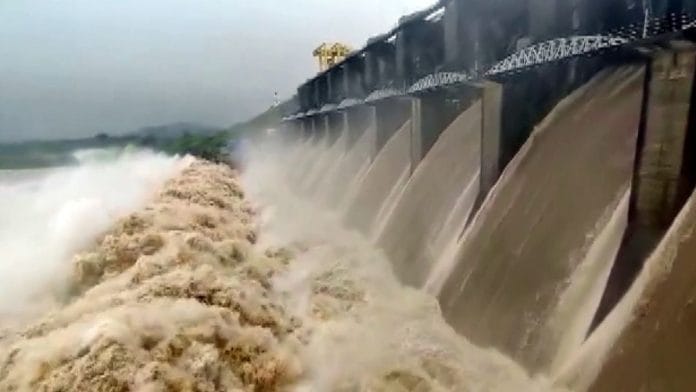


New Delhi: The Ganga’s profound cultural and spiritual significance, an over 100-year-old promise to maintain constant and unfettered flow of minimum 1,000 cusecs in the river, geological fragility and recurrent disaster history of the region, irreplaceable biodiversity, and the largest river basin in the country that nearly supports half the population of India—the Modi government has listed five reasons for not commissioning any new hydro-electric project (HEP) in the upper reaches of the Alaknanda-Bhagirathi river basin in Uttarakhand.
In an affidavit filed before the Supreme Court Tuesday, the Centre said the Alaknanda-Bhagirathi river basin occupies an “incomparable position due to its unique hydrological, ecological and cultural significance in India.”
Hence, this region is wholly distinct from other river basins in the country that have witnessed recurrent natural disasters, including landslides, flash floods, glacial lake outburst floods, cloud bursts, glacial avalanches, tunnel collapses, seismic disturbances and land subsidence, it said in an affidavit.
The affidavit, though filed by the Ministry of Environment and Forest (MoEF), reflects the joint stand of three ministries on the issue—MoEF, Ministry of Jal Shakti (MoJS) and Ministry of Power (MoP). The inter-ministerial decision was taken after an extensive study of two reports—one of an expert body constituted in 2015, which said that 28 projects could be allowed in the Alaknanda-Bhagirathi basins. and the other a top court-appointed committee set-up in 2024 that allowed only five HEPs.
The seven HEPs mooted by the Centre are Tehri Stage-II (1000 MW), Tapovan Vishnugad (520 MW), Vishnugad Pipalkoti (444 MW), Signoli Bhatwari (99 MW), Phata Byung (76MW), Madhmaheshwar (15 MW) and Kaliganga-II (4.5 MW). Four of these have been commissioned for operation, and three are in advanced stages of construction.
“The headstream zone of the Alaknanda-Bhagirathi basin is characterised by sui-generis combination of seismic, glaciological, geomorphological and hydrological factors that distinguishes it from other river systems of the country. The region continues to witness recurrent natural disasters,” the affidavit submitted, seeking the court’s permission to proceed with the seven HEPs even as it said that no other new project shall be undertaken in the region in future.
The Centre’s affidavit comes in response to top court’s January 2026 direction, asking it to take a final decision on the status of HEPs in Uttarakhand within three months. The bench had specifically asked the Centre to file a common affidavit, reflecting the “considered, collective and consensus position of three ministers concerned”.
The Supreme Court has been monitoring this matter since 2013, in the aftermath of the Uttarakhand flash flood tragedy. It then halted construction and operations of all new HEPs in the state. Since then, the government has constituted three committees to examine the question of starting new HEPs on the Ganga and study their impact.
In 2022, the government had informed the court about backing seven of the 28 proposed projects, but the apex court had questioned this decision. In August 2024, the Supreme Court constituted a committee comprising the Cabinet secretary, Centre, MoEF, Secretary, MoP, Secretary, MoJS, and the Chief Secretary of Uttarakhand, asking them to consider the 2015 recommendations of the expert body. The Centre, it directed, shall then take a decision with regard to the recommendations. Within a month this committee submitted its final recommendations to the MoEF.
The affidavit also provided an insight into the deliberations held on the expert body’s recommendations as well as the court-appointed committee’s suggestions. On Wednesday, a bench led by Justice Pankaj Mitha perused the affidavit and fixed 21 August for further hearing.
Also Read: No training, early warning or emergency exits, claim workers at Rishi Ganga & Tapovan projects
‘Special treatment needed’
The affidavit reveals that MoJS had shunned both the reports, observing the overall health of the Bhagirathi and Alaknanda river system would be severely impacted by these projects. The Ganga, it said, requires special treatment, and geological and ecological integrity needs to be maintained for the Alaknanda-Bhagirathi basin, which is the headstream for Ganga and is critical for supplying food nutrients and critical biodiversity to the riverine ecosystem.
The MoEF supported the MoJS during the internal deliberations, noting the expert body did not take into account significant impact of HEPs on the fragile ecology of the Upper Ganga Basin region such as possible landslides, flash floods, glacial lake outburst flood, seismic activities and geological factors. The affidavit claimed both the government-appointed expert body and court-appointed committee had not “adequately factored critical geological and disaster-related parameters”.
Acknowledging the benefits of HEPs and its positive contribution to ecological stabilisation as well as reduction of greenhouse gas emissions, the affidavit talked about Centre’s commitment to development of hydropower potential. But the same, it said, would be implemented based on the terrain and conditioned by site-specific environmental, geological, hydrological, ecological, social, cultural and policy attributes of that basin.
As far as the Alaknanda-Bhagirathi basin is concerned, the affidavit said, this region is the principal headstream of the Ganga, the largest river basin of the country supporting nearly half the population of India, and is critical for the supply of food, nutrients and biodiversity inputs to the river system. Moreover, the 1916 Haridwar agreement between the government, princely states and eminent social leaders promises to maintain a constant unfettered flow of Ganga at 1,000 cusecs. Construction of HEPs would disturb this arrangement.
On Ganga’s profound cultural and spiritual significance, the affidavit stated that the five prayags lie within the basin, as do the char dhams. Both give a cultural and spiritual identity to the nation with millions of pilgrims visiting these sites annually. Therefore, protection of this region is not an “obligation arising not only from environmental considerations, but also from the cultural and spiritual heritage of the nation”.
The affidavit listed out the recurrent environmental tragedies that have taken place in the region between 1991 and 2025 to highlight the geological fragility and recurrent disaster history of the place, maintaining that disasters here are not episodic but persistent.
Besides, the region, it said, is a host of critical, irreplaceable riparian and aquatic biodiversity, including endangered and Schedule-1 species. There are national parks here as well as a United Nations Educational, Scientific and Cultural Organisation World Heritage Site in this ecologically fragile area.
(Edited by Nardeep Singh Dahiya)
Also Read: Chinese checkers: India readies masterplan to draw 65 GW hydropower from Brahmaputra basin