





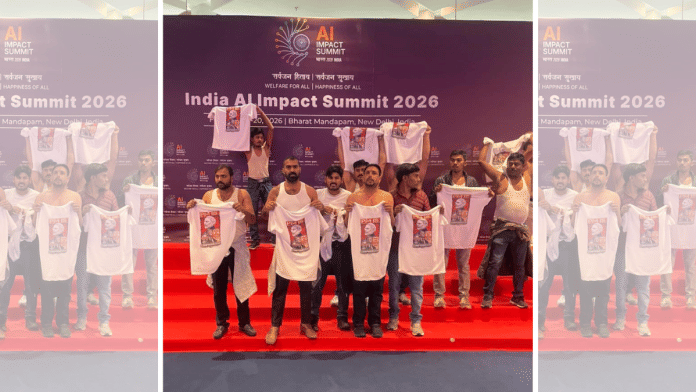



New Delhi: The Indian Youth Congress protest at the AI Impact Summit was a symbolic political critique and not an organised crime, a Delhi court said, granting bail to nine IYC workers who had demonstrated at Bharat Mandapam.
Krishna Hari, Narshimha Yadav, Kundan Kumar Yadav, Ajay Kumar Singh, Jitendra Singh Yadav, Raja Gurjar, Ajay Kumar Vimal alias Bantu, Saurabh Singh and Arbaz Khan—IYC members—were arrested after they had put up a shirtless protest 20 February at the AI Summit.
“The protest, at highest, constituted symbolic political critique during a public event: T-shirts with leadership imagery, non-inciteful slogans bereft of communal/regional taint, and transient assembly,” Judicial Magistrate First Class (JMFC) Ravi of the Patiala House Court said in his order Sunday evening.
No evidence, the order said, disclosed property defacement, or delegate panic.
“Mere executive embarrassment or policy dissent falls within ‘tranquillity’ disruption, not disorder,” it added.
The act was “political dissent”, not “recidivist violence or organised crime”, the court said.
The IYC workers booked under Sections 196 (promoting enmity, hatred, or disharmony between different groups based on religion, race, language, or caste), 197 (Imputations, assertions prejudicial to national integration) and 3(5) (common intention) of the Bharatiya Nyaya Sanhita (BNS) among others.
The judge held that none of the penal provisions carries imprisonment exceeding seven years.
The IYC workers have already undergone police custody of 11-12 days, the court said, adding that there was “no lacuna warranting prolongation” of their custody.
“No physical recoveries of contraband or material objects remain pending; the digital trails are institutional in nature, preserved through forensic backups and cloud repositories, rendering remote tampering implausible…,” it observed.
Prolonged pre-trial detention, bereft of any investigative necessity, violates the right to liberty under Article 21 of the Constitution, the judge said.
On flight risk of the nine IYC workers, the judge said that the applicants had disclosed their addresses and had cooperated post-arrest.
Last week, the arrest of Arbaz Khan and two others in Shimla led to a stand-off between the Delhi and Himachal Pradesh Police that lasted over 15 hours. A kidnapping case was registered against unidentified officers from the Delhi Police. Later, the officers received clearance from the court to leave for Delhi early Thursday with the accused in custody
In its contention, the Delhi Police informed the court that another accused Sidharth Avdhoot appears to be the principal planner and organiser of the protest.
“Saurabh Singh and Arbaz Khan are active participants in the protest inside Bharat Mandapam and part of the coordinated assembly near Google stall,” it added.
Their custodial interrogation, it said, is necessary to “ascertain the origin of conspiracy, approval mechanism within organisation, role of senior functionaries, chain of command and decision making.”
Furthermore, the police argued that police custody is required for confronting the group with other accused persons, their versions and digital evidence.
“It is required for identification of the printing press, recovery of printing bills, payment records, digital communication and source of funds for printing etc. Several participants in the conspiracy are still absconding and the accused are required to disclose their whereabouts,” the Delhi Police’s counsel said.
“The funding sources, travel arrangements, hotel bookings and printing arrangements of T-shirts are yet to be fully unearthed. The alleged offence was not spontaneous but carried under pre-decided signal and coordinated execution including concealment tactics and post-event evasion strategy. The complete conspiracy is yet to be fully uncovered,” the police contended.
(Edited by Tony Rai)