





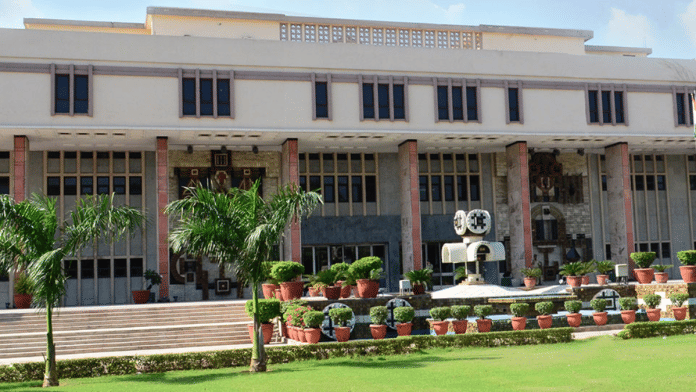

New Delhi: The Delhi High Court Wednesday stayed a Central Board of Direct Taxes (CBDT) memo that denied income tax exemption on certain allowances to Supreme Court and High Court judges who opted for the new tax regime, in an interim order.
The decision came on a plea challenging a September 2025 Office Memorandum issued by the CBDT that sought to curtail these long-standing benefits.
The memorandum stated that under the new tax regime (Section 115BAC of the Income Tax Act, 1961), certain allowances—including rent-free official residence, conveyance allowance, sumptuary allowances and Leave Travel Concession (LTC)—provided to judges would no longer be exempt.
The CBDT’s rationale was that the new regime offers lower tax rates in exchange for the removal of almost all deductions and exemptions.
The Delhi Tax Bar Association challenged this view, arguing that these are not mere “deductions” but statutory exclusions under the High Court Judges (Salaries and Conditions of Service) Act and the Supreme Court Judges (Salaries and Conditions of Service) Act, which should remain outside the tax net regardless of the tax regime.
The CBDT maintained that allowing judges to claim these statutory exclusions alongside the new regime’s lower tax rates would result in an improperly low taxable income.
Representing the petitioners, the Association argued that the allowances in question are protected by specialised legislation. Specifically, they pointed to Section 22D of the High Court Judges Act, 1954, and Section 23D of the Supreme Court Judges Act, 1958, which explicitly state that these perks shall not be included in the computation of a judge’s “salary” income.
Earlier this week, a sitting judge of the Allahabad High Court, Justice Sandeep Jain, had approached the high court challenging the denial of exemption of statutory allowances from his total income under the new tax regime. His plea is posted for the state government’s response on 28 July, as Justice Saumitra Dayal Singh and Justice Swarupama Chaturvedi of the same high court issued notice to it.
Constitutional stakes and judicial independence
The petitioners contended that the CBDT’s move is not merely a tax clarification but a violation of Articles 125 and 221 of the Constitution, which guarantee that the salaries and allowances of Supreme Court and High Court judges cannot be altered to a judge’s disadvantage after their appointment.
To place the locus of the Bar Association in this case, it emphasised that its members, who advise judges on tax and investment matters, are deeply concerned about the dignity and independence of the overall judiciary. They argued that regardless of the introduction of new tax regimes in the Income Tax Acts of 1961 or 2025, these specific judicial allowances must remain outside the “tax-net”.
A pivotal legal argument raised during the hearing focused on the unique language used in judicial service statutes. Unlike typical exemptions found in the Income Tax Act, the High Court and Supreme Court Judges Acts use a non-obstante clause, stating that “notwithstanding anything contained in the Income-tax Act”, these allowances shall not be included in the computation of income.
In an interim order passed Wednesday, the High Court Bench of justices Dinesh Mehta and Rajneesh Kumar Gupta, in its prima facie view, agreed with this distinction, noting that an amount that is never included in the income computation to begin with cannot be legally classified as a “deduction” or “exemption” that would be barred under the new regime.
The court was also informed of practical difficulties with the government’s e-filing software— Returns Preparation Utility. Currently, the software does not provide a specific “drop box” or facility to claim these judicial exclusions if a judge opts for the new tax regime, the court was told.
To address this, the court directed that judges may file or revise their returns by reflecting these allowances under the category of ‘Receipts not in the nature of income’ within the ‘Exempt Income’ section of the dashboard.
Current status of tax returns
Ensuring judicial propriety and considering that this decision in this matter would affect the Bench as well, Justice Rajneesh Kumar Gupta disclosed he had already filed under the new regime without claiming these exemptions, while Justice Dinesh Mehta stated he would file under the old regime to ensure the decision remains impartial.
The court has ordered that returns filed by High Court and Supreme Court judges following these instructions shall not be processed by the tax department until further orders. The matter is scheduled for further consideration on 3 September.
(Edited by Gitanjali Das)
Also Read: Why govt is opposing a same-sex couple’s plea for spouse tax benefits in Bombay High Court