





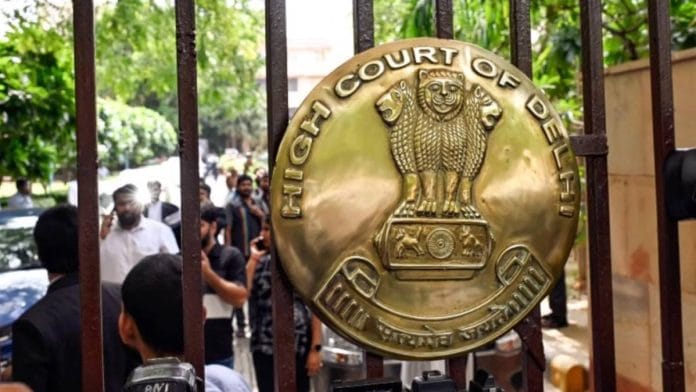


New Delhi: Stating that the right to reproductive autonomy must be remembered as a fundamental right, the Delhi High Court this week allowed an Indian Army officer’s sperm to be extracted and preserved, in the absence of his explicit written consent. The officer is currently in a vegetative state following an accident.
In doing so, the bench of Justice Purushaindra Kumar Kaurav said the absence of written consent by the officer would not disqualify him from In vitro Fertilisation (IVF) procedure.
“It is destiny that determines whether or not the fortune of parenthood shall get bestowed upon persons. This court ought not to interdict the fate of the petitioner,” it added, by insisting from the officer something which is “physically impossible and impracticable”.
The officer, who had joined the Indian Army in 2014, suffered a traumatic brain injury after falling from a considerable height last July, when he was posted in Doodh Ganga, Jammu & Kashmir. The incident happened when he was patrolling in an operational area.
The officer’s wife subsequently approached the court for extraction and cryopreservation of his genetic material. Cryopreservation refers to the freezing and storing of gametes (sperms), zygotes, embryos, ovarian and testicular tissues, according to the Assisted Reproductive Technology (Regulation) Act, 2021, or ART Act.
In her plea, she stated that the couple had got married in March 2017, and about six years later, opted for assisted reproduction with an IVF procedure. Such procedures involve an egg fertilised by a sperm outside the body, in a laboratory dish.
By way of her plea, the soldier’s wife argued that the ART Act, along with Article 21 of the Constitution, which relates to right to life, includes the right to motherhood, dignity and reproductive autonomy.
Pointing to her husband’s “unblemished” career, she said that during his long army service there were no adverse remarks made in relation to his commitment. Moreover, he also had a meritorious record, she said.
However, in July 2025, after suffering the traumatic fall, he went into a persistent vegetative state, even after undergoing surgery and operation. In light of this, the wife argued that there was no reasonable likelihood or foreseeable scope of his neurological recovery in the near future.
She also pointed out that this February, the Army had granted permission to continue with the IVF procedure, but the treatment was later stopped, causing her to approach the court.
In the case, the Army had argued that there was no “express indication of consent” from the petitioner’s husband.
Also Read: In light of Delhi HC ruling on reproduction after death, here’s how different countries handle it
High court view
On 9 April, the court passed an order recording the Indian Army’s submission that a medical board consisting of neurology, neurosurgery, critical care and reproductive medicine specialists for comprehensive evaluation should be composed, so that a final opinion can be rendered on the sperm-retrieval aspect in the case.
While hearing the matter Monday, the court was informed about proceedings before the Board of Officers of the Army Hospital, Delhi Cantonment, on this matter, which stated that since the officer had suffered a traumatic brain injury, he lacked decision-making capacity and the ability to give informed consent, which is a requirement for any procedure under the 2021 Act.
The opinion of the board was said that even if sperm was retrievable, chances of it being viable were meagre.
Section 22(1)(a) of the ART Act mandates the written “informed” consent of all parties seeking assisted reproductive technology. Without this, clinics are not allowed to perform any treatment or procedure, the court noted.
However, taking cognisance of the fact that the army officer and his wife had together volunteered for IVF treatment prior to his injury in 2025, the court said that “a conclusion can, therefore, be safely drawn that the petitioner’s husband consented for undergoing the IVF treatment” and there was no evidence pointing to the contrary.
“The parties, at the relevant point of time (2023), may not have visualised/foreseen the unfortunate incident which had occurred in the month of July 2025,” the court said in its order Monday.
Although the officer’s consent was not explicitly present, the court noted that under the facts and circumstances of the case, it was “fair, reasonable, and just” to take the IVF treatment to its logical conclusion.
The court also made it clear that the objective of the ART Act is to address issues of reproductive health where assisted reproductive technology is required for becoming a parent, or for freezing gametes, embryonic tissues for further use due to infertility, disease or social or medical concerns, and for regulation and supervision of research and development.
Section 22 of the Act simply provides the mere procedure to address the broader more fundamental problem which is being faced by the citizens, the court said.
Making it clear that procedure is the handmaiden of justice, the court ruled: “Non-compliance with the bare, strict, text of a procedural provision, destroying the substantive intent of the legislation, ought not to be countenanced.”
Similar rulings earlier
This is not the first time that the legality of cryopreservation procedures has been placed before the courts.
In a similar case last month before the Kerala High Court, it was noted that the petitioner’s husband was brain-dead and kept alive with ventilator support. While granting relief, the court allowed the extraction and cryopreservation of gametes in the case.
Similarly, in October 2024, the Delhi High Court allowed an elderly couple to get custody of the frozen sperm of their deceased son, who had passed away due to Non-Hodgkin’s lymphoma, a form of cancer, so that they could continue his legacy.
(Edited by Nida Fatima Siddiqui)