



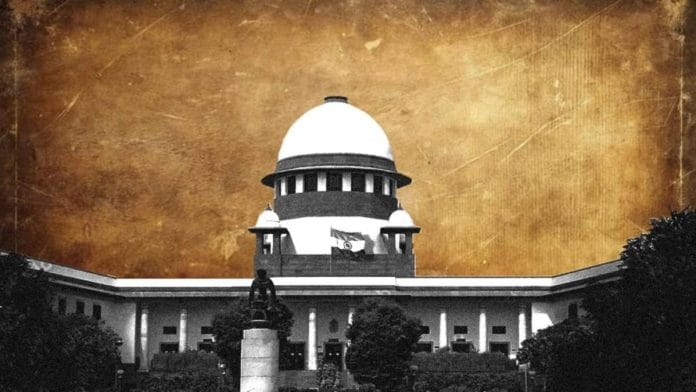

New Delhi: The Supreme Court on Wednesday set aside the compulsory retirement of an Indian Trade Service (ITS) officer, observing that his removal was “arbitrary, perverse and driven by malice”. To restore the officer’s reputation, the court asked the Directorate General of Foreign Trade to give him a farewell ceremony befitting his post. It also awarded him Rs 9 lakh as compensation for loss of reputation and Rs 6 lakh as costs.
The officer, SS Das, joined the Indian Trade Service in 1989 and rose to Deputy Director General, Joint Director General and eventually Additional Director General of Foreign Trade. In November 2017, he was elevated to the post of Joint Secretary after being selected for the Senior Administrative Grade. The promotion was formally regularised on 27 February, 2018.
Barely 10 weeks later, he was retired from service. He was served the retirement order on 10 May 2018, under a rule that allows the government to compulsorily retire officers in “public interest” without recording formal misconduct charges. Das had five years of service left at the time.
Das first challenged the order before the Central Administrative Tribunal (CAT) and, after losing there, moved the Delhi High Court. Both ruled in favour of the government, observing that the review committee had flagged concerns about his integrity and conduct. A confidential note alleging that Das had sought “favours” from industry representatives during anti-dumping investigations was cited in the decisions.
The Supreme Court, however, dissected Das’s service file and examined his Annual Confidential Reports and Annual Performance Appraisal Reports from 1994 to 2017 and found that the government’s “deadwood” assessment of the officer was in contradiction with his conduct.
His service records showed that he had been graded outstanding or scored 8 or above out of 10 in nearly every reporting year. There was one exception in 2014-15, when his appraisal noted that “there is room for improvement”. His score that year was still 8.75 out of 10 and rose to 9.6 the following year. This, the court said, showed that his integrity was not a concern.
The court also questioned the government’s core argument which was based on a 2017 confidential note by a former Additional Secretary alleging that Das had solicited favours from industry players. The court found the note “not worth the paper it had been written on”. It observed that its author had admitted there was no complaint or evidence to support the allegation. This prompted the bench to question whether the note was written to protect departmental interests or to serve outside industry interests unhappy with Das’s decisions.
The two actions—first promoting Das to Joint Secretary and then branding him “deadwood” weeks later—were “mutually destructive”, the court observed.
His promotion was merit-based and indicated that his service record was sound. Reversing that assessment on the basis of unrelated, decades-old and unsubstantiated material, it said, pointed to a pre-decided outcome rather than a genuine reassessment.
The judgment also pointed to a procedural irregularity. The same official who had signed the original retirement order later sat on the Representation Committee that reviewed and rejected Das’s appeal. The court described this as a potential conflict, invoking the principle of “nemo judex in causa sua” (no one should be a judge in their own cause).
As Das had crossed the age of superannuation, the top court could not order his reinstatement. It instead directed the government to extend all service benefits he would have received had he remained in service, including notional promotions granted to his juniors during the intervening years.
Since the court declared the compulsory retirement order arbitrary, it gave the government liberty to recover the Rs 15 lakh awarded to Das from the individual officials responsible for the abuse of their official power, even if some are no longer in government service.
The judgment is notable not only for its strong criticism of the arbitrary decision but also for the granular scrutiny of Das’s service record, including his Annual Confidential Records.
(Edited by Chingkheinganbi Mayengbam)