





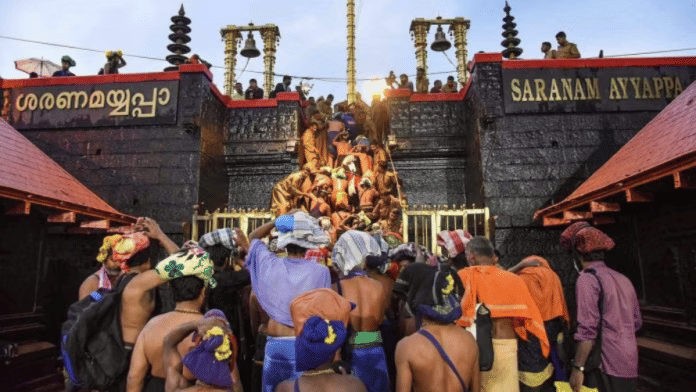



New Delhi: Opposing the entry of women of reproductive age into the Sabarimala temple, the Travancore Devaswom Board (TDB) has told the Supreme Court that courts should not interfere in matters of deep-seated faith.
Resting its case on the unique celibate nature of the deity and the autonomy of religious denominations, the temple management board argued that the restriction on women aged 10 to 50 is an “ancient and essential custom” linked to maintaining the “purity of the idol/deity” in this specific form.
A nine-judge Supreme Court bench will begin hearings on 7 April to review a five-judge Bench’s 2018 verdict in the Sabarimala case, which held that banning the entry of women in their “menstruating years” was unconstitutional. The top court allowed women of all ages to enter the temple.
The verdict triggered mass protests, hartals, and even violence led by sections of devotees, who viewed the judgment as an attack on faith. A batch of review petitions has kept the matter legally open.
The 7 April review stems from a Public Interest Litigation (PIL) filed by the Indian Young Lawyers Association challenging the age-old custom.
In the submissions to the top court, the board’s primary justification for the restriction is the specific character of the deity, Lord Ayyappa. Unlike other Ayyappa temples, according to it, the Sabarimala deity is worshipped in the form of a “Naishtika Brahmacharya”, or a perennial celibate student.
The board contends that the deity’s “great powers” are derived from “ascetic endeavours” and a strict “abstention from sexual activities”.
This religious requirement extends to the devotees, who must undergo a rigorous 41-day “vratham” (penance) involving abstinence and self-denial to “purify the human mind and body” before the pilgrimage.
On 2 March, the TDB also passed a resolution opposing the 2018 Supreme Court verdict permitting women of menstruating age to worship at the Sabarimala Temple.
A significant portion of the board’s opposition targets the “essentiality test” often used by courts to determine which religious practices deserve constitutional protection. The TDB argues that the beliefs of a community must be judged by its “subjective belief” rather than an “external, objective test” imposed by secular judges.
“A secular Judge is bound to accept that belief and it is not open for him to sit in judgment on that belief,” the board said, further warning against “rationalising religion”, a process it said falls “outside the ken of Courts”.
According to the board, as long as a practice does not violate public order, health, or morality, the state has no power to restrict it simply because it may seem “irrational or superstitious” to outsiders, essentially challenging judicial “rationalisation” of faith.
The board’s submissions were by senior advocate and Congress Rajya Sabha MP Abhishek Manu Singhvi, filed by Advocate-on-Record P.S. Sudheer.
Also Read: Sabarimala administration is stuck in the 1960s
Classification vs. gender discrimination
Addressing the argument that the ban violates the right to equality under Article 14 of the Indian Constitution, the board argued that the restriction is a “classification” based on age and physiological characteristics, not a blanket act of gender discrimination.
It added that women below 10 and above 50 are permitted entry, meaning no absolute prohibition exists against women as a whole.
The board maintained that this classification is linked to the temple’s specific religious objectives of “abstinence, celibacy, purity and self-denial”.
It further distinguished this practice from the practice of untouchability addressed by Article 17, noting that Sabarimala is otherwise egalitarian, welcoming all castes, creeds and even non-Hindus.
The TDB said that Sabarimala constitutes a religious denomination under Article 26 of the Constitution, granting it the fundamental right to manage its own affairs in matters of religion.
It added that the right of a denomination to manage its religious affairs is “wider and stronger” than individual rights and should prevail in cases of conflict.
Finally, the board raised a procedural objection to the PIL that sparked the case, contending that “non-adherents” who do not subscribe to the faith should not have the locus standi to question its internal practices.
The TDB asserted that allowing outsiders to challenge religious traditions through a PIL could “damage… the Constitutional and secular fabric of this country” and permit individuals to “hurt the religious sentiments of many others” without being personally affected by the practices they seek to overturn.
(Edited by Sugita Katyal)
Also Read: Poll season on horizon, Sabarimala gold ‘theft’ stirs the pot in Kerala. UDF takes on ruling LDF