







New Delhi: The Mines and Minerals (Development and Regulation) Amendment Bill, 2026—now passed by Parliament—clarifies that royalty under the MMDR Act, 1957, is itself a tax on mineral rights, leaving no scope for states to impose additional levies under Entry 49 (land tax) or Entry 50 (mineral rights tax).
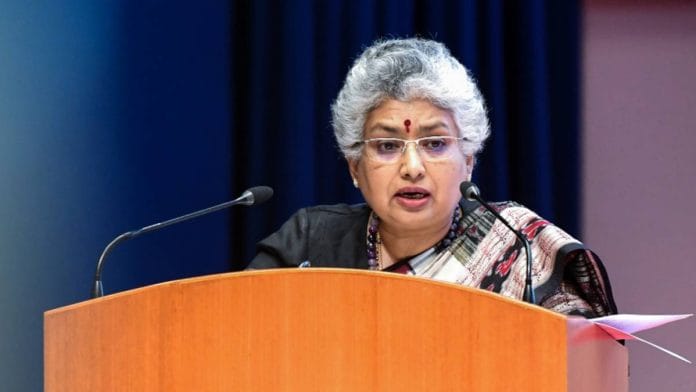
In doing so, it echoes the dissenting opinion of Justice B.V. Nagarathna, who had cautioned that overlapping state taxes would fragment fiscal policy, encourage unhealthy competition and amount to double taxation.
In a 2024 Supreme Court case on mineral taxation, a nine‑judge bench was set up to decide whether royalty, or the payment made by a mining lessee to the state, under the MMDR Act was a tax.
The majority, except Justice B.V. Nagarathna, ruled that royalty is not a tax but a payment made by the mining lessee to the state for the right to extract minerals.
Since the majority held that royalty was not a tax, states could still levy taxes on mineral rights. It also held that mineral‑bearing land counts as “land” under Entry 49, allowing states to impose land tax on it.
Delivering a divergent view, Justice Nagarathna said mineral‑bearing land cannot be taxed twice. She held that under the MMDR Act, 1957, royalty is already a tax on minerals extracted, fixed by Parliament. States, therefore, cannot also treat the same land as ordinary land and impose another tax.
According to her, taxation entries are meant to be mutually exclusive. Mineral‑bearing land falls only under Entry 50—tax on mineral rights, subject to Parliament’s law—and not Entry 49. If both were applied, it would amount to double taxation, which the Constitution does not allow.
Justice Nagarathna said that royalty is itself a tax, because Sections 9 and 9A of the MMDR Act, 1957 make it a statutory levy.
States can tax ordinary land, including agricultural, non‑agricultural, or land with buildings, but not mineral‑bearing land because it is already covered by Parliament’s law under the MMDR Act.
She emphasised that royalty is a tax fixed by law, not by private negotiation by the lessor (often the government) or lessee (the mining company or individual who obtains the lease to extract minerals from that land).
So, instead of two layers of taxation (royalty plus state tax), she argued that royalty already counts as tax and Parliament’s law limits states from adding more.
‘Unhealthy competition’
Justice Nagarathna explained that states with large mineral reserves cannot tax mineral‑bearing land in ways that harm national interests.
She warned that if states were allowed to freely impose their own levies on minerals, it would lead to uneven and haphazard mineral development, with each state competing to raise revenue.
“This ‘race to the bottom’ would facilitate unhealthy competition between the States to derive additional revenue and consequently, the steep, uncoordinated and uneven increase in cost of minerals would result in the purchasers of such minerals coughing up huge monies, or even worse, would subject the national market to being exploited for arbitrage,” she added.
She cautioned that a steep increase in prices of minerals would result in a hike in prices of all industrial and other products dependent on minerals as a raw material or for other infrastructural purposes.
As a result, the overall economy would be affected adversely, which may result in certain entities or even non-extracting states resorting to importing minerals, which would put pressure on the country’s foreign exchange reserves.
She said that is why the Constitution gave Parliament supremacy over mineral regulation. The division of powers between the Union List and State List was designed to ensure uniform mineral development across the country, not fragmented policies by individual states acting only for themselves.
Alfreza Ahmed is an alum of ThePrint School of Journalism, and an intern with ThePrint.
(Edited by Sugita Katyal)