





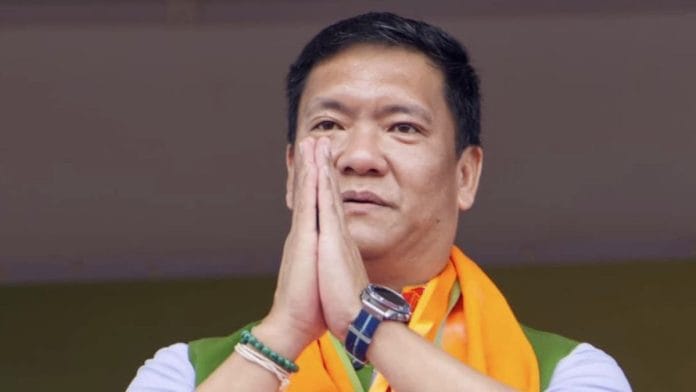



New Delhi: The Supreme Court has directed the Arunachal Pradesh government to file a “comprehensive affidavit” with details of work contracts awarded to Chief Minister Pema Khandu’s family and their firms across districts over the past 10 years, amid long-standing allegations that these contracts were granted without following the tender system.
The directive came Tuesday after the Save Mon Region Federation, an organisation representing the indigenous Monpa community, informed the court that a government affidavit in response to an earlier 18 March order only covered the properties in the Tawang region and excluded other areas where the chief minister’s family and companies may have been awarded contracts.
Taking note of the details, the court said the statistics were “telling” and added that “the coincidence is absolutely remarkable”.
A two-judge Supreme Court bench listed the matter for hearing in February next year.
The government denied allegations that government contracts were awarded to the CM’s family, and informed the Supreme Court in an affidavit that boosting employment opportunities in the state’s traditional tribal economy was one of the major objectives of awarding government contracts to locals.
“The historic development of the transition of Arunachal Pradesh from a predominantly tribal way of life to a modern day state justified the adoption of the system of allotting government contracts without following the tender system,” it said in response to allegations of awarding the CM’s family government contracts without following the tender system.
Arunachal govt’s response
In its response, Arunachal Pradesh said that government departments had conducted a detailed exercise in Tawang district and all contracts awarded to Pema Khandu, his brother Tsering Tashi, or to firms related to them, were compiled and presented before the court.
The allegations, it said, were related to only one district in Arunachal Pradesh, i.e., Tawang.
According to the affidavit, almost 95 percent of the contracts were awarded to firms or individuals related to Khandu or Tashi through an open tender process, after evaluating technical and financial bids. Based on the review, there could be no allegations of undue favours to the firms and individuals related to the Khandu family, it said.
The government told the court that Arunachal Pradesh had been following a “work order system” to award government contracts since the beginning and would continue with the practice in the larger interests of the employment of local villagers and contractors.
It added that even work that does not require special and technical know-how is awarded through a “work order”.
The government cited the Arunachal Pradesh District Based Entrepreneurs and Professional Incentive Development and Promotional Act, 2015, under which contracts costing up to Rs 50 lakh that do not require special technical knowledge can be given through such orders.
Underlining the necessity of adopting such a system of awarding contracts, the government said that Arunachal Pradesh is a tribal state with a predominantly tribal population.
Arunachal Pradesh remains one of the country’s most backward states, with an urgent need to develop infrastructure, roads, and educational institutes to reduce its isolation and dependence on others.
The government said efforts have been made to modernise the state through education, employment and other measures, including by awarding government contracts to locals, which helps boost employment opportunities in the state.
However, because the state has few people capable of executing such contracts, they were allotted to local tribes without strictly following a tender system, the government said. It also emphasised that the state’s tribal society was still in a transitional stage.
“The situation and sequence of events in Arunachal Pradesh is vastly different from any other state, and therefore the allegation of not adhering strictly to a tender system has to be looked at from a totally different perspective,” the affidavit said.
Mere allegations of not adhering to the tender system did not by themselves indicate favouritism, nepotism and corruption among the government officials or political leadership, the state added.
The government also said that the petitioners deliberately duplicated the same work in different annexures to mislead the court about the “false enormity” of the contracts.
Crux of the allegations
The origins of the plea date back to when the late Dorjee Khandu, Pema Khandu’s father, was the cabinet minister heading the state’s Department of Relief, Rehabilitation and Disaster Management in 2002-2003.
Nearly seven years later, when Khandu became chief minister, the petitioners approached the court with a PIL seeking an inquiry into alleged corruption and illegalities in the handling of food grains under the Sampoorna Grameen Rozgar Yojana, a 2001 Central government scheme to provide additional wages, employment, infrastructure, development and food security in rural areas.
According to the plea, between March 2003 and 2004, over Rs 3 crore allotted by the National Calamity Contingency Fund, for the restoration of roads, minor irrigation projects and land protection schemes, was misused and misappropriated.
It also alleged that false bills were raised for 24,8000 metric tonnes of rice allotted to the state under the 2001 scheme.
The plea filed by NGOs like the Save Mon Region Federation and Voluntary Arunachal Seva, also claimed irregularities in relief, rehabilitation and disaster management schemes. It alleged that 14 district rehabilitation officers, 16 assistant mineral development officers and other staff, like peons and drivers, were illegally appointed.
While these officers were appointed on a contract basis initially between 2003 and 2004, their appointments were regularised later. The plea also claimed that, when Dorjee was Minister of the Department of Mines and Minerals, 14 posts were allegedly created through an executive order, and illegal appointments were made.
The plea requested a Central Bureau of Investigation (CBI) or a Special Investigation Team (SIT) probe into the awarding of public work contracts to the family of the late chief minister, including his second wife, Rinchin Drema.
Previously, in March, and then again in May, the Supreme Court sought “clear-cut answers” from the Central government and the Arunachal Pradesh government in response to allegations of awarding government contracts to Pema Khandu’s family members.
Back then, a three-judge bench, led by then CJI Sanjiv Khanna, sought details of who the contracts were awarded to and the final report of the Comptroller and Auditor General (CAG) of India in the matter.
Before this, in March 2024, a bench of Justices Aniruddha Bose and Bela Trivedi disposed of the matter, while directing the CAG to examine the allegations.
However, in March, the Khanna-led bench, also comprising Justices Vikram Nath and Sandeep Mehta, said that the CAG report was “neither here nor there”, and that another final report must be submitted in this case.
(Edited by Sugita Katyal)
Also Read: ‘Don’t develop Arunachal, China could use’: IRS officer opens up on Delhi mindset