



New Delhi: The Delhi Metro Rail Corporation (DMRC) has denied any violation of Supreme Court’s 9 October order that said Delhi Police notification on closure of metro services for 10 October appeared overreaching as it imposed a complete ban on essential public transport.
The SC order directed that metro services be regulated in a proportionate manner and that such a decision should be given wide publicity.
In its 23-page affidavit, the corporation said its services remained operational on 10 October and only 45 of 303 stations were closed for entry and exit. There was no curtailment of services and 271 trains completed all 157 scheduled trips that day.
The ridership of Metro, however, saw a significant drop on 10 October. About 32 lakh passengers travelled that day against roughly 58 lakh on a normal second Saturday. This drop was attributed to the protest, due to which, the affidavit claims, commuters opted to stay at home that day. The drop was not on account of metro shutdown, it asserted.
The affidavit is DMRC’s response to the contempt notice issued to it Sunday when the top court held a special sitting to hear a batch of contempt petitions, accusing the authorities of non-compliance of the court’s 9 October order. The top court is scheduled to hear these matters Thursday and the response of the Delhi Police is also expected to be filed later that day.
Importantly, the affidavit, filed by D. Thara, secretary of Department of Capital Development, Union Ministry of Housing and Urban Affairs, starts with an unconditional apology and claims the 9 October order was passed ex-parte and was never served to the DMRC.
The 9 October order, it said, was based on a representation (of the petitioners) that there was a complete ban on the public transport. According to the affidavit, the Delhi Police notification, issued on 8 October, did not impose a complete closure on metro operations. The notification talked about closure of exit and entry gates at 57 stations and was based on law enforcement agencies’ own assessment.
However, 10 October, the restrictions were reduced subsequent to a modified police communication. The number of stations where entry and exit remained shut for metro users was brought down from 57 to 45. Even these stations were reopened at 10 pm on 10 October itself, the affidavit submitted.
As a result of the closure of these stations, only 15 percent of the network was affected as 258 stations stayed fully operational.
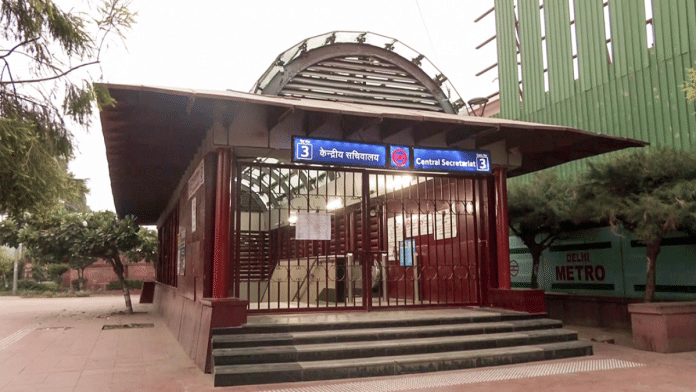
Interchanges at 14 of the 45 stations, including Rajiv Chowk, Kashmere Gate, Central Secretariat, Mandi House, Hauz Khas, Dilli Haat-INA and Netaji Subhash Place continued uninterrupted.
On 12 October, upon receiving police directions, six stations were closed from 6 am to 4 pm. Amongst them, exit gates at two stations, GTB Nagar and Vishwavidyalaya were regulated.
Adequate publicity was given to these directives, the affidavit submitted. Information regarding regulation of the services was shared on various social media platforms and regular audio announcements were made from the operations control centre and by train operators.
Advisory signages were placed at all the metro stations, the DMRC website and the Sarthi app too was updated with the latest details on the closure of entry and exit gates of metro stations.
Ground support too was augmented with extra staff and marshals at major stations for real-time monitoring and coordination with the police.
The affidavit said it acted strictly on the assessments and directions of law enforcement agencies to ensure smooth metro functioning. Regulations and restrictions were subject to their requirements for maintaining law and order.
(Edited by Viny Mishra)
Also read: Delhi under unprecedented security blanket ahead of CJP protest