





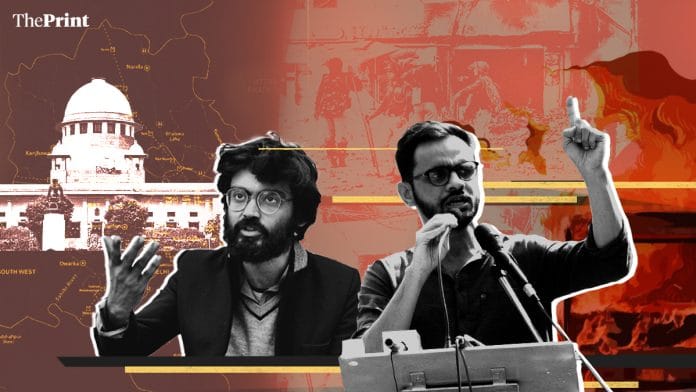



New Delhi: The Supreme Court’s denial of bail to Umar Khalid and Sharjeel Imam in the “larger conspiracy” case behind the 2020 northeast Delhi riots has brought into sharp focus a growing divergence in the court’s bail jurisprudence.
Though the court granted bail to five co-accused, it held in the same judgment that Umar and Sharjeel stood on a “qualitatively different footing”, citing its satisfaction with the prosecution’s charges of their “central and formative role” in the alleged conspiracy.
The top court’s judgment has drawn a sharp distinction between the accused based on their perceived gravity and role. It has, meanwhile, refused to allow the length of the accused’s incarceration—now approaching six years—to tip the scales decisively in favour of their bail.
Emphasising that courts could not dissect evidence at the bail stage, the bench of justices Aravind Kumar and N.V. Anjaria held that the allegations must be assessed “cumulatively” to determine whether those were “prima facie true” under Section 43D(5) of the Unlawful Activities (Prevention) Act.
The bench acknowledged that delay and long incarceration were relevant considerations. However, it clarified that judges did not operate as a “trump card” and were not capable of overriding the statutory bar, once a prima facie case was made.
This approach sits in visible tension with several earlier and equally authoritative Supreme Court rulings under stringent special laws, such as the UAPA and the Prevention of Money Laundering Act (PMLA), where the court has emphasised personal liberty under Article 21, the right to a speedy trial, and proportionality, even in cases involving serious charges.
Against this backdrop, ThePrint examines the Umar–Sharjeel judgment alongside earlier rulings to trace how the Supreme Court’s approach in granting bail under special statutes poses unresolved questions about its bail jurisprudence.
Also Read: ‘Imaginary ghost’: Madras HC slams Tamil Nadu govt while upholding order in lamp lighting row
A counterpoint: Landmark K.A. Najeeb case
In Union of India v. K.A. Najeeb (2021), the Supreme Court granted bail to a UAPA accused who had spent over five years in custody, with Najeeb’s trial still far from completion. The court, then, held that statutory restrictions on bail could not surpass the constitutional obligation of courts to protect personal liberty when incarceration became disproportionate and indefinite.
A three-judge bench of then-justices Aniruddha Bose, N.V. Ramana and Surya Kant—now the CJI—acknowledged in that judgment the seriousness of terrorism but stressed that it cannot justify holding individuals indefinitely without trial.
The court, at the time, held that prolonged detention when a trial was significantly delayed became disproportionate and violated Article 21, the right to life and personal liberty.
The ruling emphasised that the right to a speedy trial was intrinsic to Article 21 of the Constitution, and where there was no realistic prospect of the trial’s conclusion in a reasonable timeframe, continued detention itself became unconstitutional.
Crucially, the top court clarified that Section 43D(5) did not “oust constitutional courts’ powers” to grant bail in such circumstances.
Beyond Najeeb, the Supreme Court has repeatedly underscored that “bail is the rule, jail the exception” even under special statutes.
Sisodia case: Delay & proportionality
Umar-Sharjeel’s bail denial contrasts with the Supreme Court’s August 2024 grant of bail to former Delhi Deputy Chief Minister Manish Sisodia in the corruption cases that the CBI and ED had been investigating.
In Sisodia’s case, the court squarely held that his prolonged incarceration of over 17 months, without his trial commencing, was a violation of his fundamental right to liberty and to a speedy trial under Article 21 of the Constitution.
Umar and Sharjeel have been in jail for over five-and-a-half years.
In Sisodia’s case, a two-judge bench of justices B.R. Gavai and K.V. Viswanathan noted that the “commencement of the trial is yet to see the light of the day”, granting bail to Sisodia in the third round of his bail application.
The bench emphasised proportionality, holding that bail jurisprudence must account for the relationship between the length of custody and the likelihood of the trial’s conclusion. It also cautioned against using detention as a punitive tool before conviction.
While the Sisodia case did not arise under UAPA, its constitutional reasoning placed delay at the very center of his bail analysis.
Also Read: Why court junked Punjab Police DIG’s bail plea, ruled ‘posting can’t determine CBI jurisdiction’
A contrast: 2024 Sheikh case
The Supreme Court’s refusal to grant bail to Umar Khalid and Sharjeel Imam again directly contrasts its July 2024 ruling in Javed Gulam Nabi Sheikh vs Maharashtra. The court, then, placed decisive weight on Article 21 and the right to a speedy trial, despite alleged UAPA offences linked to national security.
Sheikh, as a UAPA accused, had been in custody for roughly four years. His case involved the smuggling of counterfeit Indian currency allegedly sourced from Pakistan—an offence raising national security concerns.
The top court granted him bail, even though the police had already filed the chargesheet, only because his trial had not commenced. It held that the seriousness of offences could not justify Sheikh’s continued incarceration on account of the government’s incapacity to ensure a timely trial.
In Sheikh’s case, a bench of justices J.B. Pardiwala and Ujjal Bhuyan articulated an unambiguous constitutional position, observing that if the government or the prosecuting agency had “no wherewithal” to protect an accused’s fundamental right to a speedy trial, it should not oppose bail merely on grounds that the crime was serious.
The top court categorically held that Article 21 is applicable—irrespective of the nature of the crime—and emphasised that the accused was an undertrial, “not a convict”.
Contrastingly, in the Umar–Sharjeel bail hearing, the Supreme Court admitted long incarceration but refused to treat it as constitutionally determinative.
Unlike Sheikh’s case, where the court foregrounded the government’s failure to commence trial as a reason to release the accused, the Umar-Sharjeel ruling accepts delay as a relevant but, ultimately, not an overriding factor in cases involving alleged conspiracies and public disorder.
Liberty: Principle or exception?
The Supreme Court’s refusal to grant bail to Umar Khalid and Sharjeel Imam departs sharply from its July 2024 ruling in Sheikh Javed Iqbal @ Ashfaq Ansari vs Uttar Pradesh, where prolonged incarceration was treated as constitutionally impermissible, despite grave national security threats alleged.
Iqbal had spent nine years in custody, with only two witnesses examined, in a UAPA case involving the recovery of counterfeit Indian currency worth over Rs 26 lakh near the Indo-Nepal border—an offence of cross-border terror financing and state security.
A bench of Justices J.B. Pardiwala and Ujjal Bhuyan granted him bail, holding that the right to a speedy trial was a fundamental right, traceable to Article 21, and that the seriousness of charges could not justify indefinite pre-trial detention, with “no end in sight” to the trial.
Most notably, the top court categorically rejected the prosecution’s argument that gravity alone could defeat bail, observing that prolonged delay made it constitutionally impermissible to continue incarceration of an undertrial.
Crucially, the judges in the Sheikh Javed Iqbal bail hearing reaffirmed that Section 43D(5) of the UAPA did not “oust the constitutional courts’ power to grant bail” where there is a violation of fundamental rights.
Relying on K.A. Najeeb, the bench in that case held that long incarceration, coupled with the unlikelihood of trial completion, was a valid and independent ground for bail, and that constitutional courts must “lean in favour of constitutionalism and the rule of law” even while interpreting stringent penal statutes.
In that case, the Supreme Court treated Article 21, the right to life and personal liberty, as “paramount and inviolable”, holding that it could override even strict laws that limited bail. It clarified that if prolonged detention violated such a fundamental right, statutory restrictions could not stand in the way of bail.
Contrastingly, in the Umar–Sharjeel ruling, the court treated personal liberty as subordinate to the statutory requirements under the UAPA, with the court’s preliminary view that a conspiracy case does exist.
Also Read: 2020 Delhi riots case: SC distinguishes Umar Khalid & Sharjeel Imam’s role from others to deny bail
A constitutional paradox
A juxtaposition of all the rulings reveals a clear doctrinal divergence arising from the weight accorded to delay once the Section 43D(5) threshold is crossed.
In liberty-centric rulings, the top court had treated delay and stagnation as constitutionally decisive. In the Umar–Sharjeel ruling, however, the court has acknowledged delay but subordinated it to the prima facie satisfaction of statutory conditions. The divergence is not textual but interpretive, arising from how the benches differently weighed liberty against perceived threats to public order and state security.
This difference highlights an unresolved matter in the Supreme Court’s approach to bail in UAPA cases. Is personal liberty a fixed constitutional principle that applies in all cases? Or, does it become secondary and case-dependent, shaped by the seriousness of allegations and concerns about national security?
What distinguishes the Umar-Sharjeel ruling is not merely the denial of bail, but the court’s explicit refusal to allow delay to dilute the UAPA’s bail bar.
The judgment lays bare a constitutional paradox. On the one hand, the Supreme Court continues to affirm that Article 21 is sacrosanct and that personal liberty cannot be lightly curtailed. On the other hand, it permits prolonged pre-trial incarceration to persist where allegations involve conspiracy and national security, even when trials show little sign of an early completion.
(Edited by Madhurita Goswami)
Also Read: ‘Terror’ under UAPA not just conventional violence—what SC said in denying bail to Umar, Sharjeel
It feels really good to see the frustrated fulminations of the Left-liberal cabal which enabled the rise of anti-India ‘sctivists’ of the likes of Sharjeel Imam and Umar Khalid. It is this very cabal whose patronage allowed such Islamists to rise and challenge the Republic and spew anti-Hindu and anti-Jew venom.