



New Delhi: The Supreme Court, terming the tetra-packaging of alcohol as “very deceptive”, agreed Wednesday to examine the excise policies of different states and lay down uniform guidelines “standardising and harmonising” the policies regarding the bottling of liquor.
A division bench of Chief Justice of India Surya Kant and Justice Joymalya Bagchi was responding to a plea seeking a ban on sales of alcohol in tetra-packs.
“Inconspicuous packaging”, such as tetrapacks, “has the potential to dramatically increase the public consumption of alcohol”, the petition, filed by the NGO Campaign Against Drunken Driving, stated.
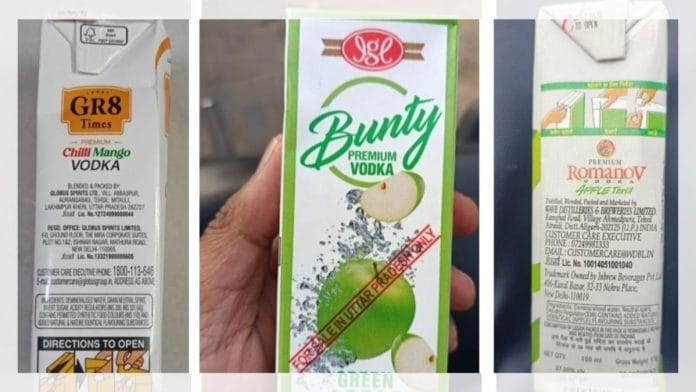
Senior advocate Vipin Nair, representing the organisation, emphasised how “unlike tobacco, there is no warning” for tetrapacks. “These packs are like fruit juices but contain vodka, with pictures of apples, chilli, mango vodka, etc.,” Nair, also the president of the Supreme Court Advocate-on-Record Association, submitted before the bench.
Taking note, CJI Kant called them “very deceptive”.
The bench also issued notices to the Centre and the excise departments of all states, seeking their responses.
Also Read: FSSAI seeks more time from SC to work on front-of-pack labels for foods with high fat, sugar & salt
The petition
The petition detailed how alcohol, particularly cheaper alcohol, was being sold in inconspicuous packaging in various states across India. These could be portable PET bottles, plastic sachets, or tetra-packs. Such packaging, the petition stated, risks increased alcohol consumption among juveniles or in moving vehicles, while making alcohol smuggling and public consumption easier, posing health and environmental risks.
Moreover, according to the petition, alcohol tetra-packs, which have attractive packaging with vivid colours, lack prominent health warnings like those on cigarettes, which could dissuade the public from drunk driving or irresponsible drinking. “The warning, if any, is only in small fine print, which would be hardly visible or discernible to a consumer,” the petition stated.
Such packaging “being deceptively similar to fruit juices, facilitates easy access and concealment, encourages underage consumption, promotes public drinking and drunk driving, and even enables smuggling across state borders”.
The petition also highlighted the alarming labels with which these tetra-packs are marketed—“Bunty Premium Vodka”, “Chelli Mango Vodka”, and “Premium Romanov Vodka–Apple Thrill”—which, the petition said, was “clearly intended to mislead consumers”.
“The use of fruit names alongside colour photographs of apples and mangoes on the packaging further reinforces this deception,” it added.
According to the petition, all these strategies reflect deliberate marketing to pass off alcoholic beverages as fruit juices, evading scrutiny by authorities and targeting underage consumers.
Excise policies
The NGO, Campaign Against Drunken Driving, identifies alcohol in “inconspicuous bottles and packaging” as one of the reasons for drunk driving and public nuisance due to drinking. It “entices underage drinkers” while keeping production costs low, and such cheap alcohol also becomes “an affordable consumable” for drivers of commercial vehicles.
The NGO has been campaigning since 2001 against the dangerous consequences of alcohol consumption, especially underage drinking and drunk driving.
Its petition stated that without uniform excise rules, authorities exercised unbridled discretion to permit any type of alcohol bottling. It also mentioned that allowing manufacturers to sell alcohol in inconspicuous packaging, such as tetra-packs, was worse.
Karnataka and Andhra Pradesh have adopted broad state-level restrictions on certain plastic packaging formats, such as polythene sachets, wrappers, and others, which, in turn, could support the sale of liquor in carton packaging or tetra-packs.
Delhi, Himachal Pradesh, Punjab, Uttarakhand, and Maharashtra, in their excise policies, still leave room for “other approved receptacles” that excise authorities can specify. In 2016, a Maharashtra government resolution mandated that all spirits must be sold exclusively in embossed glass bottles, moving away from tetra-packs. Taking the opposite direction, Delhi’s 2022 excise policy officially endorsed carton packs such as tetra-packs as a sustainable packaging alternative for alcohol.
However, the petition noted, the guiding factor in these state-level policies did not appear to be public health, safety, or environmental concerns. Overall, packaging outcomes were being “driven less by the wording of the definition clauses and more by ad hoc and unbridled delegated powers to the excise commissioner/financial commissioner under those acts, since the power to approve a receptacle for liquor packaging lies with the commissioner,” which, in essence, leaves room for the exercise of vested interests.
(Edited by Madhurita Goswami)