



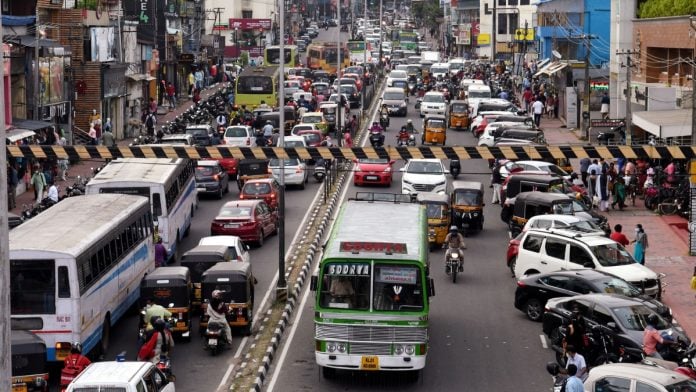
New Delhi: The Kerala High Court has said the state’s road-safety problem cannot be reduced to reckless driving or individual mistakes, pointing to failures in road design and maintenance, vehicle fitness, enforcement and coordination among government agencies.
A bench of Justices Raja Vijayaraghavan V and K.V. Jayakumar said on Thursday that Kerala already has laws, technical standards and administrative mechanisms for road safety. The issue, it said, was whether they were being implemented effectively.
The court issued a series of time-bound directions covering road design and maintenance, electronic enforcement, private bus operations and black spots. It also directed the creation of an Integrated Road Safety Monitoring Platform for real-time tracking of road-safety issues.
The Registry was also directed to place the matter before the Chief Justice to consider registering a suo motu case.
The bench was hearing a petition filed in 2020 by Advocate Clemance Thottappilly, alleging that the State had failed to implement effective measures to prevent road accidents and sought proper use of the Kerala Road Safety Fund. He also sought implementation of Sections 136A and 198A of the Motor Vehicles Act, which deal with electronic monitoring and enforcement of road safety, and accountability for complying with prescribed road-safety, design and construction standards, respectively.
The State told the court that several road-safety programmes were underway and that fatalities had declined in the first half of 2025 compared with the corresponding periods of 2023 and 2024. It also said Rs 22.13 crore remained in the Kerala Road Safety Authority’s account, while a proposal to release Rs 999.2638 crore was under examination.
The bench, however, said such claims could not be considered in isolation.
‘Not just driver behaviour’
The court was informed that Kerala recorded 49,889 road accidents, 3,733 deaths and 56,922 injuries in 2025. By July 2026, another 2,319 people had died and 36,116 had been injured.
The bench referred to an accident in which eight engineering students died after a car collided with a truck near a construction diversion. While the NHAI appeared to have attributed the crash to overspeeding, material submitted by the amicus curiae pointed to heavy vehicles allegedly parked without lights or warning boards, poor lighting, a lack of speed breakers and improperly placed direction boards.
The bench did not express an opinion on that accident as the circumstances remained under investigation. It said, however, that the case illustrated why responsibility for road safety could not rest solely with drivers.
Road condition and design, construction practices, lighting, signage, traffic diversions, parking of heavy vehicles, maintenance, enforcement and emergency response can all affect the occurrence and severity of accidents, the court said.
The court also considered findings presented by the Comptroller and Auditor General. The audit identified systemic deficiencies in licensing, vehicle registration, fitness testing, enforcement and infrastructure management. It found that 48,059 active transport vehicles in the VAHAN database had expired fitness certificates. Of these, 197 were later involved in accidents, including 19 fatal accidents.
From potholes to private buses
Examining the Kerala PWD Manual, which provides for road inspections, maintenance plans, pothole repairs and road-safety audits, the court said recurring potholes should not simply be filled repeatedly. It added that if rutting, settlement or cracking occurs, the underlying cause should be addressed.
For state highways and PWD roads, the court directed authorities to prepare inventories of defects, assign maintenance responsibilities and carry out time-bound repairs. Local bodies were directed to prepare, within 60 days, inventories of roads under their control, covering potholes, drainage, lighting and other safety defects.
The court also directed that Section 136A of the Motor Vehicles Act, which provides for electronic monitoring and enforcement of road safety, be operationalised on state highways and identified high-risk urban roads within six months. Further, the Safe Kerala AI-enabled camera project is to be extended to identified black spots and accident-prone stretches on state highways.
Private bus operations also came under scrutiny. The bench noted that unrealistic schedules could pressure drivers to overspeed or compete with other buses. The court said bus timetables must not require drivers to exceed posted speed limits to reach their destinations on time.
It directed time-and-motion studies on major private-bus routes, taking into account road width, traffic density, stops, speed limits and road geometry. It also ordered implementation of minimum gaps between buses, GPS-based monitoring, ANPR (automatic number plate recognition) cameras and action against repeat offenders.
The directions also cover construction sites and utility agencies. Construction zones will be required to have clearly identified officers responsible for road-user safety. Agencies such as the Kerala Water Authority, Kerala State Electricity Board, BSNL and gas companies must obtain prior written permission before cutting or trenching state highways or PWD roads.
The court directed that black spots be identified systematically, with responsibility assigned for both interim and permanent remedial measures.
A digital trail for accountability
The court’s most significant institutional direction is the proposed Integrated Road Safety Monitoring Platform. It said the separate systems operated by different agencies should ultimately be integrated so road-safety defects can be tracked from identification to rectification.
The platform is intended to allow people to report road defects with photographs, location and time. Each complaint would receive a tracking number and be routed to the responsible authority, with escalation if the defect remains unresolved.
The court said the aim was not to create another layer of administration, but to ensure that existing responsibilities are discharged, accountability is established, remedial action is taken within a defined period and the outcome can be independently verified.
The directions also require quarterly compliance reports detailing what was implemented, the responsible officer, defects identified and rectified, pending issues, reasons for delays, expenditure and expected completion dates. The first consolidated report is to be filed within 75 days, with the Chief Secretary responsible for collating reports from the agencies concerned.
(Edited by Chingkheinganbi Mayengbam)