





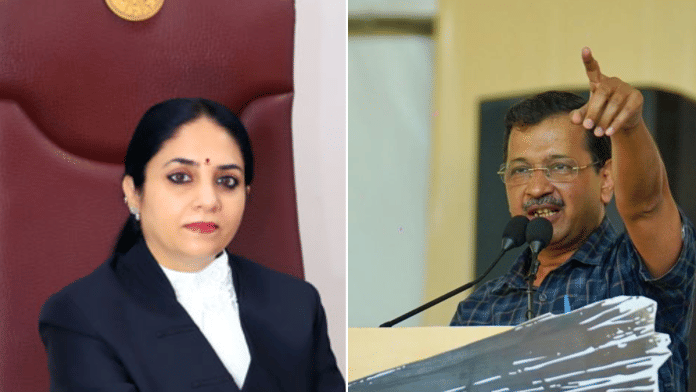



New Delhi: “You went four times to the functions organised by the Akhil Bharatiya Adhivakta Parishad, which is also called the RSS’s legal wing, and whose ideology we are openly opposing. This leads to the reasonable apprehension in my mind that this court is more inclined to them,” Aam Aadmi Party (AAP) chief Arvind Kejriwal told Justice Swarana Kanta Sharma, seeking her recusal in the Delhi excise policy case.
In Monday’s hearing, Kejriwal, along with his former deputy chief minister Manish Sisodia, addressed the court on their recusal plea. The other acquitted persons, too, want the CBI’s appeal to be listed before another court.
It may be recalled that the Central Bureau of Investigation’s appeal against the trial court order of 27 February, discharging Kejriwal and others in the excise scam, is listed before Justice Sharma.
On 9 March, Justice Sharma sought responses from all 23 accused on the CBI’s plea against their discharge, saying certain observations and findings of the trial court prima facie appeared erroneous. The Delhi High Court judge had stayed the trial court’s recommendation to hold departmental action against the CBI’s investigating officer in the liquor policy case.
Challenging this 9 March order as well, Kejriwal argued that the order was passed in the first hearing itself, while no one was present in court barring the CBI’s lawyer.
“The 9th March order made my heart sink. I had serious apprehensions about this court being biased after that. Two days later, on 11th March, I wrote to Chief Justice of the Delhi High Court, D.K.Upadhyay, requesting your recusal but he declined my request saying that once a case has been assigned to the judge, only the judge has the discretion to decide whether they want to hear it or not,” he said, pointing the judge erroneously recorded 9 March that none had appeared in court.
There was no court order asking him or others to be present in court, he contended.
Before the heavily packed court of Justice Sharma, Kejriwal argued that the February 27 order, in contrast, was passed by the trial court after conducting day-to-day hearings between November 2025 and February this year.
“The trial court read around 40,000 pages and then discharged us,” Kejriwal argued.
The high court reserved its order after the lengthy hearing.
‘Justice must be seen to be done’
Citing the 1987 ruling passed by the Supreme Court in the case of Ranjit Thakur vs Union of India, Kejriwal referred to the test of likelihood of bias in the case.
The ruling states that the proper approach for the judge is not to look at his own mind and ask himself, however, honestly, ‘Am I biased’? But to look at the mind of the party before him.”
“You are supposed to look at the mind of the party or the litigant about whether a judge is biased or not,” Kejriwal argued. “If there is a reasonable apprehension in the mind of the parties about a judge’s impartiality, the judge should recuse.”
Pointing out how even in Satyendra Jain’s case, the Enforcement Directorate (ED) had cited this principle, Kejriwal said, “There exists a reasonable apprehension in my mind that the case will not be in my favour.”
Underlining that the court has given “strong and rather conclusive findings” while dealing with his earlier petition, Kejriwal said, “It appears from the records published before this court that statements of ED officials and hawala operators pointed to findings that Rs 45 crore where allegedly the proceeds of crime in the case, which were eventually siphoned off for being used in the Goa elections. However, this is wrong. No money was taken to Goa.”
At this point, Justice Sharma interjected and asked Kejriwal to confine his arguments solely to the point of recusal.
Kejriwal then pointed out that Justice Sharma gave “strong findings” in his cases, which were at complete odds with the trial court’s findings delivered after going through 40,000 pages of evidence. “This gives rise to the apprehension that the court is predetermined. Consequently, the alleged chain of payments is also wholly speculative.”
Undue haste?
Contending that the principles of natural justice were going for a toss, Kejriwal argued that undue haste was being shown in his case, which gave rise to the reasonable apprehension in his mind that the court is premeditated.
“The trial court lambasted the investigating officer or IO in this case. While the IO never asked for any relief from the court, the CBI has come to his aid before the HC. Why is the CBI coming to his rescue if the observations are made against the IO? Why were the disciplinary proceedings against him stayed?” he argued, stating that the prosecution’s case was based wholly on statements of approvers.
The speed at which this case was going was unparalleled, he said. “This court is granting other parties three months at a stretch to file their replies, but there is a lot of undue haste in this case. The CBI is in a tearing hurry to declare me guilty, and this court has been endorsing anything the CBI demands.”
Finally, Kejriwal said that Justice Sharma attended four events organised by the Rashtriya Swayamsevak Sangh (RSS) legal wing, despite he and his party openly and strictly opposing its ideology.
Earlier, the CBI had contended that Kejriwal and other discharged accused in the Delhi liquor policy case cannot seek the recusal of Justice Sharma merely because she attended a “legal seminar” by the Akhil Bharatiya Adhivakta Parishad, as it does not demonstrate any ideological association.
Making it clear that perception matters in a functional democracy, Kejriwal said, “The Supreme Court had called the CBI a caged parrot, but who controls this cage? It’s the Centre.”
Senior advocate Sanjay Hegde, who appeared for Sisodia, said that in the case of Senator Pinochet, the House of Lords overruled the decision of the UK Supreme Court on the basis that one of the judge’s wife was a frequent contributor to Amnesty International, which was critical of Pinochet’s actions.
“When there’s even the slightest of apprehensions among the people, recusal is a wise choice. Otherwise, the entire judgment can be set aside. Since this case concerns public figures accountable to the public for the decisions they take, the court has to send a strong message,” Hegde argued on behalf of Sisodia.
Solicitor General Tushar Mehta, meanwhile, urged the HC to dismiss the recusal pleas with strictness, terming them an abuse of process and part of a larger attempt to create pressure on the judiciary.
(Edited by Tony Rai)