





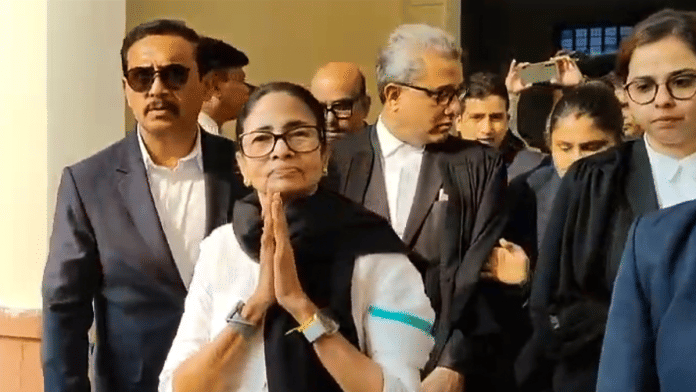



New Delhi: Terming the Election Commission (EC) as a ‘WhatsApp Commission’, West Bengal Chief Minister Mamata Banerjee alleged “harassment” at the pace and manner in which the poll body was conducting the Special Intensive Revision (SIR) process in the state.
The manner in which the EC has carried out the task to revise the electoral roll, it would lead to large-scale disenfranchisement of genuine voters, she said Wednesday before the bench led by Chief Justice of India (CJI) Surya Kant.
To buttress her allegation of political interference, she told the top court how micro observers have been appointed from the Bharatiya Janata Party (BJP)-ruled states to delete the names—thereby questioning the timing of the exercise in “the eve of elections”. “Why wasn’t the same happening in Assam?”
“There are some daughters who shifted to in-laws’ house… their names also deleted… sometimes poor people shift… because of logical discrepancy (their names are deleted),” Mamata explained to the bench also comprising Justices Joymalya Bagchi and Vipul Pancholi.
The Bengal CM’s petition alleges that the process, as being carried out by the EC, is “opaque, hasty, unconstitutional and illegal” and will result in “large-scale disenfranchisement.”
Even though senior advocate Shyam Divan represented her, the Bengal CM was given permission to address the court, as petitioner-in-person and present her concerns regarding the electoral exercise.
The last SIR in 2002 was published in Bangla, whereas the present exercise involves translating Bengali names into English, leading to deletions, she said.
“Four states going to elections. Why after 24 years, what was the hurry to do in three months? When (the) harvesting season is there… when people are travelling… more than 100 people died! BLOs died, so many were hospitalized. Why not Assam?” she said, questioning the timing of the exercise.
She went on to seek the top court’s intervention. “Problem is—when everything is finished, when we are not getting justice, when justice is crying behind the door— then we thought we are not getting justice anywhere. I have written letters to EC… I am a very less important person, I am not fighting for my party,” she said.
Accusing the EC of imposing additional documentary burdens, she added, “They say with Aadhaar we want another certificate. In other states, domicile caste certificate, etc nothing is allowed. They only targeted West Bengal on the eve of the election.”
She alleged that the pace and manner of the exercise amounted to harassment. “They wanted to do something in two months which takes two years. When people are out, they did it. BLOs committed suicided and they blamed the election officials; it is because of the harassment. West Bengal is targeted, why not Assam?” she asked.
Mamata further alleged political interference in the revision process. “Micro observers have been appointed from the BJP-ruled states to delete the names, 58 lakhs deleted in the first phase… so many (are) called dead… This Election Commission, sorry the ‘WhatsApp Commission’, is doing all of this,” she told the top court.
“We have 23 districts. SDM is dependent district-wise. We have given all class 2 officers (to the EC). In the second phase, 1.30 crore (people) have been left out. They have targeted West Bengal with micro observers and to bulldoze West Bengal people. The logical discrepancy list cannot be deleted, this is my submission,” she said, highlighting the scale of exclusions. “Please protect the people’s rights. We are grateful.”
She thanked the court for giving relief to the people of Bengal when through its 19 January order it clarified that Aadhaar would be accepted as one of the documents.
“Bengal people are so happy that this court gave (the) order that Aadhaar will be one of the documents…(in) other states, domicile certificate is allowed… caste certificate is allowed… they only targeted Bengal on (the) eve of elections,” Mamata said.
The top court told the poll panel to look into the genuine concerns raised in Mamata’s petition. It will now hear the matter next on 9 February.
Also Read: 6 kids too many? 15-yr parent-child age gap? What EC sees as ‘logical discrepancy’ in SIR
‘Cases of mismatches’
At the outset, senior advocate Shyam Divan submitted that in his client’s estimate in the logical discrepancy case, “a majority (around 70 lakhs) are cases of minor name mismatches and/or spelling variations,” and sought directions to withdraw notices limited to name mismatches.
While observing that withdrawing notices would be “impractical”, the CJI insisted on finding a solution.
Divan then urged the court to order the EC to upload reasons for including names in the logical discrepancy list. “After directions of this court, name, age, gender is there and for reasons, only D and M. No reasons are given.”
He pointed out that people whose names have been spelt differently or incorrectly have been excluded. This, he explained, was primarily due to differences in dialect and the way names are pronounced in Bengal.
When Justice Bagchi noted that the information was said to be on the website, Divan responded that “some short reasons must be given. People should know why they are not in the list.”
Agreeing in principle, CJI Kant said, “yes to the extent the person should know (the reason they are excluded) is fine… only thing is the mode in which they are informed. We were told that the list is not only communication but individual notices are being given.”
He also questioned EC counsel Rakesh Dwivedi on discrepancies arising from linguistic variations. “If ‘Roy’, ‘Dutta’, ‘Ganguly’, etc are being left out… We don’t know how ‘Tagore’ is pronounced… but that does not mean ‘Tagore’ is not Tagore,” the CJI said, noting that this concern had been raised in Mamata’s petition.
Highlighting how the pronunciation affects the translation, Justice Bagchi, who is a Bengali himself, illustrated the linguistic issue by noting that in Bengal, “Mr. Dwivedi” would be pronounced “Mr Dibedi”, as the Bengali language does not have a “va”.
When the CJI remarked whether his name would be pronounced correctly, Mamata interjected at the outset of her submissions, saying, “No. It will not, sir.”
Other SIR-related pleas
Another issue that was brought up before the court was the AI-generated errors in the 2002 electoral rolls, a point that was earlier highlighted by Mamata in her letter to the Chief Election Commissioner..
The bench, meanwhile, noted that the State of West Bengal had also filed an independent writ petition, represented by senior counsels including Divan and Kapil Sibal.
Referring to an earlier hearing, CJI Kant said that on January 19, “Mr. Sibal had explained procedural difficulties being faced by the state. Directions were then issued. Today in your plea some additional issues are flagged, every problem has a solution – we must ensure that solution comes and no innocent person is left out.”
“One objective is to weed out the dead, then to weed out those who are disqualified… and then migrants… genuine persons must remain on the rolls,” he said, explaining the objective of the SIR.
The apex court proposed that state government officers, fluent in Bangla dialects, be deputed with an EC team to assist the process. “They can scrunitise the list and point out wherever they find genuine names have been deleted,” the CJI said.
The EC informed the bench it had written to the state government seeking Group ‘B’ officers, but failed to get any co-operation from the Trinamool Congress-ruled state.
Mamata, however, denied and said the state had provided complete assistance to the poll body. Thereafter, the bench asked the state to place before it a list of Group 2 officers who can be made to work with the EC team.
(Edited by Tony Rai)
Also Read: Why SIR is an exclusionary exercise for Persons with Disabilities