





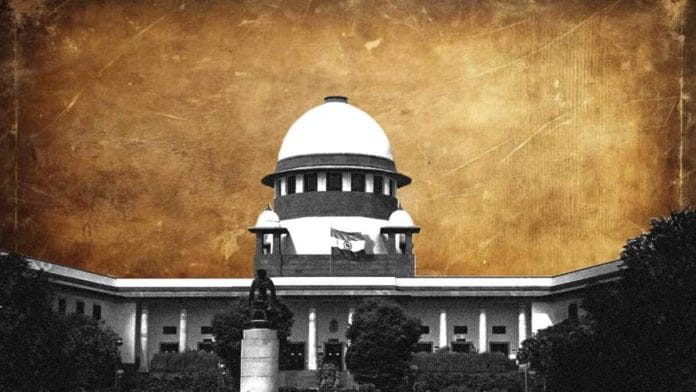


New Delhi: The Supreme Court has freed a man who was sentenced to death for the rape and murder of a 55-year-old woman after taking note of his medical report which said he was incapable of having sexual intercourse. With its order, a three-judge bench led by Justice Vikram Nath set aside trial court and Uttarakhand High Court rulings that had convicted the man and his associate, and sentenced both to death.
The trial court delivered its verdict in 2014, which the High Court upheld in 2018.
The apex court acquitted both men, poking holes in the prosecution’s version and highlighting serious lapses in the police probe, such as evidence suppression and their inability to produce a crucial witness during the trial.
“Vital incriminating circumstances have not been proved beyond all manner of doubt; it would not be safe to sustain the conviction of the appellants or the sentence of death awarded to them. Resultantly, the impugned judgment of conviction and order of sentence passed by the trial court, as affirmed by the High Court, do not withstand judicial scrutiny and deserve to be set aside,” the Supreme Court ruled in its 27 May judgment.
The Case
The case dates back to the afternoon of 29 December 2012, when the victim went missing after leaving her home to graze goats in the forest; she was found dead later.
According to the police, two unknown men approached three girls who were collecting grass in the forest. They asked for the victim’s whereabouts while calling her a “pahadan”.
The girls, according to the prosecution, thought these men wanted to buy liquor from her, so they directed the men toward the woman grazing goats. That evening, six hours later, her body was found near a water channel with bite marks, after which it was collected for investigation. Police said the two accused were last seen following the victim into the forest
According to the prosecution, this circumstance constituted a vital link in the chain of incriminating circumstances against the accused. These circumstances referred to pieces of evidence pointing toward their guilt without conclusively proving it.
However, the Supreme Court found they failed to prove this beyond a reasonable doubt.
After questioning the witnesses—which crucially included the two girls who redirected the accused toward the victim—the police picked up the men based on sketches prepared at the girls’ instance. But, the police never questioned the third girl.
Why SC rejected prosecution’s case
SC rejected the prosecution’s case that the two men had raped the woman owing to their need to satisfy their carnal desire.
Interestingly, the prosecution’s case relied heavily on witness testimonies but the court found that one female witness, whom the police claimed saw the accused heading toward the victim, was not presented in court during the trial. And, the police offered no explanation for not citing her as a witness. The girl was one of three witnesses who, the police said, established the last-seen evidence linking the accused to the crime.
This, the court held, was the suppression of the best available evidence, which “gives rise to a serious infirmity in the prosecution’s case and casts a substantial doubt on the integrity and fairness of the investigation as well as on the reliability of the prosecution’s version of events”.
The court also rejected the police’s reliance on the “last seen together” theory, finding that the prosecution failed to prove this beyond a reasonable doubt.
Poking holes in the prosecution’s case, the Supreme Court said they had failed to establish evidence to substantiate their “last seen together” theory, and the alleged recoveries from the crime scene of the blood-stained cloth could not be accepted as genuine or reliable.
Casting serious doubts on the fairness of the investigation, the court said that it is “well settled that in a case resting entirely on circumstantial evidence, each incriminating circumstance must be firmly proved, and the chain of circumstances must be so complete as to unerringly point towards the guilt of the accused”.
Prosecution’s case & the errors in it
After the trial court denied the accused bail in January 2014 following their conviction, they appealed to the Uttarakhand High Court.
In April 2018, the High Court also upheld their conviction and death sentence. However, in October 2018, the Supreme Court stayed the High Court orders.
“In the present case, the prosecution has miserably failed to establish any of the so-called incriminating circumstances so as to connect the appellants with the crime in question. The prosecution’s evidence suffers from material inconsistencies, procedural irregularities, and serious infirmities which strike at the very root of the prosecution’s case,” the court said while noting that the accused were entitled to the benefit of the doubt.
The court also noted that the prosecution had failed to conduct the Test Identification Parade (TIP), which essentially refers to a process by which the identity of persons involved in an offence under investigation or trial is established. “It is a well-settled proposition that where the accused are strangers to the witnesses, a TIP assumes considerable significance in assuring the sanctity of the dock identification. The rank failure of the investigating agency to hold a TIP, particularly in the facts of the present case, materially undermines the credibility of the prosecution’s version,” the bench said in its judgment.
These sketches, which formed a major foundation of the prosecution’s case, were supposedly prepared by an expert based in Dehradun but the court noted that the prosecution refused to share the artist’s name or identity, citing “security reasons.”
He was not even listed as a witness.
Surprisingly, the prosecution withheld even the identity of the sketch artist, the court said. The court added that the police justified this omission by offering a “flimsy and wholly unconvincing explanation”—the sketch expert was kept anonymous for safety reasons.
A delay in forwarding the evidence, articles such as the blood-stained cloth of the accused, without any explanation, constituted an unexplained lapse on the prosecution’s part, the court said.
(Edited by Varnika Dhawan)