



New Delhi: The Bombay High Court has directed authorities in Maharashtra to impose a total ban on bursting firecrackers on public streets and roads during festivities, while ordering tighter monitoring of loudspeakers, sound systems and other sources of noise pollution during religious and cultural processions.
A division bench of Justices G.S. Kulkarni and Dr Neela Gokhale said existing laws regulating noise pollution were often reduced to “paper provisions”, with enforcement agencies failing to implement them effectively despite successive Supreme Court and High Court rulings.
The directions were passed Tuesday in a suo motu public interest litigation concerning noise and environmental pollution caused by the use of amplified music systems and firecrackers during festivals.
The proceedings cover concerns arising particularly in densely populated cities, including Mumbai, Thane, Pune and Nashik.
Court targets enforcement
The High Court’s intervention comes against the backdrop of existing restrictions under the Noise Pollution (Regulation and Control) Rules, 2000.
Under the rules, loudspeakers and public-address systems require written permission. Noise standards are prescribed separately for industrial, commercial, residential and silence zones.
The court’s concern was that the existence of these restrictions had not translated into effective enforcement.
The bench noted complaints of high noise levels from multiple high-wattage speakers, musical instruments and other equipment used during processions. It also referred to sound systems using generators and batteries and the cumulative effect of several such systems in densely populated areas.
Its directions seek to put greater responsibility on police, municipal authorities, the Maharashtra Pollution Control Board and other designated authorities to monitor events while they are taking place.
The court has directed authorities to measure decibel levels generated by permitted sound systems and to take action against unauthorised or illegal use. Where breaches are found, equipment and other offending material can be seized and confiscated.
Decibel meters, sound limiters & possible deposits
One of the more significant directions concerns the organisers themselves.
Those seeking permission for events or processions involving sound-generating equipment have been directed to install decibel measurement meters at venues and procession routes. The meters are to be placed prominently so that authorities as well as members of the public can see them.
Organisers must also furnish an undertaking or affidavit that the sound systems being used are fitted with internal sound limiters.
Authorities have further been directed to record noise levels both individually and cumulatively when different permissions are being used. That cumulative assessment is important because the court has said authorities cannot assess each permission in isolation where several sound systems operate within the same ward.
Before granting multiple permissions, the authorities have been directed to consider the combined impact of noise in the area.
The court has also directed authorities to consider accepting substantial deposits as a condition for granting permissions under the Noise Pollution Rules — at least Rs 1 lakh for an association or group and Rs 50,000 for an individual.
The amount could be forfeited if the permitted decibel level is breached, apart from other action available under law.
Organisers have also been directed to display the permissions granted to them, while processions must display their permissions as well.
The order further requires the names, addresses and mobile numbers of persons responsible for organising the festivities or processions to be displayed so that accountability for violations can be fixed.
Firecrackers banned on public streets; laser lights prohibited
The court’s most direct restriction concerns firecrackers.
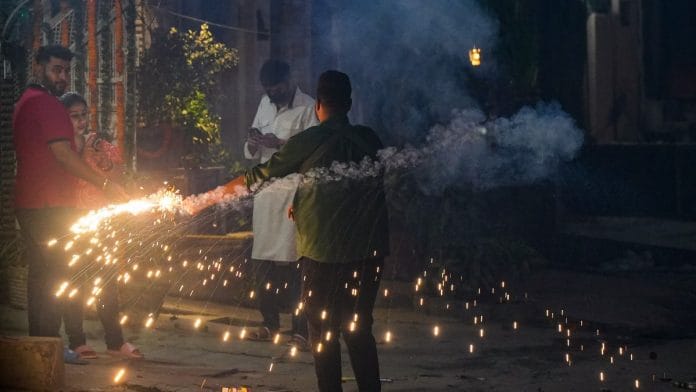
It has ordered a total ban on bursting firecrackers during festivities on public streets, roads and similar public areas, directing authorities to prevent the resulting air and noise pollution.
The order also prohibits laser lights, high-intensity lumen lights and beams during festivities and processions.
The bench linked its concern over street fireworks not only to noise but also to air pollution and safety risks. It noted that firecrackers are used on roads where pedestrians walk and vehicles move, creating the possibility of accidents.
It also expressed concern about the toxicity of smoke and the cumulative impact of pollution during September and October, when authorities are already dealing with deteriorating air quality.
The court also referred to the harm caused by excessive noise to senior citizens, people who are ill, children and students preparing for examinations.
Noise rules remain applicable during festivals
The central message of the order is that festivals do not create an exemption from the Noise Pollution Rules.
The bench rejected the impression that the rules could effectively disappear during festivities, pointing instead to the continuing statutory requirements and the need for active enforcement.
The court has directed authorities to sensitise organisers and procession participants about their obligations before events begin. It has also asked authorities to consider previous violations while deciding whether fresh permissions should be granted.
The order further makes clear that violations can attract action under the Noise Pollution Rules and Environment (Protection) Act, apart from relevant provisions of the BNS and the Explosives Act, depending on the nature of the violation.
The statutory framework allows the state government to relax the normal 10 pm–6 am prohibition on loudspeakers and public-address systems, permitting their use between 10 pm and midnight on cultural, religious or festive occasions for up to 15 days in a calendar year.
Even on those days, the prescribed noise limits remain applicable, and the relaxation does not extend to silence zones.
The proceedings have been adjourned to 15 October 2026, when compliance with the directions will be considered.
(Edited by Sugita Katyal)