





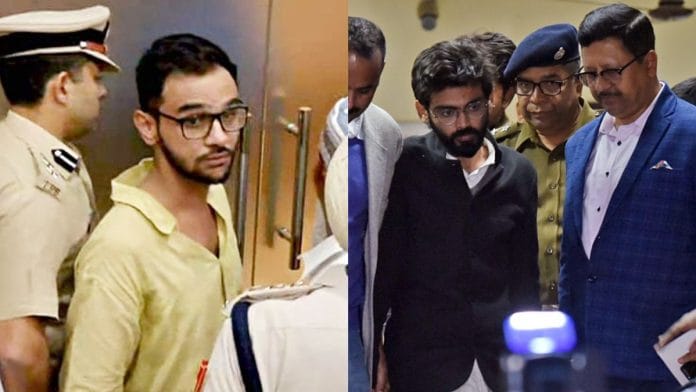



New Delhi: Holding that it cannot dissect prosecution evidence in isolation at the bail stage but must assess it cumulatively, the Supreme Court Monday rejected bail pleas of former JNU students Umar Khalid and Sharjeel Imam in the 2020 Delhi riots conspiracy case.
At the same time, the court granted bail to five other co-accused—Gulfisha Fatima, Meeran Haider, Shifa-ur-Rehman, Mohammed Saleem Khan, and Shadab Ahmed—subject to 12 stringent conditions.
A bench of justices Aravind Kumar and N.V. Anjaria ruled that Umar and Sharjeel stand on a “qualitatively different footing” from the other accused, given the “strategic centrality” and “directive role” attributed to them behind the alleged conspiracy behind the February 2020 violence in northeast Delhi.
The court emphasised that while dissent and protest occupy a protected constitutional space, such protection does not extend to an alleged design that involves “systemic disruption, engineered confrontation, and preparatory steps towards violence”.
“When sustained blockades are alleged to be executed across multiple locations, when essential civic life is alleged to be paralysed, and when violence is alleged to erupt in a coordinated manner following such blockades, the Court cannot, at this stage, rule out the applicability of the statutory framework merely because the acts are couched in the language of protest,” the bench said. It reiterated that at the bail stage under the Unlawful Activities (Prevention) Act (UAPA), the inquiry is confined to whether the accusations are prima facie true, not whether they will ultimately result in conviction.
The top court made it clear that at this stage, it could not engage in a granular dissection of the evidence or undertake credibility determinations. Instead, it was required to consider the prosecution material “taken at face value” and “viewed cumulatively”.
“This Court reiterates that dissent and protest occupy a protected space in a constitutional democracy. That protection, however, does not extend to a pleaded design which, if accepted as true, involves systemic disruption, engineered confrontation, and preparatory steps towards violence,” the bench said.
The court examined the prosecution material in detail, including the chronology of meetings, the alleged articulation and propagation of the chakka jam strategy and the operation of coordinating committees and groups.
In addition, it also took note of the protected witness statements, alleging preparatory and escalation-related discussions, “the pleaded movement of protest activity into mixed-population zones, and the alleged systemic disruption of civic life in the National Capital”.
‘Court reiterates dissent & protest occupy protected space in a constitutional democracy. That protection, however, does not extend to pleaded design which, if accepted as true, involves systemic disruption, engineered confrontation, and preparatory steps towards violence,’ says the bench.
Based on these, the court held that reasonable grounds exist for believing that accusations against Umar Khalid are prima facie true, and thus the statutory threshold under Section 43D(5) of the UAPA—which sets a very high bar for granting bail—stands satisfied.
Also Read: BJP sees ‘lesson’ for Oppn in SC’s denial of bail to Umar Khalid, Sharjeel Imam in Delhi riots case
Case against Umar Khalid, Sharjeel Imam
The SC order came on appeals filed by all the seven accused against the 2 September, 2024 judgment of the Delhi High Court, which denied them bail while describing their alleged roles as “grave” and indicative of a coordinated conspiracy behind the riots.
Violence erupted in parts of northeast Delhi in February 2020 during protests against the Citizenship (Amendment) Act and the proposed National Register of Citizens (NRC). The riots left more than 50 dead.
Both Umar and Sharjeel have been incarcerated for nearly five-and-a-half years.
The court acknowledged that prolonged incarceration raises serious concerns under Article 21 of the Constitution, but in cases involving principal conspirators under the UAPA, this factor alone cannot override the statutory embargo on bail where the prima facie threshold continues to be crossed.
While denying bail to the two, the court granted them liberty to renew their applications only after one year or upon the completion of the examination of protected witnesses, whichever is earlier. The court said when a statute imposes a high threshold and the case is conspiracy centric, “repeated bail reconsideration on the same material is not the norm”.
‘Strategic architects’ & ‘local-level facilitators’
A central feature of the judgment was the court’s sharp distinction between “strategic architects” of the alleged conspiracy and “local-level facilitators”.
The refusal to grant bail to Umar and Sharjeel also rested on the court’s satisfaction that the prosecution material depicts them as “ideological drivers” who occupied a “qualitatively different footing” from other accused.
“At this stage, the Court does not decide whether each meeting was conspiratorial. But where multiple meetings across weeks and months are alleged, and where witness material and electronic records are pressed to place the same accused at several of these junctures, the Court is entitled to view continuity itself as a relevant circumstance,” the bench said.
Adding, “Continuity is the difference between a participant and an organiser in the prosecution narrative.”
The court held that this alleged continuity of involvement elevated Umar and Sharjeel beyond episodic participation, and placed them at the level of planning, mobilisation, and strategic direction. Umar Khalid and Sharjeel Imam, both in their 30s, have completed their doctoral scholarship from Jawaharlal Nehru University. Umar’s bail pleas have been rejected at least five times in as many years. He was, however, granted interim relief twice to attend weddings in the family. Sharjeel’s bail pleas have been rejected at least twice earlier.
Alleged ‘brainchild’ Sharjeel
With respect to Sharjeel Imam, the court referred to the chargesheet, which described him as the “brainchild” of the “Muslim Students of JNU” (MSJ) WhatsApp group, allegedly used for large-scale mobilisation. The court highlighted his speeches, including the one at Jamia Millia Islamia on 13 December 2019, in which he exhorted followers to execute a “chakka jam” so extensive that “essential services like milk and water would be paralysed or choked”.
Protected witness statements, the court noted, further corroborated Sharjeel’s directive role in initiating permanent 24×7 blockades at protest sites such as Shaheen Bagh.
While Sharjeel had outwardly disavowed violence, the court held that such disavowal did not neutralise the alleged inward design of preparatory acts aimed at systemic disruption.
Umar: The ‘principal architect’
Citing the chargesheet, the court noted Umar has been identified as the “principal architect” of the conspiracy who allegedly supplied the “method”, “timing”, and “linkage” between dispersed protest sites.
According to the judgment, Umar allegedly defined the strategic transition from a peaceful “dharna” to a disruptive “chakka jam”. “This is not treated as semantics. It is treated as (a) strategy. A dharna may be expressive; a chakka jam, as alleged, is disruptive by design.”
The prosecution case, the court noted, was that the sustained choking of arterial roads, replication of blockade sites, and movement of crowds from minority clusters into mixed-population areas were “not accidental expressions of dissent, but calibrated acts meant to generate confrontation, overwhelm law enforcement, and create conditions for violence”.
Umar’s involvement was traced through alleged repeated decision points, including meetings at Jangpura, the Indian Social Institute, and the Gandhi Peace Foundation.
Umar’s counsel Kapil Sibal argued during the hearing that he was not physically present at any riot site during the critical period. The court held that even if this assertion were assumed to be correct, it did not answer the prosecution case. “The prosecution does not pitch him as an executor of the terminal violence; it pitches him as a person involved in shaping the method and seeding the strategy earlier. In a phased conspiracy, physical absence at the final scene is not the end of the inquiry,” the judges noted.
At best, the court said, such absence shifts the inquiry upstream to assess whether the accused was linked to preparatory and coordinating stages. Both Umar and Sharjeel argued that no weapons, explosives, or incriminating funds were recovered from them, and that no witness saw them at riot sites. Rejecting this contention, the court ruled that the absence of physical recoveries does not break the chain of a conspiracy involving distributed roles.
It observed that strategic organisers often do not carry instruments of execution used by ground-level actors.
Since the prosecution material prima facie linked Umar to meetings, committees, and coordination platforms, the lack of forensic or physical evidence was not determinative at the bail stage.
Both Umar and Sharjeel also argued that mere membership in WhatsApp groups such as DPSG (Delhi Police Support Group) or MSJ, or sharing location pins, could not constitute criminal conduct.
“Prosecution does not pitch him (Umar Khalid) as executor of terminal violence; it pitches him as person involved in shaping method & seeding strategy earlier. In phased conspiracy, physical absence at final scene is not end of inquiry,” notes SC.
The court disagreed, viewing such membership as indicative of managerial responsibility and command authority. It held that these groups allegedly functioned as coordination platforms where higher-level strategic decisions were transmitted to ground-level executors.
Even where an accused did not send overtly incriminating messages, their position within the coordination architecture was relevant, it noted.
Adding, “The Court is therefore unable, at this stage, to accept the characterisation of the events as mere public disorder incidental to protest.”
The prosecution case, taken cumulatively, pleaded that the blockade strategy was designed not merely to inconvenience but “to provoke, to polarise, and to create a breakdown of communal peace”.
“It is this pleaded design to fracture communal harmony, rather than the expression of dissent per se, which distinguishes the prosecution case from a narrative of innocent protest,” the court observed. Whether that design is ultimately proved, the court said, is a matter for trial. Its prima facie articulation is sufficient at the bail stage.
On prolonged incarceration & delay
Addressing the argument on prolonged incarceration, the court acknowledged that both have spent over five years in custody with no immediate prospect of completion of the trial.
However, it relied on a precedent that delay is not an “absolute or solitary determinant” particularly where allegations “implicate organised criminality or matters of public interest”.
Delay, the court said, can warrant heightened constitutional scrutiny, but it does not authorise dilution of the statutory threshold by examining the credibility of the prosecution material at this stage.
“Where the prima facie threshold continues to be crossed, delay is met through expeditious trial directions and continued judicial monitoring, not by negating Section 43D(5).”
Doctrine of differentiated roles
A pivotal aspect of the judgment was its rejection of a “homogenous” treatment of all accused. The top court observed that the chargesheet disclosed a “vertical chain of command,” with strategic directions emanating from the top—Umar and Sharjeel—while implementation was handled by local operatives. “Such differentiation is intrinsic to criminal adjudication and operates irrespective of the uniformity of charges framed,” it said.
It allowed bail to Gulfisha Fatima, Meeran Haider, Shifa-ur-Rehman, Mohammed Saleem Khan, and Shadab Ahmed, holding that their continued incarceration was not indispensable for a fair trial. It categorised them as “local-level facilitators” whose roles were “site-specific and operational”, lacking “independent command capacity” or “strategic discretion”.
For Shifa-ur-Rehman, the court noted that while he was a “financial enabler” there was no material showing autonomous decision-making authority.
The role of Gulfisha Fatima, the only woman among the seven accused, was found to be “substantially identical” to that of Natasha Narwal and Devangana Kalita, who had already been granted bail, making her continued detention violative of parity.
For these five accused, the court imposed strict conditions, including surrender of passports, restriction of their movement to the National Capital Territory, and a prohibition on public commentary about the case. It also said they must personally appear twice a week (Mondays and Thursdays) before the Crime Branch SHO to mark their attendance.
They also must not “make or publish or disseminate any information, statement, article or post whether in print, electronic or social media concerning the present case or its participants till conclusion of the trial”.
Lastly, the five shall “not participate in any programme or address or attend any gathering, rally or meeting, whether physically or virtually till conclusion of the trial”.
(Edited by Ajeet Tiwari)
Also Read: ‘Terror’ under UAPA not just conventional violence—what SC said in denying bail to Umar, Sharjeel