



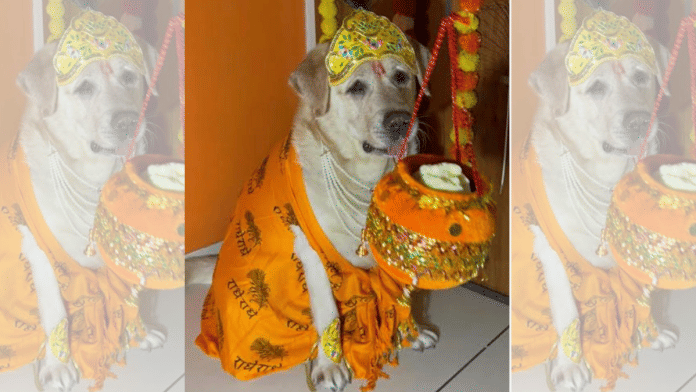

Gurugram: Two years ago, days before Janmashtami, a bank manager in Hoshiarpur put a small crown on her dog’s head, draped it in yellow cloth, and photographed it.
On the day of the festival, she set that photograph of her dog dressed as Hindu god Krishna as her WhatsApp status. She had been married six years and had no children. The dog, she would later tell the police, was the child she never had.
That single WhatsApp status led to an FIR, a police investigation, a charge sheet, and finally, an 18-page order from Justice Subhas Mehla of the Punjab and Haryana High Court that reads less like a routine quashing of an FIR and more like a meditation on where divinity actually lives.
The complaint came from a young Shiv Sena functionary who said the woman, Ranjanni Gaur, had insulted Hindu sentiments by portraying her dog as Krishna.
Police at Talwara station in Hoshiarpur registered an FIR under Section 298 of the Bharatiya Nyaya Sanhita on 3 September 2024.
Section 298 of the Bharatiya Nyaya Sanhita criminalises the intentional damaging, destruction, or defilement of a place of worship or any sacred object. The act is punishable by up to two years in prison, a fine, or both, provided it was done with the intent to insult the religion of any class.
When she was questioned, Gaur did not deny what she had done. She was, however, unaware that her actions could have hurt anyone’s religious sentiment.
Her counsel, Mitul Singh Rana, told the court the case did not even meet the technical requirements of the law. The objects in question—a crown, a peacock feather, a strip of yellow cloth—were not sacred objects in a temple or being carried in a religious procession, which is what Section 298 actually protects.
He also argued that a WhatsApp status seen by a limited circle of contacts could hardly amount to a deliberate attempt to wound an entire community’s sentiments, and pointed to Supreme Court rulings, including one involving cricketer Mahendra Singh Dhoni’s own Krishna-themed magazine cover, to argue that intent to insult must be proven, not assumed.
For context, in April 2013, Business Today magazine put out an issue with M. S. Dhoni’s face depicted as Lord Vishnu, holding some of the products he endorsed at the time (including a soft drink bottle and a bag of chips). The cover was titled ‘God of Big Deals’.
VHP leader Shyam Sunder filed a complaint in an Anantpur district court in Andhra Pradesh, alleging the portrayal hurt Hindu religious sentiments. This led to a non-bailable warrant being issued against Dhoni in January 2016.
The Supreme Court quashed the criminal proceedings against Dhoni in September 2016. But the matter didn’t end there, it resurfaced, and the Supreme Court, in a bench led by Justice Dipak Mishra, quashed a fresh criminal complaint on the same matter again in April 2017, ruling that the portrayal could not be treated as an act of hurting religious sentiments.
Returning to the case in hand, the state, through Additional Advocate General Subhash Godara, pushed back, arguing that the FIR disclosed an offence and that Gaur’s own admission during investigation was enough to send the matter to trial.
Justice Mehla did not stop at settling the legal question raised by the state.
Ruling that the “object” Gaur used did not fall within the meaning of Section 298 at all, and that nothing in the case showed intent to insult anyone’s religion. He went further, into Hindu scriptures. He cited the Bhagavad Gita’s verse on the sage who sees a dog and a learned Brahmin with equal vision, the Mahabharata’s account of Yudhishthira refusing to abandon a stray dog even to enter heaven, and Kal Bhairava’s dog-mount in Shaivite tradition, to argue that the dog occupies a place of unusual reverence in Hindu thought.
“If Krishna himself says that a sage sees no difference between a priest and a dog because the same divine soul (Atma) resides in both, then seeing Krishna in a dog is not sacrilege— it is a realisation of divine truth,” said the order, quoting the Bhagavad Gita.
The high court’s order also travelled beyond India, to Egyptian animal gods, Japan’s Shinto spirits, and the dog-headed Aztec deity Xolotl, before returning to the Bhakti tradition and Kabir’s idea of a formless God present in every atom.
The court went on to add, “This Anthropomorphisation is prominent in Indian mythology… The petitioner in this case has subjected her pet dog to this phenomenon out of love.”
It closed on a line from Tulsidas’s Ramcharitmanas, that a person sees the divine according to the feeling in their own heart. “Jaaki rahi bhawna jaisi, prabhu moorat tin dekhi jaisi,” the order said, reproducing the verse from the Ramcharitmanas.
“Individual expression of the petitioner, shaped by her personal experiences, cannot be criminalised merely because it does not align with the sensitivities of others,” the judge held, quashing the FIR, the final report filed before the trial court, and all proceedings that flowed from it.
(Edited by Viny Mishra)
Also read: A ‘terhvi’ for dead dogs—Delhi mourns mass killing of strays in Telangana