






New Delhi: Jharkhand High Court, under scrutiny by the Supreme Court for taking 22 years to decide a murder appeal, has never worked with full strength since 2002.
In an affidavit submitted to the apex court last week, the High Court painted a grim picture about judges’ inadequacy and mounting pendency there. The affidavit was filed in response to the Supreme Court seeking an explanation from the High Court on the 22-year delay in deciding a murder appeal in a 45-year-old murder case.
On 28 July, the top court had sought the affidavit while hearing a 70-year-old convict’s appeal against the High Court order sentencing him to life in a 1981 murder case.
Jharkhand HC in Ranchi was set up in November 2000 under the Bihar Reorganization Act, which led to the creation of Jharkhand. Before the bifurcation the court in Ranchi was the circuit bench for Patna HC.
According to the affidavit, between 2002 and 2006, the sanctioned strength of Jharkhand HC was 12. It points out that 2002 was the only year when the High Court worked with full strength. A year later it came down to 11 and dropped to 6 in 2004 and 2005.
With new appointments in 2006, the strength went up to 10. Thereafter, the High Court’s sanctioned strength was increased to 20 in 2007.
However, appointments could never match up to the sanctioned strength.
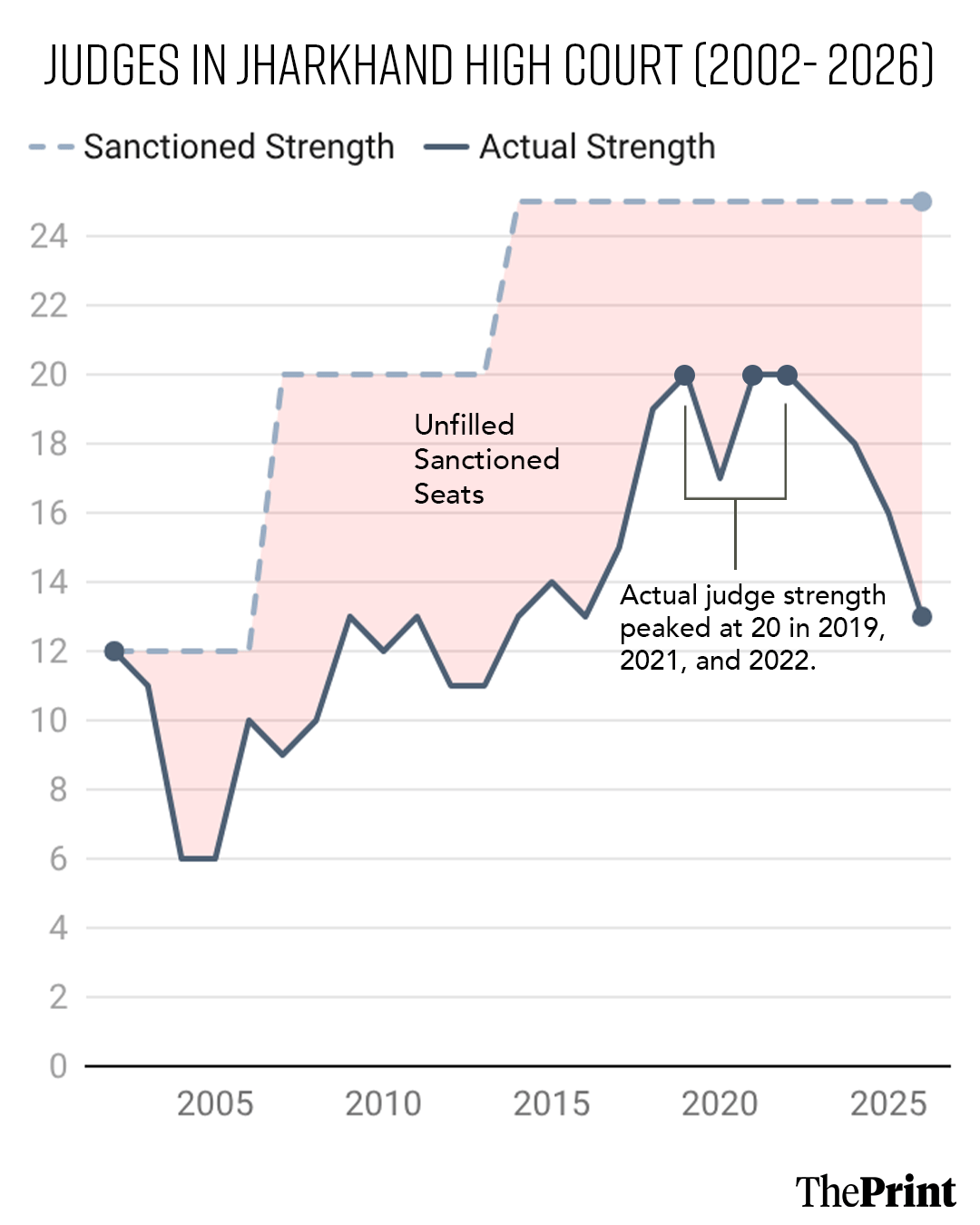
Till 2013, when another 5 positions were added, only twice had the Jharkhand HC worked at 65 percent strength or higher. In 2007 it functioned with less than 50 percent, as the number of judges then serving was only 9 as against the sanctioned strength of 20.
The appointment of one judge a year later took the number to 10 and then to 13 in 2009. It dropped to 12 in 2010 then increased to 13 again in 2011.
For two years, 2012 and 2013, the High Court had 9 vacancies with only 11 judges working then. With the addition of 5 more positions, the High Court’s sanctioned strength was increased to 25 in 2014 and remains so to date.
Creation of new posts, however, did not lead to more appointments in Jharkhand HC.
In the last 12 years the maximum working strength there has been 20. Between 2014 and 2017 the High Court worked with a little over 50 percent strength. In 2014 it had 13 judges, followed by 14 judges in 2015, 13 judges in 2016 and 15 judges in 2017.
In 2018 the number of judges in the High Court touched 19. The next year it was 20.
The strength came down to 17 in 2020, but for the next two years, 2021 and 2022, the High Court worked with its best strength to date, which was 20.
Since 2023 the numerical strength of judges has seen a downward trend in the High Court, from 19 in 2023 to 18 in 2024, then 16 in 2025, and now 13.
Also Read: 22 judges per million, 26 lakh cases pending: India’s judicial gap widens despite years of reform
‘Legacy inadequacies’
The affidavit in the Supreme Court also threw light on how low sanctioned strength of judges, coupled with equally low working strength, has imperiled the hearing of pending criminal appeals before the Jharkhand High Court.
Official documents annexed with the affidavit show that until 2014 the High Court had a single two-judge division bench to hear criminal appeals filed against trial court orders.
Thereafter, it has either had two or three division benches, depending upon the working strength. Currently, the High Court has two division benches.
However, these division benches do not hear criminal appeals exclusively. They also take up matters of other nature related to the bench, as per the roster.
The High Court accepted in its affidavit the 22-year delay in adjudicating the case, now pending before the top court. Filed by the registrar general of the High Court, the official document said that the “delay has occurred on account of legacy administrative, infrastructural and systemic inadequacies”.
Since 2024, however, the High Court said, it has taken measures to “earnestly” address the pendency of cases, particularly criminal appeals. This was done after a top court-appointed committee suggested reforms in High Courts to expedite old pending criminal appeals, particularly those pending for more than 20 years.
According to the affidavit, Jharkhand HC has disposed of 466 criminal appeals since 2024. These appeals were filed between 1992 and December 2004.
Yet, as many as 1,669 criminal appeals, filed between 1996 and 2005, are pending for a final decision in the High Court. While 78 appeals were filed in 1998, 73 are from 1999, 108 from 2000 and 1 from 2001.
Sixty-nine appeals filed in 2002 are also in the queue for a hearing.
Similarly, more than 1,300 criminal appeals filed between 2003 and 2005 (319, 560 and 450) are still to be heard and concluded.
FIR registered in 1981
As for the case that has reached the top court, six persons were named as accused. Two died before framing of charges and three of the four convicted died while the appeal was pending before the High Court. The sole remaining accused, who has appealed against his conviction, is suffering from multiple ailments and surrendered after the High Court convicted him for the offence in October 2024.
Notably, his appeal was heard only after the High Court took steps to fast-track old criminal appeals. It was concluded within a month of it getting listed, almost two decades after it was admitted.
The explanation given by the High Court for the delay was that since the four accused were released on bail in September 2002, almost a month after they filed their appeals, their case was added to a list of criminal appeals where bail had been considered. Going by the practice followed in the High Court, appeals in which bail was yet to be considered were being heard on priority.
There was also inordinate delay at the trial court level. The affidavit disclosed that the chargesheet in the case was filed five months after the FIR was registered on 18 October, 1981. Committal of the case to the sessions court for a trial took two years.
Failure of the accused to turn up for the trial for a period of six years delayed the progress of the case due to which charges were eventually framed only on 20 September, 1991.
The trial concluded in June 2002 and judgement was delivered, convicting the four accused.
The trial suffered several delays due to frequent intra-court transfers as well as adjournments sought on the account of the death of two accused. According to the affidavit, the case was transferred in the trial court itself five times.
On 19 August, a Supreme Court bench led by Justice J.B. Pardiwala took cognisance of the High Court affidavit. “Altogether, he (accused) has spent only 2 years, 4 months and 12 days in custody; hence the crime went unpunished,” it said.
However, considering the accused’s 45-year ordeal and noting his medical condition, the top court suspended his sentence and directed his release on the condition that he won’t commit any crime when on bail and on his personal surety.
With regard to the pendency of criminal appeals as pointed in the High Court, the bench impleaded the Centre in the matter, fixing 19 September to hear it again.
(Edited by Amrtansh Arora)