





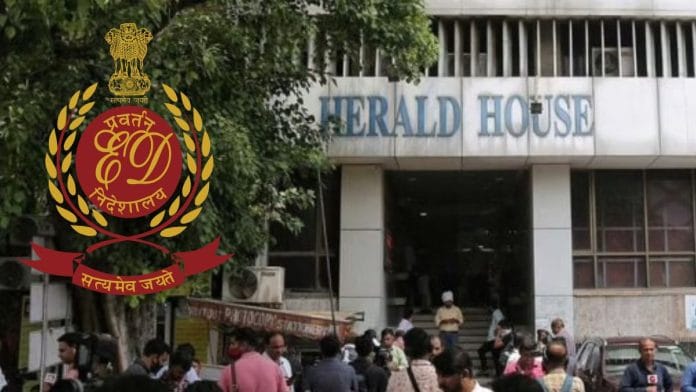



New Delhi: The Enforcement Directorate (ED) cannot initiate a money laundering probe against Sonia Gandhi, Rahul Gandhi and others in the National Herald case because a “foundational requirement” to investigate a scheduled offence under the Prevention of Money Laundering Act (PMLA) had not been fulfilled, a Delhi court said as it dismissed the agency’s prosecution complaint.
The registration of a First Information Report (FIR), Special CBI Judge Vishal Gogne stated in his order, would be the “jurisdictional trigger” for the ED to begin investigation by lodging an ECIR (an investigative agency’s version of an FIR) and then a prosecution complaint (equivalent of a police charge sheet).
A scheduled offence, under the PMLA, refers to the predicate offence (like terrorism, drug trafficking or tax evasion) from which stem the “proceeds of crime” that are investigated under the anti-money laundering law.
The order stated that simply a complaint filed by a public person in a court under Section 223 of the erstwhile Code of Criminal Procedure (CrPC), even if it disclosed a scheduled offence, did not give the ED the jurisdiction to investigate.
The court also said that the ED, in proceeding with this case, had gone against its own usual practice of basing its probes on the CBI’s FIRs and charge sheets even as the latter remained wary about the case’s viability, essentially “inverting the template”.
The National Herald case
In November 2012, BJP leader Subramanian Swamy submitted a private complaint in a Delhi court, alleging that the Congress provided an interest-free loan of Rs 90.25 crore to Associated Journals Ltd (AJL) between 2002 and 2011 to revive the daily National Herald.
The publisher, Associated Journals, was founded by India’s first prime minister, Jawaharlal Nehru.
On a magistrate’s order, the ED opened an Enforcement Case Information Report (ECIR) in June 2014, summoning the Gandhis and other Congress leaders, including the late Motilal Vora and Oscar Fernandes.
Swamy alleged that in 2010, AJL’s board approved the transfer of the loan to a newly incorporated firm, Young India Limited (YIL), controlled primarily by the Gandhis, for a payment of Rs 50 lakh.
By virtue of this transfer of debt, Swamy alleged, the Gandhis through YIL acquired 99 percent of AJL’s shareholding and “fraudulently” took over assets valued between Rs 2,000 crore and Rs 5,000 crore. Sonia and Rahul held a 38 percent stake each in YIL.
The ED ultimately filed a prosecution complaint against the Gandhis, Sam Pitroda, Suman Dubey, directors of the firm, and three others.
The Delhi court this week heard arguments by Abhishek Manu Singhvi, who represented the Gandhis, and the ED’s counsel, Additional Solicitor General S.V. Raju, in the National Herald case.
However, it said it would not interfere with the agency’s probe based on an FIR lodged by the Delhi Police’s Economic Offences Wing (EOW), which in October booked the Gandhis and others over similar allegations.
“In view of the ongoing investigation by the ED in consequence of the FIR registered by the EOW, Delhi on 03.10.2025, it is now premature and imprudent for the court to decide the submissions made by the ED as well as the proposed accused in relation to the merits of the allegations,” the judge observed.
Addressing a press conference Wednesday after the court order, Congress president Mallikarjun Kharge said the sole objective of the case was to “harass the Gandhi family” and target the Opposition. He also alleged the misuse of central investigative agencies for political gain.
“I want to say that after this judgment, Modi and Shah should resign because it is like a slap on their face. They should give their resignation as they should not harass people like this. They should know that if they do such things, people will not tolerate it,” Kharge further said.
Court throws the ED rulebook at ED
The Delhi court observed that the ED had cited summons issued to the Gandhis and others by the Patiala House Court on 26 June 2014 as the basis of the predicate offence for a money laundering probe and prosecution complaint. This summons was issued by the magistrate in response to Swamy’s complaint.
The ED, the court further said, used the summoning order as the basis of its complaint, not disclosing that it had received a complaint with the same allegations directly from Swami.
“The present prosecution complaint from the ED is therefore, in effect, based on the complaint made by Swamy not only before the Ld. MM on 09.01.2013 but also the separate complaint made by him to the ED on 04.07.2014,” the court observed. “Essentially, the complaint by a public person viz Swamy had formed not only the basis of the proceedings in the predicate offence but is also very much the incipient content of the complaint under Section 4 PMLA before this court.”
Additionally, the court cited a 2024 Financial Action Task Force (FATF) report, which emphasised the role of nodal officers within law enforcement agencies in identifying and communicating to the ED potential cases to be probed under the PMLA.
Under the framework, there is a two-way flow of information between the ED and the law enforcement agency (LEA) on potential cases and identification of underlying predicate offences, the court observed. But this two-way flow of information cannot happen between the ED and a private complainant like Swamy, it said, adding that an FIR in the case of a scheduled offence was “qualitatively superior” to proceedings based on a private complaint.
The judge also cited the ED’s annual report to establish that it relies on law enforcement agencies’ investigations to identify potential cases and initiate money-laundering probes.
He further cited two instances—before the Central Information Commission (CIC) in November 2013 and during an appeal hearing in the Right to Information matter last year—when the ED itself noted the necessity of an FIR to initiate a money-laundering probe.
“The approach of the ED, evidenced from the FATF reports, its own annual report and its consistent stand before various authorities confirms that the agency has always considered investigation of an offence under the PMLA to be dependent upon recording of a FIR and consequent investigation of predicate offences by another LEA,” the court observed.
Yet, the court said, the ED registered an ECIR on 30 June 2021—seven years after receiving Swamy’s complaint and the magistrate’s order dated 26 June 2014—based solely on a summoning order in the complaint case.
“The consistency of a long-held view regarding the requirement of a FIR in the predicate offence as a trigger for PMLA investigation was ruptured by the ED in instituting the present prosecution complaint sans such a FIR,” the court said.
‘Inverted the template’
Special CBI judge Gogne further observed that ED officials were themselves unconvinced about whether a private complaint and a summons order constituted a valid predicate offence for a money laundering probe, evident from their own case diaries and communications with the CBI.
Citing the ED’s case diaries, the court observed that there appeared to be a consensus among its officials between 2014 and 2021 that no predicate offence was made out under the court order passed in June 2014. It also cited a ‘technical circular’ of the agency in effect at the time, which indicated that lodging a case was not advisable.
In fact, the ED wrote to the CBI on 28 July 2014, stating that no predicate offences were made out under the complaint lodged by Swamy because it contained no reference to an FIR.
Subsequently, the court noted that the ED director followed this up with a letter to his CBI counterpart, to take necessary action “if deemed fit”. Swamy had sent a separate complaint to the CBI director with the same allegations.
Seven years after Swamy’s complaint, the ED went ahead and lodged an ECIR, even as the CBI remained “circumspect” about the case’s viability. This was despite the two agencies generally working in tandem, the court added.
As the country’s premier investigative agency, the court noted that the ED has often relied on the CBI’s FIRs and charge sheets to initiate its money-laundering cases and prosecution complaints.
Accordingly, the court held that the CBI’s “reticence” to lodge an FIR, despite being aware of the allegations for a similar period, should have governed the ED’s investigation.
“Upon first having shared information with the CBI in 2014 and then having waited for seven years for the CBI to act, the ED simply inverted the template of money laundering being consequential to the predicate offence by recording its own ECIR on 30.06.2021,” the court said.
The order further said: “This act was not a mere expression of the independent nature of the ED as an agency to probe proceeds of crime. It rather reflected a unilateral overreach of the other law enforcement agency viz. the CBI on one hand and an ill-advised outpacing of the scheme of the PMLA itself. The PMLA perceives the scheduled offence to be recorded and commenced for investigation as the first step and the probe into money laundering as the second step. Perhaps, the ED should have stayed as staid as the CBI.”
(Edited by Sugita Katyal)