





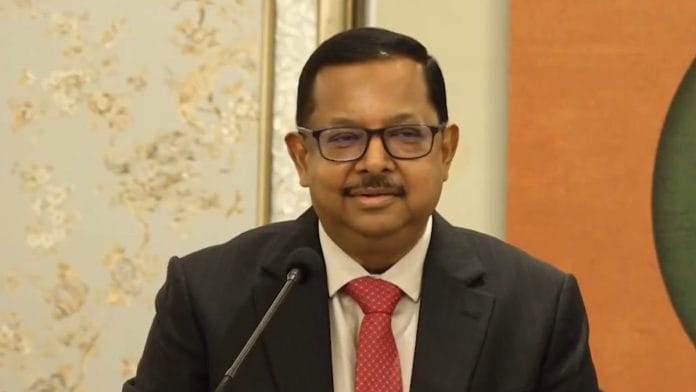

Expressing “grave concern” over how the “detachment” expected of police officers “seems to be disappearing”, Supreme Court Justice Ujjal Bhuyan Friday said that seeing young Indian Police Service officers “personally going and assaulting protesters and demonstrators” is very “distressing”.
In his address at the launch of retired IPS officer and former secretary (security) Yashovardhan Azad’s book ‘Policing the Republic’, Justice Bhuyan said, “All of us are dismayed when we see young officers of the Indian Police Service personally going and assaulting protesters and demonstrators. This is something very, very distressing to observe.”
We still look towards the police force “at times of crisis and when the need arises”, he added. “However, there are certain issues which cannot be brushed aside.”
He further brought up the issues of custodial torture and extra-judicial killings.
“For most common people, a policeman on the street wielding a whistle and a lathi represents the power and authority of the State. When they feel wronged, they seek the help of the police. It is, therefore, of utmost importance that the police force maintains its credibility,” he remarked.
Here’s the full text of Justice Bhuyan’s speech:
A very good evening to all of you.
At the outset, I thank Mr. Yashovardhan Jha Azad, the author of the book which we have just unveiled, for inviting me to this function. I take this opportunity to compliment and congratulate him for his very well-written and well researched book Policing the Republic which promises to give us an insider’s view of how our country fights corruption and crime while protecting the rights of the citizens.
The book is contemporary and extremely relevant in today’s context.
I must confess that as of today, I have only flipped through the book and speed read the pages but this is a book which requires serious reading and attention. I have promised myself to do that in a couple of long weekends which we have
in the next two months.
Yashovardhan Azad Jha is a highly decorated police officer belonging to the Indian Police Service. In a career spanning four decades starting from 1976 till his retirement, he served in the Madhya Pradesh Police in various capacities, as the Special Director of the Intelligence Bureau, besides serving as the Secretary (Security) to the Government of India.
During his service career, he has had extensive operational experience in counter terrorism and internal security operations, besides being a driving force in national security strategy and intelligence gathering. After his superannuation, Yashovardhan Jha Azad was appointed as the Central Information Commissioner in which capacity the record discloses that he had delivered more than 8,000 decisions under the Right to Information Act, 2005. He is also a very sought after public commentator and critic on various societal issues but focusing primarily on police and policing.
And now, he has ventured into writing. Given his track record as a highly efficient police officer, Information Commissioner and with his ability to critically look at things, I am sure we will see a new avatar of Yashovardhan Jha Azad as a distinguished and an insightful writer. Therefore, I see the writing and launch of this book as the beginning of a new chapter in the life of Yashovardhan Jha Azad.
Once again, many congratulations.
Yashovardhan Azad, it seems, has imbibed many qualities of his illustrious father Bhagwat Jha Azad, who was a noted freedom fighter. He had actively participated in the Quit India movement in 1942 and had made tremendous sacrifices including suffering physical injury for participating in the freedom struggle. His passion and commitment to freedom led people to refer to him as ‘Azad’ which means ‘free’ and which got suffixed to his name. In independent India, he was a long-term Member of Parliament from Bihar and became a Union Minister. Later, he served as the Chief Minister of Bihar.
While going through the pages of Azad’s book, I was reminded of an event in my earlier years at the Bar. I had joined the Bar in March, 1991 and in June of that year, there was an annual festival organized by the Bar Association and I won the first prize in the quiz competition. In the meeting coinciding with the prize distribution ceremony, the then Chief Justice of the Gauhati High Court Justice Ullal Laxminarayana Bhat gave me a copy of the Companies Act, 1956 as my prize and as he handed over the book to me, he said, company lawyers make a lot of money. I accepted the prize with great reverence but it was the speech delivered by the former Chief Minister of Assam Sarat Chandra Sinha which has remained etched in my memory till this day. He was a leader of tall stature; a statesman and in his later life kept himself aloof from power politics. That evening, he spoke with a great deal of passion. He spoke about criminalization of politics and politicization of crime.
As a young lawyer, I listened to him with rapt attention. Without taking any individual names and without mentioning any wing of the government, he said, when there is an avalanche, it does not distinguish between any biological species. When we came back home, as was the practice at our home, we discussed about the speech of Sarat
Chandra Sinha. My father explained to me that what Sinha conveyed was that corruption was eating into the vitals of our country and that it had affected all the three wings of the State. Where there is a societal degradation, the legislature, the executive and the judiciary are equally effected.
That was in 1991. Today we are in 2026. If it was true then, it is equally if not more true today.
Coming back to the book, the same is like a panorama covering all aspects of policing: from corruption to crime to terrorism to protection of rights and interestingly, the book also deals with the significant role played by Yashovardhan in cricket diplomacy and the security concerns in the wake of the Indian cricket teams tour to Pakistan in 2003-04.
Indian Police Service is an all-India service assigned with the very important task of policing the nation. On April 20, 1947, on the eve of independence, the venerable Sardar Vallabhbhai Patel, who was then the Home Member, Government of India and who became the first Home Minister of independent India, addressed the probationers of the All India Administrative Service at the All-India Administrative
Service Training School at Metcalf House, Delhi.
He said:
“As all of you are aware, the days of the Indian Civil Service of the old style are going to be over and in its place we have brought into being the All-India Administrative Service. The change is both significant and epoch making. The days when the Service could be the masters are over and the officers must be guided by a real spirit of service in their day to day administration. It will be your bounden duty to treat the common men in India as your own or to put it correctly, to feel yourself to be one of them and amongst them, and you will have to learn not to despise or to disregard them. In other words, you will have to adopt yourselves to democratic ways as opposed to purely imperialistic ways of administration. Above all I will advise you to maintain the utmost impartiality and incorruptibility of administration. A civil servant cannot afford to, and must not, take part in politics. Nor must be involved in communal wrangles. To depart from the path of rectitude in either of these respects is to debase public service and to lower its dignity. Similarly, no service worth the name can claim to exist if it does not have in view the achievement of the highest standard of integrity.”
Prophetic words indeed.
If that was true for the civil services, it was equally true for the police service.
If that was relevant in 1947, it is even more relevant today 80 years later.
Police officers, policemen and policewomen in India work under trying conditions ranging from inadequate infrastructure, including housing, to lack of adequate technology, shortage of manpower, which hampers their functioning while discharging their duties. Even then, all of us will acknowledge that at every stage of the police hierarchy, there are very competent and courageous police officers and personnel who are honest to the core. They go about doing their duties silently but efficiently away from the limelight.
I remember, as a Judge of the Gauhati High Court, I had attended an awareness programme organized by the Assam Police Accountability Commission at the district headquarter town of Lakhimpur. I had remarked that there has to be a reorientation of the police force: from a force that was used to suppress the native people to ensure that the colonial power continued to maintain its grip over the country to that of a modern and sensitive force that has to perforce perform the role of a friend and protector of the people in independent India.
Viewed in that context, there is no contradiction between police or policing and human rights. Policing and upholding human rights are not mutually antagonistic. There can be effective policing without any excess or infringement of human
rights.
For most common people, a policeman on the street wielding a whistle and a lathi represents the power and authority of the State. When they feel wronged, they seek the help of the police. It is, therefore, of utmost importance that the police force maintains its credibility. It can do so only by strictly adhering to the Constitution of India, by functioning as a truly professional force acting impartially, displaying courage and acting with conviction, maintaining integrity and adhering to secular principles, thereby upholding the rule of law. Most policemen and women do adhere to these principles. Therefore, notwithstanding aberrations here and there, we still look towards the police force at times of crisis and when the need arises.
However, there are certain issues which cannot be brushed aside. One such issue is that of custodial torture. Custodial interrogation of an accused is an important part of the investigative process. The accused is under the custody of the police and the police has got absolute control over the person of the accused during the period of such custody. It is here that the true character of a policeman is most tested; whether you resort to third degree methods for extracting information or use your investigative skills to extract the information without resorting to physical violence.
Custodial violence has always been considered to be a serious breach of the trust entrusted to the policemen to keep the constitutional promise. According to the data placed before the Lok Sabha, as on March 15, 2026, India had recorded 170 custodial deaths in the year 2025-26, up from the figure of 140 in the year 2024-25. These are cruel statistics staring at our face.
Supreme Court in a catena of judgements, particularly in the late 1970s and the 80s, had invoked Article 21 of the Constitution of India and by an expansive interpretation has developed the jurisprudence of civil liberties and human rights which are inseparable from policing. As you all know, Article 21 of the Constitution is a one-line article which says that no person shall be deprived of his life or personal liberty except according to procedure established by law. By judicial interpretation, the expressions ‘life’ and ‘personal liberty’ have been expanded to encompass within its ambit, all that is required for a human being to live life and to be treated as a human being.
The case which immediately comes to mind when we talk of custodial violence is the case of D.K. Basu Vs State of West Bengal. Deprecating custodial violence, more particularly custodial death which is the extreme form of torture in police custody, Supreme Court observed:
“22. Custodial death is perhaps one of the worst crimes in a civilised society governed by the rule of law. Any form of torture of cruel, inhuman or degrading treatment would fall within the inhibition of Article 21 of the Constitution, whether it occurs during investigation, interrogation or otherwise. If the functionaries of the Government become law breakers, it is bound to breed contempt for the law and would encourage lawlessness. No civilised nation can permit that to happen. Does a citizen shed off his fundamental right to life, the moment a policeman arrests him? Can the right to life of a citizen be put in abeyance on his arrest? These questions touch the spinal chord of human rights jurisprudence. The answer, indeed, has to be an emphatic ‘No’.”
All of us are dismayed when we see young officers of the Indian Police Service personally going and assaulting protesters and demonstrators. This is something very, very distressing to observe. The detachment expected of police officers somehow seems to be disappearing, and this is indeed a matter of grave concern.
In that case, Supreme Court issued a slew of directions regarding arrest and interrogation. It is not necessary for me to elaborate on this. But D.K. Basu did not stop at that. Supreme Court acknowledged the need for compensating the victims whose human rights were violated. Such compensation by way of public law remedy would be in addition to compensation under the private municipal law, thus reiterating the principles laid down in Nilabati Behera’s case.
Another issue which is intrinsically connected with policing and human rights is the issue of extra-judicial killings or what is known as fake encounters. Supreme Court took a very serious note on fake encounters in Prakash Kadam Vs. Ramprasad Vishwanath Gupta, and declared in no uncertain terms that fake encounters nullify the very essence of the rule of law. Supreme Court used strong words to deprecate such practice by taking the view that where a fake encounter is proved against policemen in a trial, it must be treated as the rarest of the rare case and they must be given the death sentence. Encounter philosophy is a criminal philosophy.
Government of India in 1977 appointed a National Police Commission for fresh examination of the role and performance of the police both as a law enforcing agency and as an institution to protect the rights of the citizens enshrined in the Constitution. The Commission after an in-depth examination, field research and wide ranging consultations with all the stakeholders, submitted a number of reports to the Central Government including the final report in May, 1981. The reports dealt with wide ranging issues from modalities for inquiry into complaints of police misconduct to securing professional independence for the police.
When the recommendations of the National Police Commission were not implemented, Prakash Singh and others moved the Supreme Court under Article 32 of the Constitution seeking various reliefs. Prakash Singh, an eminent police officer of outstanding competence, was the Director General of Police, Assam besides holding similar positions in other assignments.
In Prakash Singh Vs. Union of India, a three-Judge Bench of the Supreme Court headed by Justice Y.K. Sabharwal, the then Chief Justice of India referred to a research paper political and administrative manipulation of the police published in the year 1979 by the Bureau of Police Research and Development warning that excessive control of the political executive and its principal advisors over the police has the inherent danger of making the police a tool for subverting the process of law, promoting the growth of authoritarianism and shaking the very foundation of democracy. In that context, Supreme Court declared that the approach of the police has to be service oriented. The commitment, devotion and accountability of the police has to be only to the rule of law.
This judgment also refers to a letter dated 03.08.1997 of the Union Home Minister addressed to the State Governments. The Union Home Minister expressed the view that popular perception all over the country appears to be that many of the deficiencies in the functioning of the police had arisen largely due to an overdose of unhealthy and petty political interference at various levels. The Union Home Minister was of the view that rising above narrow and partisan considerations, it is of great national importance to insulate the police from the growing tendency of partisan or political interference in the discharge of its lawful functions of prevention and control of crime including investigation of cases and maintenance of public order. In that judgment, Supreme Court issued a series of directions including constitution of state security commission, selection and minimum tenure of the Director General of Police, separation of police investigation, establishment of police establishment board, setting up of police complaints authority etc.
Prakash Singh in his book The Struggle for Police Reforms in India lamented that the directions of the Supreme Court have not been followed in letter and spirit.
Coming back to the book, Policing the Republic, I find that there is a chapter on the beautiful State of Manipur and the tragedy unfolding in that State. Subject to correction, Tagore referred to Manipur as the jewel of India; others would call it the pearl of Asia. Geographically, it is a small state but inhabited by extremely talented people. In a gathering of say hundred people, there would be around 40 to 50 academicians, 20 to 25 theatre personalities and cultural activists of exceptional calibre and the remaining would be sports persons of a high standard. But as the tragic events of Manipur has shown, despite being perhaps the most fortified State in terms of the presence of security personnel, including policemen, paramilitary forces, Assam Rifles and the Indian army, peace continues to remain elusive. In the tragedy of Manipur, there is a lesson for all of us. I leave it at that. May be some other day, we will discuss.
Once again, I thank Yashovardhan Azad for inviting me to unveil this very important book. I wish the author and the publishers the very best. I am sure the panel discussion which follows will be a vibrant and a robust one. I would have loved to stay back but because of prior commitment, I would have to leave. Please excuse me for that.
Thank you very much.
Have a wonderful evening and God bless.
Also Read: In SC judge Ujjal Bhuyan’s candour beyond the courtroom, some questions for the judiciary