





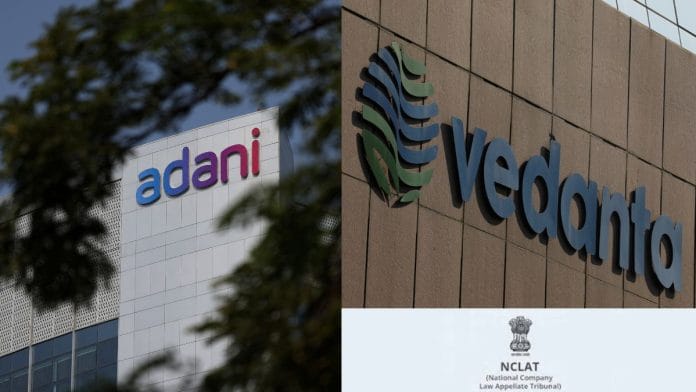


New Delhi: Relying on the “commercial wisdom” of creditors in insolvency proceedings, the National Company Law Appellate Tribunal (NCLAT) has cleared the path for Adani Enterprises to acquire Jaiprakash Associates Ltd (JAL), dismissing a legal challenge from Vedanta Ltd whose bid had a higher total Net Present Value (NPV).
On Monday, a bench of Chairperson Justice (Retd) Ashok Bhushan, a former Supreme Court judge, and Barun Mitra (Member, Technical) upheld the right of the Committee of Creditors (CoC) to prioritise immediate upfront cash over deferred long-term payments when in a race for distressed assets.
The 96-page decision of the tribunal said “commercial wisdom of the CoC enjoys primacy and cannot be supplanted by judicial review”. The bench went on to warn that unsuccessful applicants often use the judicial system strategically to reopen commercial decisions under the guise of procedural flaws, which “erodes the value of the Corporate Debtor”.
Crucially, the NCLAT found no “material irregularity” in how the Resolution Professional (RP)—appointed by the National Company Law Tribunal (NCLT)—or the CoC conducted the process, thereby upholding the March decision of the NCLT Allahabad bench that the Adani plan was feasible, viable and met all statutory requirements under the Insolvency and Bankruptcy Code (IBC).
Adani Enterprises has filed a caveat in the Supreme Court in anticipation of Vedanta’s appeal against the NCLAT order.
Also Read: Meta & WhatsApp step back, tell SC they’ll comply with take-it-or-leave-it NCLAT privacy order
Battle of billions
Indian conglomerate JAL, flagship company of Jaypee Group, is involved in engineering, construction, cement and real estate. The Corporate Insolvency Resolution Process (CIRP) against the company began in June 2024 on an application by ICICI Bank.
Under the IBC, a CIRP is initiated by creditors or debtors when a company defaults on payments, aiming to restructure debt or liquidate assets to maximise value.
By early 2025, the RP—appointed to conduct the insolvency resolution process and replace the Board of Directors in driving the CIRP—had invited Expressions of Interest, drawing major industry players, including Vedanta, Adani Enterprises, Dalmia Cement, and Jindal Power; thereby setting off a corporate tussle with billions at stake.
In September 2025, during a Challenge Process, Vedanta emerged as the highest bidder on an NPV basis, offering a proposal valued at Rs 12,505.85 crore after five rounds of bidding.
Despite this seemingly superior offer, the Committee of Creditors (CoC) ultimately moved to approve the plan submitted by Adani Enterprises Ltd with a high 93.81 percent vote share.
‘Addendum’ controversy
The crux of the dispute lay in how the bids were scored.
The CoC employed a structured ‘Evaluation Matrix’ which allocated 80 marks to quantitative parameters and 20 to qualitative factors. While Vedanta secured the maximum 35 marks for its NPV, it lagged significantly in the ‘Upfront Cash Recovery’ section.
The NCLAT’s Monday order noted that Adani Enterprises offered substantially higher immediate liquidity to the secured financial creditors. Specifically, Adani proposed an upfront cash recovery of Rs 6,005 crore, whereas Vedanta’s original final plan offered only Rs 3,770 crore, or almost half. Adani Enterprises also committed to completing payments within two years, while Vedanta’s payout schedule stretched to five.
The NCLAT emphasized that the CoC is not legally bound to pick the highest NPV. The order noted that under the Request for Resolution Plan (RFRP), the CoC “is under no obligation to any of the Resolution Applicants… to approve a Resolution Plan which has the highest NPV”. The tribunal ruled that the creditors’ preference for “immediate realisable value” over long-term projections was a valid exercise of commercial judgment.
Realizing that its lower upfront cash offer was a weakness, Vedanta sent an unsolicited “Addendum” via email on 8 November, 2025—just two days before voting was set to begin. In this, Vedanta attempted to nearly double its upfront payment to Rs 6,563 crore and increase its equity infusion from Rs 400 crore to Rs 800 crore.
The CoC refused to consider this late-stage improvement. Vedanta argued this was a “clarification” that furthered the IBC’s goal of value maximisation. The NCLAT disagreed, characterising the Addendum as a “unilateral and unsolicited action” intended to “improve” scoring after the formal bidding process had closed.
The tribunal held that allowing such a modification would have “vitiated the entire process” and even invited litigation from other bidders. It said the tribunal found that the email “had effect of modification of the Resolution Plan… and could not be held to be only clarificatory”.
The ruling heavily cited the principle that courts should not second-guess the business decisions of creditors. Citing the preface to the Supreme Court ruling of February this year in Torrent Power Ltd. vs. Ashish Arjunkumar Rathi and Others, the NCLAT noted that the IBC represents a shift to a “creditor-driven process” where decisions on valuation and “acceptable haircuts” are commercial, not judicial.
(Edited by Nardeep Singh Dahiya)