



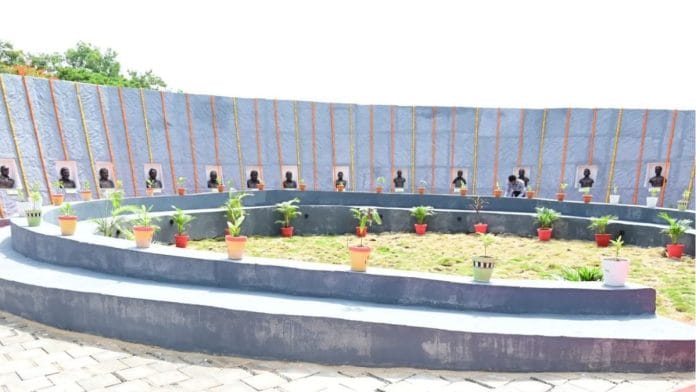
New Delhi: The 2013 Jheeram Valley massacre—which left 27 people dead and 33 severely injured, wiping out almost the entire top brass of the Chhattisgarh Pradesh Congress Committee—was “not an opportunistic act of violence but a meticulously planned, cold-blooded terrorist operation”, a special NIA Court held while sentencing 10 Communist Party of India (Maoist) cadres to death last week.
Comparing the scale of the attack with the 2008 Mumbai terror attack, the court also pointed to evidence that Maoist commanders specifically selected Jheeram Valley for its topographical vulnerability, with steep hills on one side and a gorge on the other. The court also said the evidence pointed to prior reconnaissance and rehearsals.
The perpetrators, the court noted, deployed 8-9 kg of high-grade military explosives, felled trees to trap the convoy and positioned shooters on surrounding hilltops who discharged over 206 rounds directly at civilian and police vehicles.
A key factor behind the court’s justification for capital punishment was what it described as the “unprecedented degree of cruelty, barbarity, and cold-blooded calculation”.
The judgment said that when Congress leader Mahendra Karma surrendered to protect others, the attackers dragged him into the forest, shot him at close range, smashed his face with heavy boulders, and stabbed his corpse repeatedly with knives.
The court said medical evidence confirmed dozens of severe injuries on his body, while eyewitnesses recounted how the attackers performed a celebratory victory dance around his corpse, demonstrating a “complete absence of human feeling or remorse”.
The court further held that the attack constituted a direct assault on “democratic governance and the constitutional sovereignty” of India. By targeting political leaders during an ongoing electoral campaign (Parivartan Yatra) and chanting slogans calling for the elimination of police personnel and state leaders, the Maoists sought to destabilise state institutions by creating terror and panic, the judgement said.
Security personnel, personal security officers, drivers and bystanders were also among those killed.
This judgement came months after Union Home Minister Amit Shah declared India and the Bastar region in Chhattisgarh effectively “free from Naxalism” in May, 2026, following a government deadline of 31 March 2026 to eliminate left-wing extremism.
Those killed included prominent political figures such as Mahendra Karma, former minister and founder of the anti-Maoist tribal movement Salwa Judum; Nand Kumar Patel, then state Congress chief; his son Dinesh Patel; former MLA Uday Mudaliyar; and former Union Minister Vidya Charan Shukla, who suffered multiple gunshot wounds and succumbed during treatment.
Security personnel, personal security officers (PSOs), drivers, and innocent bystanders were also killed.
Twenty-seven other co-accused commanders, including top leaders Deva, Vinod, Surender, and Sonadhar, remain absconding, with their trials pending upon arrest. One co-accused died in custody during the trial.
In the final sentencing order pronounced on 16 September following the conviction ruling on 5 September, Special Judge Ajay Singh Rajput held all 10 accused guilty under multiple provisions of the Indian Penal Code (IPC), the Unlawful Activities (Prevention) Act (UAPA), the Explosive Substances Act, and the Arms Act.
“The manner in which the crime was committed exhibits an unprecedented degree of cruelty, barbarity, and cold-blooded calculation. Surrendered, unarmed victims were not merely shot; their bodies were mutilated with sharp weapons and crushed with stones while the perpetrators celebrated. Such acts shock the collective conscience of a civilized society,” the 185-page judgement written in Hindi reads.
Ambush in the dense forests of Bastar
The incident took place on 25 May 2013 at about 4:30 pm along National Highway 221, now NH 31, in the forested terrain of Jheeram Valley (Jheeram Ghati), under the Darbha Police Station in Bastar district.
A convoy of about 20 vehicles carrying leaders, office-bearers, security personnel, and workers of the Chhattisgarh Pradesh Congress Committee was returning from a public rally in Kesloor after concluding the party’s Parivartan Yatra in Sukma.
The heavily forested valley in the Bastar region of Chhattisgarh was one of the operational strongholds of the Communist Party of India (Maoist) “Red Corridor”.
As the convoy crossed a curve flanked by steep hills on one side and a deep gorge on the other, a large improvised explosive device (IED) was detonated beneath the leading vehicles. The explosion hurled vehicles into the air and shattered the convoy, while Maoist teams blocked the narrow passage by felling trees, trapping nearly 150 political figures, police bodyguards, and civilians.
The judgement said that 150 to 200 heavily armed Maoist insurgents positioned on surrounding hilltops unleashed an indiscriminate barrage of high-caliber gunfire and hand grenades lasting nearly two hours.
What the NIA alleged: A pre-planned terror campaign
The investigation, initially registered as an FIR at Darbha Police Station, was taken over by the National Investigation Agency (NIA) two days later. The NIA argued in court that the attack was not an opportunistic assault but part of a long-term, pre-planned conspiracy hatched by the banned outfit CPI (Maoist) under its Tactical Counter Offensive Campaign (TCOC).
The NIA presented extensive forensic, testimonial, and documentary evidence proving that high-level strategic meetings were held between 16 February and 25 February 2013 by the South Regional Unified Command and the Dandakaranya Special Zonal Committee (DKSZC) in the forests of Darbha and Pidiyacode.
The agency also said that Maoist commanders, including Surender, Vinod, Deva, and Sonadhar, conducted detailed reconnaissance of the highway and held dry-run rehearsals six to seven days before the attack near Akam-Chakpal.
The NIA alleged that local village militia (Janmilitia) and local cadres were also forced or deployed to stockpile over 25 bags of rice, cooking rations, and supplies at temporary forest camps, along with 8 to 9 kilograms of high-intensity explosives.
It added that the primary objective of the operation was the targeted assassination of Mahendra Karma, who had been on the top of the Maoists’ hit-list since 2005-2006 due to his leadership of Salwa Judum. The attack was also aimed at eliminating the state political leadership and waging war against the constitutional authority of India, it said.
The agency alleged that after the massacre, the insurgents searched the victims and vehicles and looted nine AK-47 rifles, seven INSAS rifles, two SLR rifles, nine 9mm pistols, ammunition magazines, wireless sets, cash, and personal belongings.
Who are the convicts on death row?
Pramila Modiyam was a female Maoist commander, who the NIA alleged was actively involved in the military formation and was armed with a 12-bore gun. The NIA said she opened fire directly on the convoy.
According to the agency, Banjami Sanna was a local committee secretary, responsible for collecting funds, enforcing village blockades, organising militia logistics, and extracting supplies for the strike team.
Aayta Madkam was an active cadre accused of facilitating the movement of explosives and armed insurgents through the Darbha corridor.
Muka Mandavi was accused of coordinating local militia gathering and securing the perimeter during the ambush. Madkami Deva was an active operative accused of assisting in positioning weapons and looting arms from fallen police officers.
Chetu Lekam was the platoon commander/cadre recruited in 2007. The NIA said he was armed with an INSAS rifle during the attack and had confessed to firing 10 rounds at the convoy and witnessing the execution of leaders.
Kawasi Kosa was accused of being involved in the recovery and concealment of looted automatic weapons, bombs, and ammunition. Mahadev Nag was accused of storing 25 bags of rice and ambush rations at his residence before the attack, and standing armed within 20 metres of the blast site.
Joga Madkami was accused of managing local intelligence and tracking the Naxalite movement for the strike team. Sumitra was a female cadre who was accused of participating in active militia meetings, weapons maintenance, and ambush field support.
All of them were between the ages of 25 and 40 at the time of the attack.
During the sentencing hearings, the defense counsel said that Chhattisgarh had officially declared itself “Naxal-free” as of 31 March 2026, arguing that the threat of Maoist violence was neutralised and the convicts possessed full potential for social reformation.
“Rarest of rare”
Rejecting the defense’s plea for leniency, Special Judge Ajay Singh Rajput relied on precedents in holding that the aggravating factors completely overwhelmed any mitigating claims.
The court highlighted the horrific manner of the killings recorded by eyewitnesses and medical officers.
It said that when Mahendra Karma surrendered to save the lives of others, calling out his identity, the Maoists dragged him into the forest. Medical reports confirmed that he suffered multiple bullet wounds, over 69 distinct injuries, was repeatedly stabbed with daggers and knives, and had his face and skull crushed with heavy boulders.
Eyewitnesses testified that the attackers performed a celebratory victory dance around his body, shouting slogans of “Maoist Zindabad”.
Similarly, Nand Kumar Patel and his son Dinesh Patel were bound tightly with ropes behind their backs, dragged into the deep forest, and executed at point-blank range, the court said.
The court observed that the attack was designed to destabilise the democratic structure of the country by murdering political representatives during an electoral campaign.
Citing the Kasab case (2012), the court ruled that when an armed group unleashes mass violence using military-grade explosives and automatic weapons to terrorise society and wage war against the state, it transcends conventional criminal homicide and constitutes a severe act of terror.
“This was not an ordinary murder; it was a waging of war against the Constitutionally established Government of India. Over 206 rounds were fired into civilian and security vehicles, destroying democratic leadership and killing 27 human beings. The primary intention was to instill paralysis, terror, and fear across the nation,” the judge noted in Hindi.
Evaluating the jail reports, the court found that all 10 convicts were physically and mentally mature adults who consciously participated in a complex terrorist operation. They held loaded weapons, fired on innocent citizens, actively looted government arms, and provided crucial operational support over weeks of planning.
The court noted that their active, unrepentant role throughout the ambush barred any inference of reformative potential.
Concluding the sentence, the Court stated that “the option of life imprisonment is unquestionably inadequate”.
In accordance with law, the death sentences have been submitted to the Chhattisgarh High Court for formal confirmation, and the convicts have been remanded to Central Jail, Jagdalpur, pending appellate review.
(Edited by Sugita Katyal)
Also Read: 2013 Jheeram Ghati naxal attack: Special NIA court convicts all 10 accused