





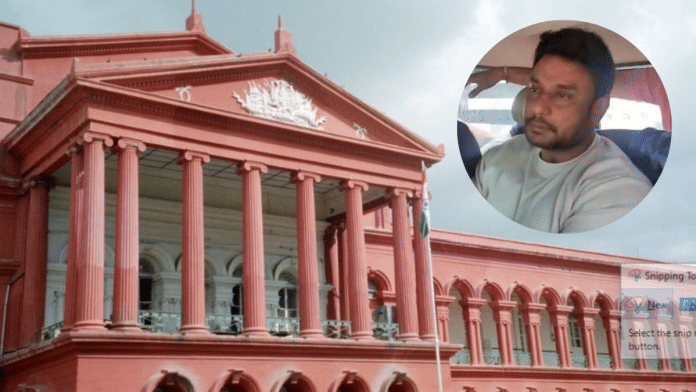


New Delhi: Turning down the Karnataka government’s plea urging cancellation of bail to four accused in the 2024 Renukaswamy murder, the Karnataka High Court held that the Supreme Court’s decision to set aside bail granted to the prime accused, actor Darshan, cannot be a ground to set aside the relief given to his co-accused by a trial court.
Justice S. Rachaiah pointed out that the accused were neither celebrities nor influential persons, adding that they have neither violated the bail conditions nor have “they misused the liberty granted to them”.
The court also noted that Darshan’s case, where the Supreme Court set aside the bail granted to him in August last year, was “entirely different” from the facts and circumstances in the present matter.
One of the grounds for the cancellation of the bail given to Darshan and co-accused, girlfriend Pavithra Gowda, were their standing as celebrities and that there may be chances of tampering with the prosecution witnesses.
However, in the present case, the accused were “neither influential nor celebrities” and their entire family was dependent on their income.
The court noted that bail is the rule and jail the exception, and that its cancellation requires cogent and overwhelming circumstances, which were absent.
It also pointed out that cases involving either celebrities or common men must be treated equally to render justice.
“The process of granting or rejecting bail falls within the discretionary power of the court, which must be exercised judiciously,” the judge said. “It is equally important to mention that merely because the respondents are linked to a case where celebrities are co-accused is not a ground to set aside their bail.”
Although the order was reserved in April, it was pronounced in June, after a gap of nearly two months.
What the case is about
In June 2024, Kannada actor Darshan Thoogudeepa along with his girlfriend Pavithra and others were accused in connection with the Renukaswamy murder case.
Subsequently, the Supreme Court on 14 August that year cancelled the bail granted to the actor and the other accused persons.
Darshan, Pavithra and fellow co-acused were accused of abducting and torturing 33-year-old Renukaswamy, a fan who allegedly sent obscene messages to Pavithra.
According to the police version, the victim was held in a shed in Bengaluru for three days in June 2024 and tortured. His body was recovered from a drain.
In its judgment passed 10 June, the court held that bail is the rule and jail is the exception, and the principle applies to all cases. “All cases must be treated alike,” it said, adding that each application needs to be dealt with considering its nature, gravity and impact on society.
“In criminal jurisprudence, the accused is presumed to be innocent and the prosecution has to prove the case beyond reasonable doubts. Until the accused is proven guilty, the personal rights and liberty cannot be deprived,” the court said.
Appreciation of evidence was impermissible now in this case since the Supreme Court had already laid down the ratio with respect to the grant, annulment or cancellation of bail, it added.
Significantly, the court pointed out that the accused persons worked in the houses of the main accused, and were seen chatting with Renukaswamy. Meanwhile, the specific act attributed to the other accused was that he had assaulted Renukaswamy inside the shed.
Finally, the court said that simply because the accused were linked to a matter where their co-accused was a celebrity, it will not be a ground to set aside their bail order. Moreover, it said that the accused were otherwise also entitled for bail, if their covert acts were taken into consideration.
The case
On 20 June, the Karnataka HC set aside the Karnataka government’s plea seeking to set aside an order passed in December 2024 by the Bengaluru sessions court, where the accused including Puttaswamy and Raghavendra N. were granted bail.
The trial court had found that the grounds of arrest were not properly served to the accused. The HC upheld this order, saying that setting aside bail is a serious matter involving deprivation of personal life and liberty.
“The law does not permit annulment of bail order, unless there are cogent and overwhelming circumstances which threaten the fairness of the trial,” it held.
Essentially, the Karnataka government’s case was that the accused Puttaswamy worked as a security officer in an apartment complex by the name of ‘Sattva Anugraha’ which was situated at Summanahalli, Bengaluru.
On 9 June, 2024, Puttaswamy had said that he saw a man’s body lying near a storm-water drain there. He claimed to have immediately informed the police.
Investigation, however, revealed that certain accused persons voluntarily admitted their guilt. Later, the police found some more persons who were linked to the murder and a chargesheet was filed.
The accused persons had then approached the trial court, which granted them bail in December, 2024.
The Karnataka government contested the bail in the high court. The prosecution argued that the Supreme Court had set aside the bail order of Darshan—the main accused—on grounds that the arrest was a procedural lapse, but that in itself did not entitle the accused for bail, or render his custody illegal.
The prosecution argued that in furtherance of a common intention, the accused murdered Renukaswamy “brutally”, and at least 39 injuries were found on the body.
It added that there were eyewitnesses, and that bail should not have been granted by the trial court in the first place.
On the other hand, the lawyer for the accused argued that setting aside bail is a serious matter, involving the deprivation of life and personal liberty, and that the law did not justify setting aside such orders, without compelling reasons.
(Edited by Tony Rai)
Also Read: Why SC cancelled actor Darshan’s bail, pulled up HC for ‘mechanical exercise of discretion’