





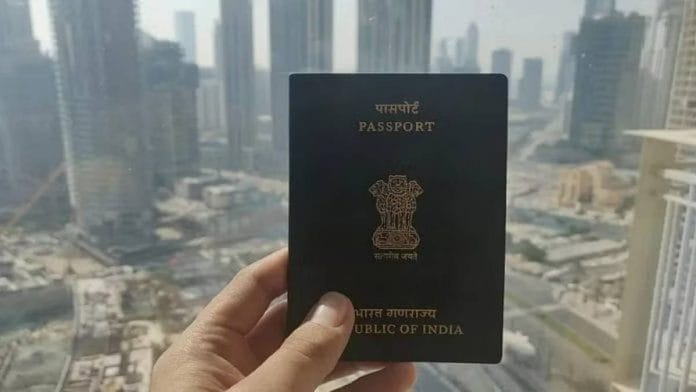



New Delhi: Underlining that the law does not bar a person facing criminal proceedings from getting a passport, the Supreme Court has allowed a person facing charges under the Unlawful Activities (Prevention) Act to renew his passport.
A two-judge bench of Justices Vikram Nath and A.G. Masih said freedom to travel was a fundamental right guaranteed by Article 21, which protects right to life and personal liberty.
“The freedom of a citizen to move, to travel, to pursue livelihood and opportunity, subject to law, is an essential part of the guarantee under Article 21 of the Constitution of India,” the court observed.
The bench added that while the government may regulate or restrain this freedom in the interests of justice, security or public order, such restrictions must be confined to what is necessary, proportionate to the object sought, and clearly anchored in law.
The 37-page order was passed while the court was acting on a plea by Mahesh Kumar, whose passport expired in August 2023.
Agarwal was charged with offences like raising funds for terrorist activities under the UAPA, criminal conspiracy and causing the disappearance of evidence.
He is also facing trial in a 2018 case involving allegations of extortion, levy collection and related activities in the Amrapali and Magadh coal mining areas in Jharkhand, including alleged funding of a banned organisation.
Recalling its landmark rulings in the 1978 Maneka Gandhi vs Union of India and 2004 Navin Jindal vs Union of India cases, which upheld the right to travel abroad and to hold a passport as facets of the fundamental right to life under Article 21, the court said it can only be restricted if it is fair, just and reasonable, and bears a “rational nexus with a legitimate purpose”.
Before Agarwal’s passport expired, an NIA Court in Ranchi had allowed the release of his passport only for renewal and directed him to deposit the renewed passport with the court. He was barred from travelling abroad without permission.
In May 2022, the Delhi High Court suspended his sentence in the coal block case and raised no objection to him renewing his passport for 10 years. However, it said that this was on the condition that he would not leave the country without seeking permission.
Although the Delhi High Court and the NIA court had allowed him to renew his passport, the Regional Passport Office in Kolkata refused to renew it.
It cited Section 6(2)(f) of the Passports Act, which allows passport authorities to refuse a passport or travel document if criminal proceedings are pending and a person has been sentenced to at least two years of imprisonment.
Agarwal approached the Calcutta High Court, which also dismissed his plea for renewal. He subsequently approached the top court.
Also Read: What Madras HC said slamming practice of seeking husband’s nod for a woman to apply for passport
What Supreme Court said
After analysing the provisions of the Passports Act, 1967, the court noted that Section 22 empowers the Centre to exempt any person or class of persons from specific provisions of the Act, subject to conditions it deems necessary in public interest.
Based on this provision, the Centre issued a notification exempting people facing criminal proceedings from the bar under Section 6(2)(f) provided they obtained permission from the relevant court and complied with the conditions in the notification. The court said the notification recognised that people facing criminal proceedings are not barred from getting a passport. “Instead, it permits such persons to obtain a passport,” it observed.
The court added that this is subject to the relevant criminal court considering the matter and passing an order on the issuance or use of the passport, and the applicant giving an undertaking to appear before the court when required.
The court said the notification links the exemption to the conditions imposed by the criminal court, while adding that if the court specifies a period for which the passport is to be issued, the passport authority must honour that period.
“Where the court does not stipulate any period, the notification provides default rules, including issuance for a shorter period, ordinarily one year, in appropriate cases,” it said.
The court clarified that the government notification does not insist that criminal courts must grant prior blanket permission to “depart from India” in every case. It added that a “no objection certificate” or permission from the criminal court, along with the applicant’s undertaking, was enough for passport renewal.
Such a procedure can even “override an adverse police report with reasons recorded by the Passport Officer” and can also address cases where more than one court is involved, indicating that the orders of all such courts are to be read together.
“The Calcutta High Court has treated Section 6(2)(f) as an unyielding bar so long as any criminal proceeding is pending, unless the criminal court simultaneously authorises a specific foreign trip for a defined period,” the court said.
The Passports Act does not require criminal courts to convert every permission into a one-time licence to undertake a particular journey, the division bench said.
It added that it equally permits the court to renew passports while retaining complete control over each instance of foreign travel by insisting on its prior leave, as both courts have done in the present case.
(Edited by Sugita Katyal)
Also Read: 80 lakh e-passports issued since May, all passports to be chipped by May 2035—MEA