





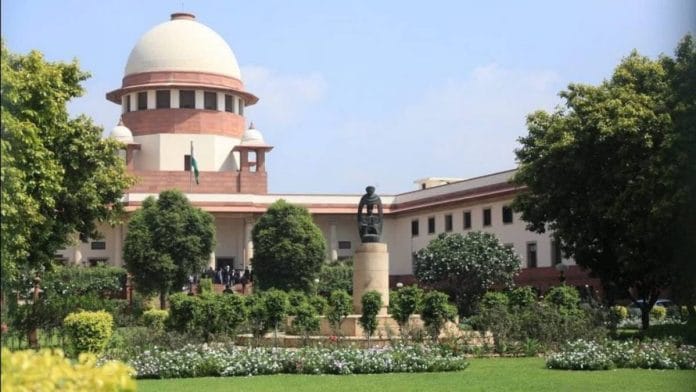



New Delhi: Can a cooperative society buy or invest in a company during insolvency proceedings under the Insolvency and Bankruptcy Code (IBC)?
Yes, said the Supreme Court on Thursday—but within limits.
In a ruling that will shape the rights of cooperative societies in future insolvency proceedings, the top court ruled that Multi-State Co-operative Societies (MSCS) can bid to occupy the company under the IBC, only if their investment is in the “same line of business” as the debtor.
The case stemmed from the Corporate Insolvency Resolution Process (CIRP) of Morarji Textiles Ltd, in which a cooperative society, Nirmal Ujjwal Credit, tried to acquire the debtor in 2024.
Nirmal Ujjwal Credit, which operated a textile unit called ‘Nirmal Textile’ in Nagpur, submitted a formal expression of interest and a subsequent resolution plan totalling Rs 169 crore to acquire Morarji Textiles.
But the Resolution Professional (RP) and the Committee of Creditors (CoC) rejected the bid, saying the cooperative society was ineligible as its bye-laws didn’t allow it to make such an investment, and because the cooperative society and corporate debtor were not in the same line of business.
The National Company Law Tribunal and the National Company Law Appellate Tribunal (NCLAT) also agreed.
The appeal eventually reached the Supreme Court.
While the cooperative society sought to withdraw its appeal after the judgement was reserved following the hearing of arguments, a bench of Justices J.B. Pardiwala and K.V. Viswanathan used the case to clarify the principles for future insolvency proceedings governing the Multi-State Cooperative Societies (MSCS) Act, 2002, and the IBC.
In a 30-page judgement, the court said that Section 64(d) of the 2002 Act permits an MSCS to invest or deposit its funds in two distinct categories of institutions: a subsidiary institution and any other institution in the same line of business.
Same line of business
The core of the legal debate involves Section 64(d), which governs how a society may invest its funds.
On 3 August 2023, the Ministry of Cooperation significantly amended this section to curb the misuse of members’ money, stipulating that an MSCS may only invest in the shares, securities, or assets of a subsidiary institution or any other institution in the same line of business as the society itself.
The court said the Joint Parliamentary Committee (JPC) examining the amendment to Section 64(d) of the 2002 Act noted that the existing provision permitting investment in “any other institution” was open-ended in nature and had given rise to concerns of misuse.
“The Ministry of Cooperation, in its comments, specifically highlighted that the absence of any limiting standard had enabled certain societies to deploy funds in a manner that did not align with prudential considerations,” the court said.
“The rationale of the amendment was tied to the broader objective of ensuring the safety and security of members’ funds and strengthening governance standards,” it added.
Defining the ‘same line of business’
A critical question before the court was the meaning of the phrase “same line of business”, which is not explicitly defined in the MSCS Act.
The Supreme Court held that this must be determined by examining the core business activities of both the MSCS and the target institution. Also, there must be a predominant or substantial sameness in business, rather than a remote or incidental connection.
The court clarified that the bye-laws of the MSCS serve as the decisive charter document for this inquiry. In this case, the bye-laws primarily characterised it as a financial service provider focused on accepting deposits and advancing loans to its members.
While its bye-laws permitted the processing of “agro-products”, the court found this was a “limited” vertical compared to its primary financial functions.
The court noted that the company under insolvency and the appellant, or the cooperative society, operated in “entirely different sectors”.
While the cooperative society’s textile unit focused on agro-based products derived from agricultural sources, the corporate debtor was engaged in the industrial manufacturing of man-made fibre and synthetic textiles using chemical processes.
The Supreme Court agreed with the NCLAT’s reasoning that these activities were not the same.
The court noted that even if both entities broadly fell under the “textile” umbrella, the nature of raw materials, technology, and regulatory environments differed substantially.
Consequently, the appellant failed to meet the threshold of being in the “same line of business” as the target company.
“This expression requires a substantial or predominant, or closely related sameness in business activities, which must be determined with reference to the objects and functions contained in the bye-laws of an MSCS,” it ruled.
Allowing the appellant to withdraw the appeal, the Supreme Court clarified the legality of the law to guide future insolvency proceedings involving co-operative societies.
It directed that the CIRP of Morarji Textiles continue in accordance with the IBC, ensuring that the resolution process moves forward without further delay from the ineligible bidder.
(Edited by Sugita Katyal)