





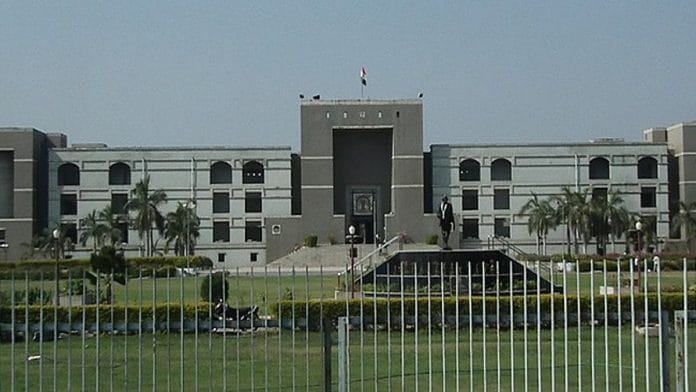


New Delhi: In a big relief to families of road accident victims, the Gujarat High Court has held that the brothers of an accident victim who died in a road accident can seek compensation for his death even if they were not financially dependent on him.
In doing so, a bench of Justice Mool Chand Tyagi set aside a 2014 ruling of the Motor Accident Claims Tribunal (Main), Surat, which partly allowed the claim of the accident victim’s brother, and awarded him a sum of over Rs 2 lakh, along with interest at the rate of 9 percent.
The case dates back to February of 1994, when the late accident victim was travelling on his moped “at very moderate speed and on the correct side of the road”, according to the the order dated 11 June. However, a speeding truck hit him, leading to the rider’s injuries and eventually his death.
In 2014, the tribunal found that the truck driver was responsible on account of his negligence and directed the truck’s owner and driver to pay compensation to the victim’s family. However, they challenged the 2014 order, before the Gujarat HC, which led to the present case.
In its 11 June order, the court rejected the claim of the truck driver and owner, where they argued that the late victim’s brothers were not dependent on him, so they were not entitled to the compensation. The insurance company had argued that the vehicle was not insured, so it was not liable.
Relying on the 2015 ruling delivered by the Supreme Court in Sadhana Tomar’s case where family members including father and younger sister were not entitled to the compensation as they were not dependent, the appellants had opposed the tribunal’s order.
On the other hand, the victim’s brothers argued that after completing the investigation, the investigating officer had filed the charge sheet against the driver, and there was a proper trial in this case. Relying on a host of different judgments passed by the Supreme Court, and the Gujarat HC as well, like Oriental Insurance Company vs. Raman Purshothaman Nair, the claimants argued that under Section 166 of the Motor Vehicles Act, the brothers are legal representatives of the late victim, hence entitled to compensation.
Section 166 of the MV Act, 1988, is a crucial legal provision that allows victims of road accidents, or their legal representatives, to claim compensation for injuries, permanent disability, death, or property damage.
What the court ruled
In the present case, after the truck was found at the place of accident, its owner Rameshbhai Mohanbhai Parmar was cross-examined in court, along with the driver who was brought to the witness box.
Before the court, the driver claimed that he had been falsely implicated in the case. However, given the oral and documentary evidence, the court noted that the tribunal had not committed any error in holding the driver of the offending truck responsible for the accident, owing to his negligence.
Upholding the 2014 order, the court said the victim’s brother was a bachelor, and the victim had no legal representatives. Since the brothers were living separately, and neither was dependent on the other, the court cited Section 166(1)(c) to say that the brothers can claim compensation on account of death.
It was indisputable that the brother was a legal representative, and was entitled to compensation, the court said.
“In view of the catena of judgments of the apex court as well as various high courts, I am of the considered view that the brothers can claim the compensation on account of death of their brother and the claim petition is maintainable under Section 166 of the Motor Vehicles Act,” the court noted.
What the law says
In the 2007 case of Manjuri Bera vs. Oriental Insurance Company, the Supreme Court had noted that a married daughter can also claim the compensation for the death of her parents.
Similarly, in the 2021 ruling in N. Jayasree vs. Cholamandalam Ms General Insurance Company, the court said that the sister and brother’s children can also claim compensation.
“It is thus settled by now that the legal representatives of the deceased have a right to apply for compensation,” the Supreme Court had noted in its 2020 ruling in National Insurance Company Ltd vs Birender.
Even major married and earning sons of the deceased, being legal representatives, have a right to apply for compensation and it would be the bounden duty of the tribunal to consider their applications, the Supreme Court had said, adding that their claim would be considered, irrespective of whether the concerned legal representative was “fully dependent on the deceased” or not.
(Edited by Viny Mishra)
Also read: Haryana youth died in road accident just before joining new job. Why HC tripled compensation to kin