





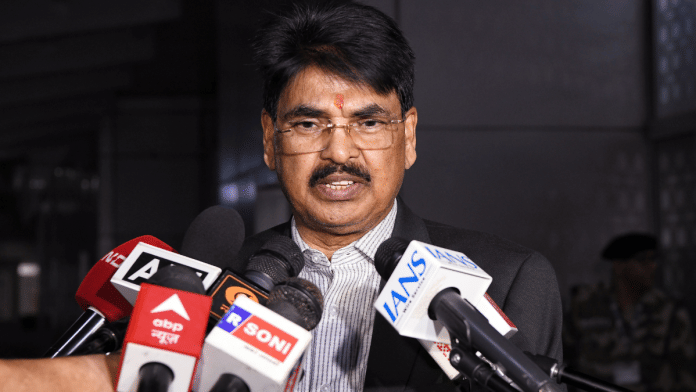


New Delhi: The chairman of the Bar Council of India (BCI), Manan Kumar Mishra, Saturday issued a letter addressed to the nation’s law students to express regret about the “concern and anguish” that has gripped a section of the student community over the past few days.
The statement comes amid the controversy related to a BCI order asking state units not to register as advocates the 2026 graduates of Hyderabad’s NALSAR University of Law due to their objection to the presence of Chief Justice of India Surya Kant at their convocation ceremony, a directive which was later withdrawn. The order had drawn widespread condemnation, and even CJI had Friday sharply pulled up the BCI, saying what was happening at the NALSAR was “a dialogue between students and me”.
Mishra—who is also a sitting Rajya Sabha member elected on a BJP ticket—acknowledged that recent developments caused significant distress, emphasising that whenever students feel aggrieved, “their concerns deserve to be heard with patience, sensitivity and respect”.
He wrote: “If anything connected with the present controversy, any of my words, or letter, has hurt the feelings of our law students, I sincerely regret and apologise for the same.” He went on to dismiss any notions of pride standing in the way of this gesture, asserting that “an expression of regret is not a matter of prestige or ego”, but is instead “simply an acknowledgment that the feelings and concerns of our students matter”.
Mishra defended the capabilities and rights of law students, particularly those at National Law Universities and other leading institutions, describing them as highly informed citizens capable of applying their own independent minds. He declared that “peaceful disagreement, questioning and protest are important features of a constitutional democracy”, affirming that students must always remain free to express their views without being subjected to external pressure. He added that there is no inconsistency in first expressing a genuine grievance, and then objectively considering a subsequent clarification.
With respect to NALSAR’s convocation, the BCI chairman appealed to students to make their own choices without external compulsion, stating that “no student should be compelled to attend, and no student should feel compelled to abstain”. Mishra expressed hope that the issue would be resolved through dialogue and mutual respect rather than acquiring a ” political or extraneous colour through outside influence”. He concluded by urging all institutions to respect the students’ independence of thought and to allow enough space for “dialogue and moving forward without bitterness”.
Earlier Saturday, over 700 students and alumni of the National Law School of India University (NLSIU), Bengaluru, rallied behind students of NALSAR, condemning what they described as the BCI’s “unconstitutional and illegal” action over opposition to the CJI attending NALSAR’s convocation.
In a statement, NLSIU’s graduating Class of 2026, current students and alumni expressed “unconditional solidarity” with NALSAR and accused the BCI and chairperson Mishra of mounting a “direct, coordinated assault” on the fundamental rights of academic communities.
The NLSIU statement called for the BCI to apologise unconditionally to NALSAR students and faculty for what it described as an attempt to infringe their fundamental right to freedom of speech and expression.
The students also demanded that the BCI explain the protocol governing the use of its official letterhead by its chairperson, pointing to the absence of council approval on the initial letter issued to NALSAR.
They also expressed strong disapproval of Mishra attending NLSIU’s convocation without taking responsibility for his actions in the NALSAR controversy.
Supporting NALSAR students’ request to reconsider the CJI as chief guest at their convocation, the NLSIU students said they were equally opposed to the CJI attending their own convocation.
They described the invitation to individuals who had shown “disdain and condescension” towards students as “offensive, humiliating, and a mockery of students and their struggles”.
How the controversy began
The controversy erupted on 13 August, when Mishra issued a BCI letter directing that NALSAR’s graduating Class of 2026 be barred from enrolling with any state Bar Council.
Mishra also directed NALSAR’s Vice-Chancellor to conduct an inquiry to identify students, faculty members and alumni who had expressed dissent over the CJI’s proposed presence as chief guest at the university’s convocation.
Although a second, modified letter permitted the graduates to enrol, it retained the demand for an inquiry and alleged that a “handful of teachers and outsiders” had “instigated innocent students”.
Following intense public backlash, Mishra announced on X later that night that all proceedings against NALSAR had been cancelled.
Despite the withdrawal, the two student bodies have refused to let the matter rest, arguing that withdrawing the threat does not absolve the BCI of accountability for what they describe as abuse of power.
In its statutory and constitutional defence, the NALSAR Student Bar Council argued that the BCI had exceeded its legal powers. It pointed to Section 24A of the Advocates Act, 1961, which sets out the grounds for disqualification from enrolment, arguing that a ban based on political expression was not legally authorised.
The students also argued that the BCI’s reliance on the Supreme Court judgment in ex-Capt. Harish Uppal v. Union of India was “fundamentally misplaced”, as the judgment was about regulation for practising advocates during court strikes and did not give the BCI power to intervene in the internal affairs of universities.
Citing Supreme Court judgments including Javed Ahmad Hajam v. State of Maharashtra, they argued that lawful dissent is an integral part of the freedom of speech guaranteed under Article 19(1)(a) of the Constitution.
‘Chilling effect’ on campuses
Echoing their colleagues in Hyderabad, NLSIU signatories launched a scathing critique of the BCI’s actions, calling its directive to “separately identify” protesters a “witch-hunt” intended to create a “chilling effect on free speech” across Indian universities.
They also rejected what they described as the BCI’s patronising suggestion that students had been manipulated by outsiders.
“To be absolutely clear, we write this letter of our own volition and not under the influence of any amorphous outsiders,” they said.
The students further pointed to Section 4 of the Advocates Act, arguing that the BCI is a collective body comprising the Attorney General, Solicitor General and representatives from state Bar Councils. They therefore contended that its chairperson “has no legal powers to unilaterally issue orders of this nature”.
The solidarity statement has drawn 702 signatures across the NLSIU community: 165 graduating students from the Class of 2026 across the BALLB (Hons), LLB (Hons), MPP and LLM programmes; 409 current students from the BA (Hons), BALLB (Hons), LLB (Hons), MPP, LLM and PhD programmes; and 128 alumni from graduating classes between 1993 and 2025.
(Edited by Viny Mishra)
Also Read: NALSAR row not one-off: How Manan Mishra has used BCI to weigh in on politics, protests, judiciary