





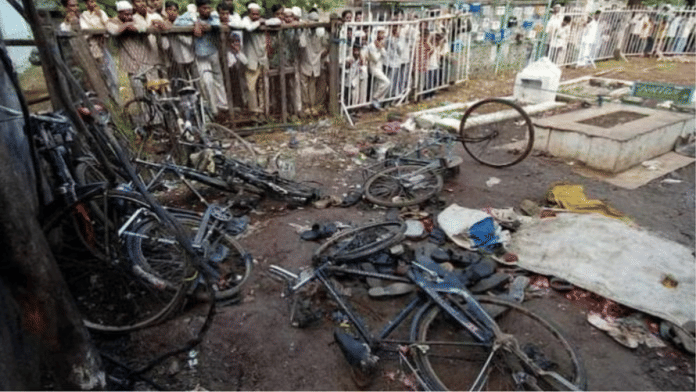


New Delhi: Twenty years after the 2006 Malegaon blasts that killed at least 31 people and injured hundreds, the Bombay High Court said Wednesday the case had reached a “dead end” because of “contradictory, irreconcilable” and “diagonally” opposite” investigations by two agencies.
This effectively means that nobody is on trial right now for the blasts, even after the case was investigated by three separate agencies—first the Anti-Terrorist Squad (ATS), then the Central Bureau of Investigation (CBI) and lastly the National Investigation Agency (NIA).
A division bench of Chief Justice Shree Chandrashekhar and Justice Shyam C. Chandak discharged all four accused—Manohar Narwaria, Rajendra Chaudhary, Dhan Singh, and Lokesh Sharma—saying there was insufficient evidence to proceed with a trial against them.
“The things as stand today give two contradictory versions of the incident and both stories as floated by the ATS and NIA cannot be reconciled by any stretch of imagination,” the high court said in a 25-page verdict.
Over nearly two decades, the case involving the four bomb blasts on 8 September 2006 has moved through multiple hands and sharply divergent investigative theories, both of which now cannot be reconciled by “any stretch of imagination”, the HC said.
This verdict comes almost a year after a Special NIA court acquitted all seven accused, including the BJP’s Pragya Thakur and then Col. Prasad Shrikant Purohit, in the separate 2008 blasts in Malegaon.
The probe for the 2006 blasts started by the Maharashtra ATS, later backed by the CBI, accused members of the banned Students Islamic Movement of India (SIMI).
However, when the NIA took over the investigation in 2011, it advanced a completely different theory of conspiracy, which it claimed was based on confessions and its broader investigation. The four individuals discharged on Wednesday by named by the NIA in 2013.
This shift left the prosecution between two mutually exclusive versions, each with a different set of accused. This, the Bombay High Court said, ultimately weakened the prosecution’s case to the point where neither could sustain a trial.
Also Read: ‘Bare allegations’—how Malegaon ruling debunked ATS & NIA’s theories on RDX, conspiracy meetings
The original theory: ATS and CBI (2006-2010)
The ATS theory of the three blasts at Hamidiya Masjid, Bada Kabrastan and Mushawarat Chowk of Malegaon was that they were a conspiracy by members of the banned SIMI, who, according to the squad, had preplanned the attack at a meeting in May 2006.
It was alleged that they formed an “organized crime syndicate and committed illegal acts” in a criminal conspiracy with an object to promote insurgency and to overthrow the government”. It was also alleged that the accused SIMI members visited Pakistan in 2003 and received “terrorist training” there.
To support its theory, the ATS said that explosive bomb material RDX was procured by two of the accused, and bombs were prepared in another accused’s godown.
Even after the CBI took over in 2007 and filed a supplementary chargesheet in 2010, it corroborated the ATS’s findings and backed it with forensic voice samples of intercepted conversations recorded on CDs.
Also Read: Malegaon holds stories beyond its Superboys and Supermen. We’ve just begun looking
NIA’s theory of conspiracy (2011–2013)
In April 2011, when the NIA took over the investigation following a central government order and filed a supplementary chargesheet in May 2013, it completely discarded the findings of both the ATS and the CBI.
Departing from the earlier focus on alleged SIMI members, the NIA put forward a new theory of a conspiracy by a different group and named a different set of accused, including those currently discharged by the Bombay High Court order.
This new angle was based on a confession by Swami Assemanand, an RSS activist, who later retracted his statements.
In his confession, Assemanand said that Sunil Joshi, also an RSS activist, had told him that the “Malegaon blasts were the handiwork of his boys”.
According to him, “It was proposed in the meeting held in June 2006 that Malegaon may be a suitable place which has 86% Muslim population and Sunil Joshi assured that during the Diwali his persons would cause bomb blasts in Malegaon.”
The NIA also said that the first set of accused had retracted their confessions as they were obtained by the ATS under alleged “duress and pressure”.
Crucially, the Bombay High Court noted that the NIA’s version was built largely on the retraction in statements, which is impermissible in law.
Also Read: Malegaon & its many rewrites. Riots, bombs, Superman & now Reels
The ‘dead-end’
The court highlighted the “intrinsic improbability” of the prosecution’s shifting stance. Some major investigative discrepancies identified by the high court were how the ATS claimed Mohd. Jahid Majjid Ansari was the bomb planter, while the NIA claimed he was 400 km away from the bomb site on the day of the blast.
Another inconsistency identified by the HC was how the ATS alleged that one of the accused purchased the bicycles used in the blasts, whereas the NIA claimed the appellant Rajendra Chaudhary, one of the four accused, purchased them under a false name.
The high court noted that the materials gathered by the NIA to demonstrate how the accused purchased bicycles on which the bomb was planted were actually hearsay evidence.
It said the NIA knew that the bicycles were purchased and used in the crime by the first set of accused by the ATS and CBI. Yet, the NIA was “projecting an entirely different story” and “completely ignored” the ATS’s chargesheet.
The court also questioned how the NIA could ignore forensic reports collected by the ATS that found RDX traces in the soil of the first set of accused’s godown.
The court also said there was “no explanation coming forth as to how the voice samples and FSL reports collected by the ATS and CBI”, which were contradictory, could be ignored by the trial court.
It said that the evidence collected by the ATS remained on record and had to be considered by the trial court, even if the current set of accused were implicated by the NIA while the ATS implicated different people
“There seems to be no answer in law as to how the trial Judge can deal with the materials collected by the ATS, which implicates another set of accused persons. The case seems to have reached a dead end,” said the high court bench.
The court also criticised the Special Judge’s September 2025 order framing charges against the four individuals, saying that the judge had acted as a “mere post office” and did not apply his mind before framing the charge against the accused person “at the behest of the prosecution” instead of sifting the evidence to find a prima facie case.
The high court also emphasised that a Test Identification Parade (TIP) conducted by the NIA six years after the incident had “no probative value”. Furthermore, it ruled that much of the NIA’s evidence was “hearsay” or based on inadmissible custodial statements.
“A criminal trial is not like a fairy tale where one is free to give flight to one’s imagination and fantasy,” said the judgment, reiterating a Supreme Court precedent.
The judgment concluded that because the ATS investigation, which implicated the first set of accused, was not wiped from the record, and the NIA version implicating the second set was inadmissible and contradictory, the prosecution had reached a point where no one was left on trial for the 31 lives lost.
(Edited by Sugita Katyal)
Also Read: From breakaway to breakthrough—how ISLAM party has redefined Malegaon politics in mere months