





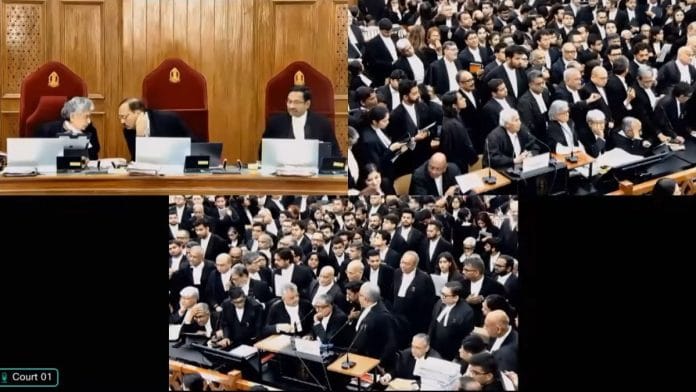



New Delhi: The Central government on Tuesday launched a critique of the concept of ‘constitutional morality’ before the nine-judge bench in the Sabarimala reference, noting how the concept is essentially a subject of political science rather than a textual legal standard for judicial review.
Arguing for the government, Solicitor General Tushar Mehta contended that this “judicially evolved, vague and indeterminate concept” has been used to overstep the written text of the Constitution and rewrite religious traditions.
The hearings of the review petitions of the 2018 Sabrimala verdict are underway in the top court, with the bench examining the question of whether its own five-judge bench was right in lifting the ban imposed on menstruating women (10-50 years) from entering the shrine of Lord Ayappa on Kerala’s Sabarimala hill. One of the seven questions the bench will answer is about the scope and extent of the word ‘morality’ under Articles 25 and 26 of the Constitution and whether it is meant to include ‘constitutional morality’.
It is important to note at this juncture is that the Constitution does not define or provide any interpretation or reference to ‘constitutional morality’, making the concept part of an evolved jurisprudence via various landmark judicial cases.
What the Centre says
By way of written submissions, Solicitor General Mehta said, “The concept of constitutional morality is essentially a subject of the concept of political science and it is a political doctrine. This doctrine is used and is relevant where the constitution is unwritten, which requires constitutional conventions to be the guide of governance in all three spheres, i.e. the judiciary, the legislature and the executive.”
It thus argues that the notion of constitutional morality is a political doctrine relevant primarily to jurisdictions with unwritten constitutions, such as Great Britain. In such systems, constitutional conventions serve as the ‘morality’ of the constitution to guide governance. However, the government asserts that for a country like India with a written text, judicial review must be exercised based upon that written law and the court’s own earlier interpretations, rather than a subjective and fluid notion.
Also, it argues that the Constitution already contains the necessary legal tools to address ‘hard cases’ in religion—where a practice infringes equality, non-discrimination, liberty, dignity, anti-exclusion guarantees, or any other right, the court can say so directly under Articles 14, 15, 17, 19, 21 and other applicable provisions.’
“Where the issue concerns public order, health, secular regulation, or social reform, Articles 25(1) and 25(2) provide express textual routes,” it says, therefore concluding that there is no “doctrinal necessity to invoke an additional and vague standard of ‘constitutional morality’ as an independent ground”.
That “constitutional morality” may, at best, remain “an aspirational constitutional ethic for public culture, institutional responsibility, and democratic practice, but it ought not to be treated as an independent, enforceable ground of judicial review”.
Crucially, the government has also urged the court to declare the reasoning in the 2018 Joseph Shine verdict—striking down the offence of adultery—bad in law as it rests on the subjective application of “constitutional morality”.
Also Read: Sabarimala administration is stuck in the 1960s
Evolving doctrine
Since India does not have a constitutional meaning of the concept of “constitutional morality”, courts have evolved one when dealing with cases sensitive to one’s fundamental rights.
The journey of constitutional morality has largely relied on political and governance-based definitive judgements of the court like the Kesavananda Bharati and Jayalalithaa cases. However, in the last decade it has seen a shift to cases involving personal autonomy, liberty and dignity, like decriminalising adultery and homosexuality.
In landmark cases like Kesavananda Bharati v. State of Kerala (1973)—the court relied on the concept of constitutional morality by establishing that the “spirit, soul, or conscience of the Constitution” is superior to its literal text of it. The court, by a narrow 7:6 majority, upheld the view that the amendments must respect the “fundamental framework” of the Constitution—rejecting the notion that the elected representatives have “absolute” power simply because they possess a massive majority. The judgement also quoted Dr. Ambedkar —“Constitutional morality is not a natural sentiment. It has to be cultivated. We must realize that our people have yet to learn it. Democracy in India is only a topdressing on an Indian soil, which is essentially undemocratic.”
In 2001, the top court in B.R. Kapoor vs State of Tamil Nadu & ors., declared the appointment of J. Jayalalithaa as chief minister of Tamil Nadu unconstitutional and invalid. While examining the appointment of a non-legislator as the chief minister or minister, Justice Patnaik said in his concurring opinion, “… the constitutional limits bind both the federal and state organs of the Government, which limits are enforceable as a matter of law.”
Citing constitutional morality, the five-judge bench prioritized the sanctity of the Constitution over political expediency and noted that the doctrine is not merely about adhering to the literal text but following the unwritten maxims and values that ensure a stable and ethical democracy.
Many important rules of constitutional behaviour, the judge said, which are observed by the prime minister and ministers, members of the legislature, judges and civil servants are contained neither in Acts nor in judicial decisions. “But such rules have been nomenclatured by the constitution writers to be the rule of “the positive morality of the constitution” and sometimes the authors provide the name to be “the unwritten maxims of the constitution” –rules of constitutional behaviour which are considered to be binding by and upon those who operate the Constitution but which are not enforced by the law courts nor by the presiding officers in the House of Parliament”.
In Govt. (NCT of Delhi) v. Union of India (2018), the Supreme Court emphasised that constitutional morality requires adherence to core democratic principles, “ensuring that the Lieutenant Governor acts on the aid and advice of the elected government, except in exceptional circumstances”. The five-judge bench verdict upheld representative democracy, holding that “constitutional functionaries must facilitate, not hinder, the democratic aspirations of the people”.
“Constitutional morality in its strictest sense of the term implies strict and complete adherence to the constitutional principles as enshrined in various segments of the document…. constitutional morality, appositely understood, means the morality that has inherent elements in the constitutional norms and the conscience of the Constitution,” it said.
The K.S. Puttaswamy v. Union of India (2017) verdict, which declared privacy a fundamental right, relied on constitutional morality to elevate privacy from a mere common law right to an intrinsic part of human dignity, and liberty and autonomy under Article 21. The Court asserted that the Constitution is a “living document” and that its core values – dignity, liberty, and equality – “must prevail over majoritarian opinions or outdated societal standards”.
In 2018, the top court decriminalised adultery by striking down Section 497 of the IPC. The five-judge bench in Joseph Shine v. Union of India unanimously held that the law was unconstitutional as it violated Articles 14, 15, and 21 of the Constitution by treating women as the “chattel” or property of their husbands, thus denying them their dignity and agency.
In this case as well, the court emphasised that constitutional morality must prevail over the prevailing “social morality” or paternalistic notions that women lack independent agency in marital relationships.
The 2018 Sabarimala verdict, Indian Young Lawyers Association v. State of Kerala, allowed women of all ages to enter the Sabarimala temple, as against the centuries-old exclusionary tradition that restricted entry of women aged 10 to 50. The Supreme Court ruled that the practice violated the constitutional principles of equality and non-discrimination and constitutional morality by prioritising gender equality and dignity over discriminatory, centuries-old customs.
Ruling that religious freedom under Article 25 is subject to fundamental rights, and exclusion based on menstruation constitutes a form of “untouchability” forbidden by Article 17 – the 4:1 majority bench stated that constitutional morality mandates that practices rooted in discrimination and exclusion cannot be allowed.
In the December 2018 landmark verdict decriminalizing consensual homosexuality, the top court in the Navtej Singh Johar case relied on constitutional morality to override social morality. It held that individual dignity, autonomy, and rights under Articles 14, 15, 19, and 21 superseded majoritarian views, ruling that Section 377 violated the fundamental rights of the LGBTQ+ community. The Supreme Court emphasised the constitutional values of equality, dignity, and privacy and held that sexual orientation is an essential component of individual identity, and criminalising it violates the right to dignity and privacy.
(Edited By Nardeep Singh Dahiya)
Also Read: ‘Judges must uphold constitutional morality, not be swayed by popular opinion’—retd SC judge AS Oka