





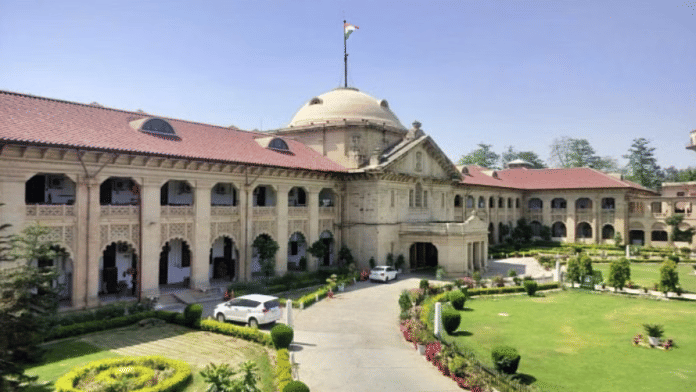


S: Allahabad HC judges voice contrasting views on NHRC’s madrasas inquiry, with one criticising its priorities on rights violations, the other objecting to passing remarks without hearing all parties.
New Delhi: Two judges of the Allahabad High Court expressed starkly different opinions Monday, while dealing with a petition challenging certain orders passed by the National Human Rights Commission (NHRC) with respect to functioning of madrasas or Islamic institutes.
In a difference of opinion, Justices Atul Sreedharan and Vivek Saran disagreed on how the human rights body was functioning in the country.
Justice Sreedharan said the human rights body has not been taking cognisance of attacks and violence inflicted on members of the Muslim community, including lynching. On the other hand, Justice Saran said he did not agree with the order dictated by Justice Sreedharan, and sought to adjourn the matter.
“Instead of taking suo motu cognisance where members of the Muslim community are attacked and at times lynched, and where cases are not registered against perpetrators or not investigated properly, the Human Rights Commissions is seen dabbling in matters that prima facie do not concern them,” Justice Sreedharan said in the 27 April order.
“This court is not aware of the NHRC taking suo motu cognisance in situations where vigilantes take the law in their own hands and harass ordinary citizens of this country or, harass individuals on account of the nature of relationship between persons of different communities or where even having a cup of coffee at a public place with a person of a different religion becomes a fearful act,” the court noted in its order.
Pulling up the NHRC for a February 2025 order which sought an inquiry into the 588 madrasas in UP, Justice Sreedharan said, “This court is astounded by the order passed by the NHRC.” He added that the powers and scope of the NHRC arise from the Protection of Human Rights Act, 1993, whose objective is to deal with human rights violations.
Making it clear that the NHRC can only intervene when there is a violation of human rights in question, Justice Sreedharan said the NHRC and other state human rights commissions must realise that they are not tribunals which can try cases.
Justice Sreedharan noted that if the NHRC feels that citizens’ human rights have been violated and its intervention is warranted, the human rights body can become a complainant before the court, and even get an FIR registered, if the victim is unable to do so.
In the present case, though, the court noted that it had a doubt as to whether such a direction could be given to officers of the executive to act in a particular manner, in a case where human rights were not involved.
The judge also said he found it surprising that Human Rights Commissions in the country were trying to get involved in matters which should otherwise have been placed before the HCs, through a PIL, if need be.
Finally, the court listed the matter for further hearing on 11 May, while issuing notice to the NHRC, and asking it to respond within three days.
The NHRC order
The court was acting on a plea filed by the Teachers’ Association Madaris Arabia, challenging three orders passed by the NHRC.
One of these orders, passed by the NHRC on 28 February 2025, included a statement from a complainant that 588 madrasas are currently running in the state of UP in collusion with officers of the UP government’s Minority Welfare Department.
Significantly, the complainant had asked the NHRC to conduct an inquiry into the matter while alleging that these madrasas receive government grants while not meeting any standards, have illiterate teachers, and lack basic educational infrastructure, buildings, furniture, and hostels.
In its February 2025 order, the human rights body had also recorded the complainant’s observation that “uneducated” teachers were recruited in these madrasas allegedly with bribes and commissions to state authorities.
While forwarding the complaint to the economic offences wing (EoW) of the UP government, the NHRC had directed the EoW to look into the allegations and submit an action taken report within four weeks.
Justice Saran’s disagreement
Differing with his colleague, Justice Saran said the order by Justice Sreedharan was passed while the NHRC’s counsel had sought an adjournment.
“The petitioner was not arguing the case,” Justice Saran noted, pointing out that there was no representation on the NHRC’s behalf either that day. The only opposing party present was the UP government’s counsel, he noted.
Making it clear that all parties should be heard before passing such an order, Justice Saran said, “I am strictly of the opinion that if any order touching on the merits of the case or even touching on the role of the NHRC had to be passed, then all parties concerned ought to have been heard.”
He agreed to adjourn the matter to 11 May for further hearing.
(Edited by Viny Mishra)
Also read: NHRC issues notice to NMC, health ministry over long duty hours of PwD medical students