


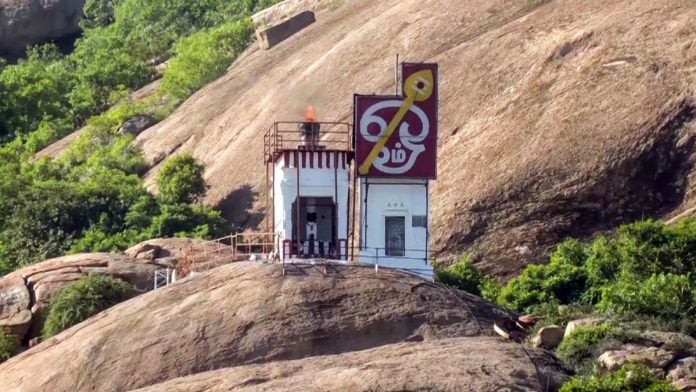
New Delhi: A fresh application before the Supreme Court has brought the Thiruparankundram Deepam controversy back into focus, with petitioners seeking permission to carry the flame from the customary Deepa Mandapam near the Uchipillaiyar temple to the disputed Deepathoon pillar atop the hill in Madurai.
Senior advocate Guru Krishnakumar, appearing for the petitioner, sought an urgent hearing Wednesday, submitting that the lamp lit at the mandapam on 24 November was still burning and that its flame could be carried to Deepathoon. The Supreme Court said it could take up the application Thursday or Friday.
The fresh move follows the top court’s 20 November order permitting the Karthigai Deepam to be lit at Deepathoon on 24 November by a restricted team authorised by the temple. The ritual did not take place at the pillar, prompting allegations of non-compliance and contempt proceedings against Tamil Nadu authorities.
But why has the location of a religious ceremony become a prolonged legal dispute? And what exactly have the courts said?
What is the Deepathoon controversy
Thiruparankundram hill in Madurai is home to the Arulmigu Subramaniya Swamy temple and the Sikandar Badusha Dargah.
The temple has traditionally conducted the Karthigai Deepam ceremony at the Uchipillaiyar Deepa Mandapam. However, devotees have been seeking permission to light the lamp at Deepathoon, a stone pillar situated higher up the hill, about 50 metres from the dargah.
The disagreement is not merely about the location of the ceremony. It also involves competing claims over the use of different portions of the hill, the temple’s established practices and the administration’s responsibility to implement judicial directions.
A property suit filed in 1920 resulted in a 1923 decree at Madurai, which allocated most of the hill to the temple while excluding certain areas, the steps leading to the mosque and the hillock on which the mosque and flagstaff stood including Nellithope. The Privy Council (Supreme Court equivalent in British Era) restored the decree in 1931.
The respective areas associated with the temple and the Dargah have since figured in arguments concerning the Deepathoon and the annual ceremony.
Madras HC ruling in 1996
The question of where the annual lamp should be lit had come before the Madras High Court much earlier.
In an order dated 21 November, 1996, the High Court said the Devasthanam should ordinarily light the Deepam at the traditional mandapam near the Uchipillaiyar temple.
It also left room for an alternative location, subject to prior permission and certain conditions. These included maintaining a distance of 15 metres from the Dargah and ensuring access to the steps and Nellithope.
The temple has relied on this order to support its position that the customary ceremony should continue at the mandapam.
Also Read: Could’ve been resolved if not for ‘disgruntled elements’. What Madras HC said on lamp lighting row
Present round of litigation
The present round of litigation began in November 2025, when Rama Ravikumar filed a writ petition before the Madras High Court seeking permission to light the Deepam at Deepathoon. The temple opposed the request, citing its established practice of conducting the ceremony at Uchipillaiyar Deepa Mandapam.
On 1 December, 2025, Justice G.R. Swaminathan directed the temple to facilitate the lighting of the Deepam at Deepathoon in addition to the customary ceremony.
However, the lamp was not lit at the pillar three days later, on 3 December, leading to contempt proceedings, against temple and district adminstration officials, specifically the temple EO and the District Collector.
A division bench of the Madras High Court upheld the direction on 6 January this year, subject to safeguards. The Tamil Nadu government subsequently challenged the decision before the Supreme Court.
Separately, the Hindu Dharma Parishad moved an application on 12 November seeking deployment of the CRPF to ensure that devotees could light the lamp at the pillar on 24 November.
SC order on 20 November
On 20 November, a bench of Justices Aravind Kumar and Vipul M. Pancholi permitted the lighting of the Deepam at Deepathoon on 24 November as a one-time arrangement.
The top court directed that the ceremony be conducted by a restricted team authorised by the Devasthanam. Madurai District Collector Nishant Krishna was appointed nodal officer to determine the team’s size and composition in consultation with the temple’s executive officer, the Archaeological Survey of India (ASI) and the city police commissioner.
The order did not recognise a permanent customary or proprietary right to light the lamp at Deepathoon. The Supreme Court also stayed the relevant findings of the High Court while the appeals were pending. The immediate question, therefore, was how the one-time arrangement would be implemented.
Also Read: ‘Imaginary ghost’: Madras HC slams Tamil Nadu govt while upholding order in lamp lighting row
Why was SC order not implemented?
The lamp was not lit at Deepathoon on 24 November. In a preliminary status report filed before the Supreme Court on 25 November, Collector Nishant Krishna said the district administration had made arrangements to implement the order.
These included preparing a 10-member team, arranging 27 workers for preparatory work and putting in place a security plan involving 5,797 police personnel.
However, the Collector said the temple’s Board of Trustees declined to authorise the proposed team and decided to retain the customary practice of lighting the lamp at Uchipillaiyar Deepa Mandapam.
The Collector maintained that he had taken steps to comply with the Supreme Court’s directions and had not deliberately disobeyed the order. He also tendered an apology.
The state informed the Supreme Court Wednesday that the lamp could not be lit at the designated location.
What did HC say on 24 Nov
The implementation dispute also reached the Madurai Bench of the Madras High Court through five petitions on 24 November.
Some petitions challenged the Collector’s 23 November restrictions on movement and gatherings on the hill under Section 163 of the BNSS. Others sought permission for devotees to watch the Deepam from nearby public areas and requested the deployment of central forces.
A bench of Justices G.R. Swaminathan and M.D. Sumathi said authorities were bound by Article 144 of the Constitution to act in aid of the Supreme Court. It also observed that the pendency of a review petition could not be used as a reason to avoid implementing the Supreme Court’s order.
The bench said devotees could undertake Girivalam (circumambulation) and gather at ground-level vantage points to watch the Deepam, but could not climb the hill.
Referring to Gulam Abbas v. State of Uttar Pradesh, the High Court observed that lawful religious activities should not be restricted merely because another group threatened disruption.
It disposed of the petitions based on the state’s assurance that the Supreme Court’s directions would be followed.
What happens next
The latest application seeks permission to carry the flame from the lamp at Uchipillaiyar Deepa Mandapam to Deepathoon, potentially providing another way to carry out the Supreme Court’s 20 November direction.
The Supreme Court is expected to consider the fresh plea and the allegations of non-compliance, alongside the Collector’s status report and the temple’s position.
Aditya Edara is an alum of ThePrint School of Journalism, currently interning with ThePrint.
(Edited by Amrtansh Arora)